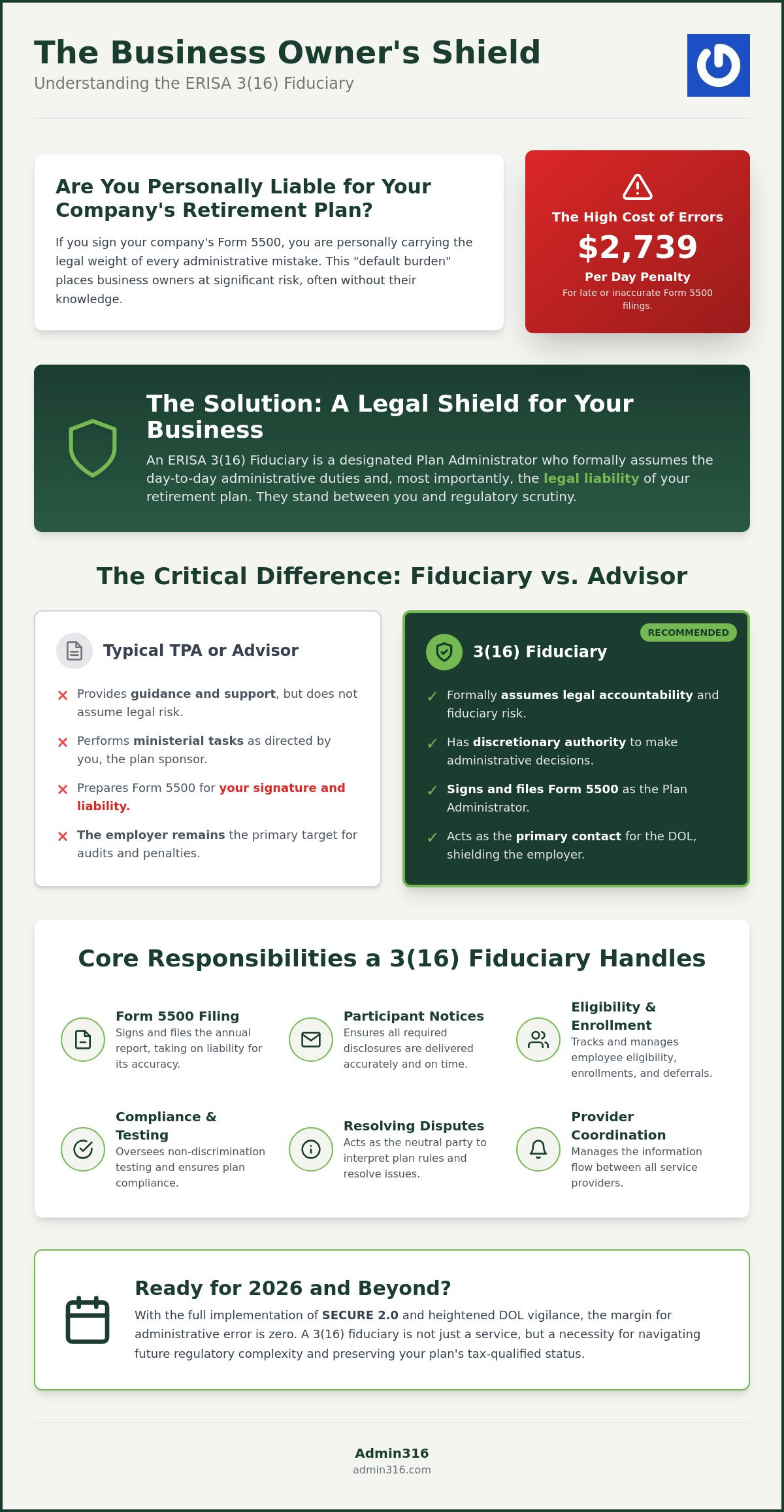
If you are still signing your company’s Form 5500, you aren’t just managing a retirement plan; you’re personally carrying the legal weight of every administrative mistake your team might make. Many business owners ask, what is a 3(16) fiduciary, when they realize that the Department of Labor can assess penalties up to $2,739 per day for late filings. It is a heavy burden to track participant eligibility and stay ahead of shifting regulations while trying to grow your business. You likely feel the constant pressure of potential ERISA audits or the fear that a single missed notice could lead to personal liability.
We understand that you want to focus on your company’s mission rather than drowning in participant notices and compliance tracking. This article shows how an ERISA 3(16) fiduciary shields your business from liability and lifts the administrative heavy lifting from your shoulders. We will examine the critical differences between a TPA and a fiduciary, the impact of 2026 compliance deadlines, and how to secure your plan’s future without replacing your trusted advisors. By the end, you’ll see how to achieve total peace of mind through professional delegation.
Key Takeaways
- Understand what is a 3(16) fiduciary and how this role acts as a legal shield by assuming the day-to-day administrative weight of your retirement plan.
- Discover how to offload the burden of participant notices and eligibility tracking by transferring discretionary authority to a specialized guardian.
- Learn the critical difference between ministerial TPA tasks and fiduciary accountability to ensure your business is fully protected from ERISA compliance errors.
- Identify how a 3(16) partner works alongside your existing team, providing a layer of protection without displacing your current professional relationships.
- Explore the practical steps to outsource your liability and gain peace of mind that all filings remain accurate and timely in the face of 2026 regulatory changes.
Defining the ERISA Section 3(16) Fiduciary
To understand what is a 3(16) fiduciary, one must first identify where legal accountability rests within a retirement plan. Under the Employee Retirement Income Security Act of 1974 (ERISA), every qualified plan is required to have a designated administrator. This entity is the 3(16) fiduciary. They are the legal anchor for the plan’s operational integrity. While many providers offer advice, the 3(16) fiduciary is the only entity that assumes the actual day-to-day administrative weight of the plan. They don’t just suggest actions; they execute them with full legal accountability.
The role functions as a professional shield. When you appoint a 3(16) fiduciary, they often serve as the “Named Fiduciary” under ERISA Section 402(a). This designation is critical. It signifies a formal transfer of discretionary authority. We assume the responsibility for the plan’s compliance so that the employer is no longer the primary target for regulatory scrutiny. This is not a mere consulting relationship. It is a legal partnership where the fiduciary stands between the business owner and the complex demands of federal oversight.
The Default Burden: Why Employers are Unknowingly Liable
Most business owners don’t realize that by simply offering a 401(k), they’ve already stepped into a high-stakes legal role. By default, the law views the employer as the Plan Sponsor and the Plan Administrator. You carry the weight of every participant notice, every eligibility check, and every filing deadline. If an error occurs, the Department of Labor doesn’t penalize your software provider. They hold you personally liable. This “DIY” approach to administration creates a massive exposure to risk. If you are unsure whether your current setup leaves you exposed, reviewing the signs you need a 3(16) fiduciary can help you identify the specific gaps in your protection. Professional fiduciary delegation removes this burden. We take the legal duties off your desk and place them onto ours.
The Role of ERISA Section 3(16) in 2026
The regulatory environment in 2026 is more demanding than ever. With the full implementation of SECURE 2.0 provisions and heightened DOL vigilance, the margin for administrative error has vanished. A 3(16) fiduciary provides a burden-lifting service that evolves alongside these rules. They ensure that catch-up contribution changes and new distribution requirements are handled with precision. This specialized oversight is vital for both standard 401(k) plans and more technical structures like cash balance plan administration. When what is a 3(16) fiduciary becomes a part of your team, you gain an expert guardian who preserves your plan’s tax-qualified status while you focus on growth.
Not sure where your plan’s fiduciary liability actually sits?
Admin316 serves as your named 3(16) plan administrator and takes the filing, notice and compliance work off your desk — along with the liability that comes with it. A 15-minute call is usually enough to tell you where you stand.
Core Responsibilities: What a 3(16) Fiduciary Handles
Understanding what is a 3(16) fiduciary requires a granular look at the administrative “heavy lifting” that keeps a plan in good standing. While a standard advisor might provide guidance, a 3(16) fiduciary assumes the actual discretionary authority to make decisions on behalf of the plan. This transfer of duty represents a literal hand-off of legal risk. The fiduciary doesn’t just oversee the process; they own the outcome. They coordinate with all service providers to ensure that every action aligns with the plan document and current federal mandates. This level of involvement is why many business owners seek professional fiduciary support to manage their 401(k), Profit Sharing, and Cash Balance plans.
The scope of these fiduciary responsibilities is broad, covering everything from interpreting plan provisions to resolving participant disputes. By assuming these duties, the fiduciary acts as a shield, ensuring that the plan remains compliant while the employer focuses on business operations. This is particularly vital in 2026, as complex SECURE 2.0 provisions regarding Roth catch-up contributions and automated enrollments require meticulous execution.
Form 5500 Filing and Execution
One of the most significant tasks of the 3(16) fiduciary is the signing and filing of Form 5500. For calendar-year plans, the deadline to file for the 2025 plan year is July 31, 2026. Most business owners are unaware that signing this document makes them personally liable for its accuracy. When you hire a 3(16) fiduciary, they sign the form as the Plan Administrator. They take on the liability for any errors or omissions. This process involves a meticulous review of plan assets, participant counts, and compliance testing results to ensure a clean filing that avoids triggering a DOL audit.
Participant Notices and Eligibility Tracking
Tracking employee eligibility is a constant administrative burden, especially for companies with multiple locations or high turnover. A 3(16) fiduciary manages the distribution of Summary Plan Descriptions (SPD), annual safe harbor notices, and fee disclosures. They ensure that every eligible employee receives the correct information at the right time. This prevents the common “missed participant” errors that often lead to costly corrective contributions. By centralizing this data, the fiduciary provides a layer of protection that manual internal processes simply cannot match. It’s a methodical approach to communication that preserves the plan’s integrity and reduces the risk of participant lawsuits.
The Critical Difference: 3(16) Fiduciaries vs. TPAs and Advisors
There is a common misconception that having a Third Party Administrator (TPA) or a financial advisor means your plan is fully protected. In reality, these roles serve very different functions. A standard TPA performs “ministerial” tasks, which means they process data based on the instructions you provide. They don’t make legal decisions, and they don’t carry the weight of your plan’s compliance. To truly understand what is a 3(16) fiduciary, you must recognize that this role is about authority and accountability. While others provide the tools, the 3(16) fiduciary is the entity that actually wields them, standing as a legal shield for your business.
It’s also vital to distinguish between administrative and investment oversight. A 3(16) fiduciary manages the operation of the plan, not the assets within it. If you are looking for someone to select and monitor the plan’s investment lineup, you are looking for a 3(38) or 3(21) fiduciary. We often see confusion here, which is why we’ve detailed the 3(16) administrator vs 3(38) fiduciary distinction to help you build the right team. We focus on the administrative “heavy lifting” so that your other partners can focus on their specific areas of expertise.
Why Your TPA is Likely Not a Fiduciary
Most TPAs operate under a service agreement that explicitly states they are not fiduciaries. They handle the math, but you handle the liability. If you provide them with incorrect payroll data or miss a participant notice, the TPA isn’t responsible for the error. This creates a dangerous “gap” in your protection. A 3(16) fiduciary fills this gap by taking legal accountability for the data and the decisions. We don’t just process the numbers; we oversee the entire process to ensure it meets ERISA standards. We assume the administrative risk so that you don’t have to. Plan sponsors who recognize this gap are often already exhibiting the most common signs you need a 3(16) fiduciary to step in and assume full legal accountability.
Collaborating with Your Financial Advisor
Hiring a 3(16) partner doesn’t mean you have to replace your current team. In fact, our “non-displacement” approach is designed to fortify your existing professional bonds. We act as an independent layer of protection that works alongside your financial advisor and recordkeeper. While your advisor focuses on investment performance and participant outcomes, we coordinate the back-end integrity of the plan. This collaborative environment ensures that your data is accurate, your filings are timely, and your legal exposure is mitigated. We don’t disrupt your relationships; we preserve them by removing the professional anxiety that comes with complex plan administration.
How to Outsource Your Fiduciary Liability: 4 Practical Steps
Transitioning from a state of administrative anxiety to professional peace requires a methodical approach to delegation. You don’t simply hire a vendor; you appoint a guardian to assume the legal duties that currently rest on your shoulders. This process is designed to be a burden-lifting experience that preserves your existing advisor relationships while creating a robust shield against regulatory scrutiny. If you are still wondering what is a 3(16) fiduciary in a practical sense, it’s the entity that takes the physical weight of plan management off your desk. By following these four steps, you can successfully transfer your liability and reclaim your time.
Step 1: Conduct a Fiduciary Gap Analysis
The first step is to identify exactly where your business is exposed. Review your current service agreements with your TPA and recordkeeper to see who is actually responsible for signing the Form 5500 or tracking participant eligibility. Most employers find they are performing high-risk tasks that they assumed were covered by their providers. A fiduciary gap is the space between ministerial tasks and legal accountability. Once you identify this gap, you can begin the process of filling it with a specialized partner who assumes full liability for these actions.
Step 2: Evaluate Tenure and Independence
When selecting a partner, institutional permanence matters. You need a firm that has managed the complexities of ERISA since the late 1990s, ensuring they have the historical depth to navigate shifting regulations. It’s also vital to choose an independent fiduciary who doesn’t have a conflict of interest with your plan’s investments. This independence ensures their only priority is your plan’s compliance. If you already have a provider but feel the weight is not being fully lifted, consult our guide on switching 3(16) plan administrator to ensure a seamless transition.
Step 3: Formalize the Legal Transfer
The delegation isn’t complete until the legal documents reflect the change in authority. This step involves updating your plan document to name the 3(16) fiduciary as the Plan Administrator and, in many cases, the 402(a) Named Fiduciary. We coordinate this process alongside your current team so that the hand-off is clean and documented. This formalizes the shift of discretionary authority, officially moving the target of DOL scrutiny away from your business.
Step 4: Realize Professional Peace
The final step is the ongoing execution of duties. Once the fiduciary is in place, they oversee the filings, coordinate with recordkeepers, and handle participant notices. You move into a monitoring role rather than an execution role. We do the heavy lifting so that you can focus on the mission of your company. To begin removing the administrative weight from your business today, you can request a fiduciary consultation with our specialized team.
Admin316: Your Specialized Guardian in Plan Administration
Admin316 is more than a service provider. We are a specialized national fiduciary firm that has been assuming the roles of ERISA 3(16) Plan Administrator and 402(a) Named Fiduciary since 1997. We recognize that for many business owners, the initial question of what is a 3(16) fiduciary is followed by a deeper, more urgent desire for relief from administrative complexity. Our firm was built to handle the “heavy lifting” behind the scenes so that you don’t have to. We provide the institutional permanence and geographic reach required to navigate the complexities of 2026 compliance with absolute confidence. By taking on the full legal accountability for your 401(k), Profit Sharing, or Cash Balance plans, we allow you to return your focus to your company’s mission.
The Admin316 Shield
We act as a quiet, methodical guardian between your business and the weight of regulatory anxiety. The Admin316 shield is designed to mitigate your personal risk while improving the granular accuracy of your plan’s administration. When exploring what is a 3(16) fiduciary, it’s essential to find a partner who coordinates with your recordkeeper and TPA to ensure that every filing is precise and every participant notice is dispatched on schedule. This “burden-lifting” approach doesn’t just save your internal team hours of work; it preserves the long-term stability of your retirement offering. Most importantly, we operate with a strict non-displacement philosophy. We work alongside your current financial advisor to fortify your existing team. We don’t seek to replace your trusted partners. Instead, we support them by assuming the specific legal duties that they are not structured to carry.
Securing Your Plan’s Future
As federal oversight from the Department of Labor intensifies, a proactive approach to your fiduciary duties is the only way to ensure long-term safety. Appointing an ERISA 3(16) plan administrator is a strategic decision that protects your personal assets and your employees’ futures. We invite you to experience the profound relief that comes with professional delegation. Our team is prepared to analyze your current plan structure and identify the specific gaps where you are currently exposed to liability. When you are ready to transfer the administrative weight of your plan to a seasoned expert, we provide the stability and precision you deserve. We oversee the technical details so that you can enjoy professional peace. Contact us today for a comprehensive fiduciary consultation and take the first step toward securing your plan’s future with a specialized guardian.
Secure Your Professional Peace Through Fiduciary Delegation
The regulatory landscape of 2026 leaves no room for administrative oversight. By now, you understand that what is a 3(16) fiduciary is more than a technical definition; it’s a legal shield that preserves your business and your time. We’ve explored how transferring the weight of Form 5500 filings and participant tracking to a specialized guardian removes personal liability while keeping your existing advisor relationships intact. We assume these complex duties so that you can return to the work that matters most. This partnership creates a layer of protection that fortifies your plan without displacing the team you already trust.
Since 1997, Admin316 has provided independent 3(16) and 402(a) fiduciary protection with a national scope. We offer the institutional permanence required to navigate federal scrutiny with precision. Don’t let the burden of ERISA compliance distract you from your core objectives. Let Admin316 lift the weight of your retirement plan administration today. You deserve the confidence that comes with knowing your plan is managed by methodical experts who value your success as much as you do. Your path to a secure, compliant future is just one conversation away.
Frequently Asked Questions
Who signs the Form 5500 if I hire a 3(16) fiduciary?
The 3(16) fiduciary signs the Form 5500 in their capacity as the Plan Administrator. This action officially transfers the legal weight of the filing from your desk to theirs. By signing, the fiduciary assumes the liability for the accuracy and timeliness of the document. You are no longer the one personally testifying to the plan’s compliance on this federal form, which provides a significant layer of professional relief for business owners.
Is a 3(16) fiduciary the same as a Third Party Administrator (TPA)?
They are fundamentally different roles. A TPA typically performs ministerial tasks like data processing and recordkeeping without taking legal accountability. In contrast, when you ask what is a 3(16) fiduciary, the answer lies in discretionary authority. A 3(16) fiduciary makes the final decisions on plan operations and assumes the legal risk. While the TPA provides the tools, the 3(16) fiduciary is the entity that actually wields them to ensure compliance.
Can I keep my current 401(k) advisor if I hire a 3(16) administrator?
You can absolutely keep your current 401(k) advisor. Our firm operates with a non-displacement philosophy, meaning we fortify your existing team rather than replacing it. We act as an independent guardian that handles the administrative “heavy lifting” while your advisor continues to focus on investment performance and participant outcomes. This collaboration ensures that your professional bonds remain intact while adding a necessary layer of legal protection for the plan sponsor.
What happens if there is an error in plan administration under a 3(16) fiduciary?
If an administrative error occurs, the 3(16) fiduciary is the entity legally responsible for the correction. They oversee the resolution process and coordinate with regulatory bodies if necessary. Because they have assumed the role of Plan Administrator, the legal and financial weight of the mistake rests on their shoulders. This shielding effect is a primary reason why businesses outsource these duties, as it mitigates the risk of personal liability for the employer.
Does a 3(16) fiduciary manage the investments in my retirement plan?
No, a 3(16) fiduciary does not manage your plan’s investments. Their authority is strictly limited to the day-to-day administration and operational compliance of the plan. Investment management is the responsibility of a 3(38) or 3(21) fiduciary. Understanding what is a 3(16) fiduciary helps clarify that their role is to protect the plan’s tax-qualified status through meticulous oversight of notices, eligibility, and filings rather than picking stocks or mutual funds.
How does hiring a 3(16) fiduciary reduce my personal legal liability?
Hiring a 3(16) fiduciary reduces your liability by legally transferring specific duties defined under ERISA. When you appoint a professional administrator, you shift the “Named Fiduciary” status for those tasks. The Department of Labor then holds the service provider accountable for administrative errors or missed deadlines. While you maintain a duty to monitor the provider, you are no longer the primary target for penalties related to participant notices or Form 5500 accuracy.
What types of retirement plans can benefit from 3(16) fiduciary services?
A wide range of retirement structures benefit from these services, including 401(k), Profit Sharing, and Cash Balance plans. Defined Benefit plans also require the specialized oversight that a 3(16) fiduciary provides. Any plan governed by ERISA that carries an administrative burden can be shielded by this role. Whether you manage a simple 401(k) or a complex hybrid plan, a fiduciary guardian ensures that the operational weight is handled with professional precision.
Is hiring a 3(16) fiduciary expensive for a small business?
For a small business, the cost of a 3(16) fiduciary is often less than the internal labor costs required to manage a plan manually. It is also significantly lower than the potential fines for non-compliance, such as the DOL penalty of up to $2,739 per day for late filings. By delegating these duties, you avoid the professional anxiety of a DIY approach and ensure that your plan’s filings are accurate and timely.
Transfer this responsibility to a professional fiduciary.
Every item in this article is work Admin316 does for plan sponsors every day as an ERISA 3(16) administrator. Bring us your plan documents and we’ll show you exactly which risks move off your shoulders.