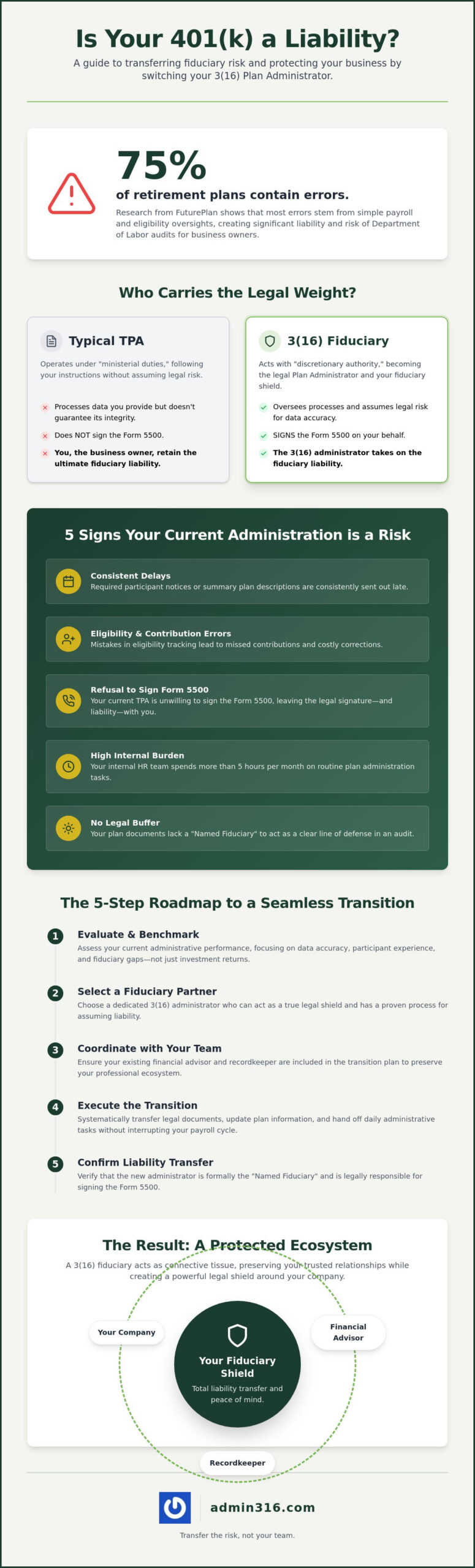
Research from FuturePlan indicates that errors exist in over 75% of retirement plans, often stemming from simple payroll oversights that lead to significant liability. For many business owners, the administrative weight of a 401(k) has become a source of professional anxiety rather than a benefit. If you feel your current setup leaves you exposed to Department of Labor audits, switching 3(16) plan administrator services can be the most effective way to transfer that legal burden. It is a strategic move that allows you to hand off the responsibility of signing the Form 5500 and overseeing daily compliance to a specialized guardian.
You have likely worked hard to build a relationship with your financial advisor, and the thought of disrupting that partnership to fix administrative gaps is frustrating. We understand that you need a shield between your company and regulatory entities, not a total replacement of your trusted team. This guide explains how to transition your fiduciary duties to a more capable administrator while keeping your existing advisor and recordkeeper intact. You will learn the exact steps to achieve total liability transfer, lower your internal HR overhead, and ensure a seamless transition that protects your employees and your peace of mind.
Key Takeaways
- Learn why the 2026 regulatory environment requires shifting the administrative weight from your internal team to a dedicated fiduciary shield.
- Understand how to benchmark your plan’s performance based on administrative accuracy and compliance metrics rather than just investment returns.
- Discover a methodical five-step roadmap for switching 3(16) plan administrator that ensures a clean break from liability without interrupting your payroll cycle.
- See how an independent 3(16) fiduciary acts as the connective tissue that preserves your existing relationships with investment advisors and recordkeepers.
- Gain clarity on how a specialized guardian assumes full legal accountability for your plan, effectively mitigating the risk of Department of Labor audits.
Why Plan Sponsors Are Switching 3(16) Plan Administrators in 2026
The regulatory climate in 2026 has reached a tipping point. With the Department of Labor increasing its focus on administrative compliance and the complex rollout of SECURE 2.0 Act provisions, the “do-it-yourself” model of plan administration has become a liability. Many employers are finding that their internal HR teams are hitting a breaking point. They’re managing payroll, employee benefits, and now, the intricate demands of a 401(k) plan. This internal burnout is a primary driver for switching 3(16) plan administrator services to a partner that can carry the load. It’s no longer enough to have a vendor that simply records data; you need a partner that assumes responsibility.
Think of your plan’s legal duties as a physical weight. For years, you might have believed your recordkeeper or TPA was carrying this for you. However, if you are the one signing the Form 5500, you are still the one holding the object. In a 2026 audit, the Department of Labor doesn’t just look at who did the data entry; they look at who had the legal authority to ensure its accuracy. This realization often serves as the catalyst where business owners seek a true shield between themselves and regulatory entities. By transferring this weight, you don’t just clear your desk; you mitigate your risk.
The Difference Between a TPA and a 3(16) Fiduciary
Most Third Party Administrators (TPAs) operate under “ministerial duties.” This means they follow your instructions but don’t make discretionary decisions. They process the numbers you give them, but they don’t oversee the integrity of the process. A 3(16) fiduciary operates with discretionary authority. They don’t just process the data; they assume the legal risk for it. If your current contract has a “Silent Fiduciary” gap, you are likely exposed. Your TPA might be doing the work, but you are still the one responsible for meeting ERISA guidelines. A specialized guardian fills this gap by stepping into the legal role of Plan Administrator.
Signs Your Current Administration is Failing
It’s rarely a single catastrophic event that triggers a switch. Instead, it’s usually a series of small cracks in the foundation. If you notice these patterns, it’s time to consider switching 3(16) plan administrator providers:
- Consistent delays in sending out required participant notices or summary plan descriptions.
- Eligibility tracking errors that lead to missed contributions and expensive corrections.
- Confusion or frustration over why your current TPA refuses to sign the Form 5500.
- Internal HR teams spending more than five hours a month on plan-related “busy work.”
- The absence of a “Named Fiduciary” in your plan documents to act as a legal buffer.
When these signs appear, it’s a signal that your plan needs professional fortification. Moving to a specialized fiduciary allows you to return your focus to growing your business while a methodical expert handles the heavy lifting behind the scenes. This transition preserves your peace of mind and ensures your plan remains a benefit rather than a burden. Working through a thorough 401k plan compliance checklist can help you identify exactly which administrative gaps are putting your plan at greatest risk before you begin the switching process.
Not sure where your plan’s fiduciary liability actually sits?
Admin316 serves as your named 3(16) plan administrator and takes the filing, notice and compliance work off your desk — along with the liability that comes with it. A 15-minute call is usually enough to tell you where you stand.
401k Plan Benchmarking: Evaluating Your Administrative Performance
Traditional 401(k) benchmarking often stops at investment returns, leaving a massive blind spot in administrative health. While fund performance matters, it is rarely the primary trigger for a Department of Labor audit. In 2026, a comprehensive evaluation must include operational efficiency and fiduciary oversight. Research from FuturePlan reveals that errors exist in over 75% of analyzed retirement plans, usually stemming from preventable payroll and eligibility mistakes. If your benchmarking process doesn’t account for these risks, you aren’t truly evaluating your plan’s health. It’s time to measure the “weight” of your administrative duties and decide if that burden is being managed effectively.
A methodical evaluation should focus on three key operational pillars:
- Data Accuracy: The frequency of payroll data corrections and the speed of eligibility tracking for new hires.
- Participant Experience: The timeliness of mandatory notices and the accuracy of distribution processing.
- Fiduciary Shielding: Whether a named fiduciary is actually assuming legal liability for these tasks or simply acting as a ministerial service provider.
Benchmarking Administrative Fees vs. Value
Understanding the ROI of outsourcing requires looking beyond the base fee. You must account for the hidden costs of internal administration, including staff time spent on plan maintenance and the potential cost of error corrections. Fiduciary benchmarking is a necessity to ensure “fee fairness,” which is the process of verifying that the costs paid by the plan are reasonable relative to the level of liability protection provided. When you compare the price of a specialized guardian against the potential cost of a $50,000 audit penalty, the value of switching 3(16) plan administrator services becomes clear. Performing a thorough 401(k) benchmarking review can clarify whether your current setup is a support system or a growing liability.
Audit Readiness as a Benchmark
The ultimate test of an administrator is their response speed to a regulatory inquiry. If a DOL auditor requests a participant communication log or proof of notice delivery, can your current provider produce it within 48 hours? Many TPAs provide the data but leave the employer to organize the defense. An independent 3(16) fiduciary maintains a “clean” plan record by providing proactive oversight, ensuring that Form 5500 filings are accurate and signed by a professional who takes full legal accountability. If your benchmarking reveals a lack of audit readiness, it’s a strong indicator that switching 3(16) plan administrator partners is the only way to fortify your plan against future discovery. Engaging specialized 401k audit services can provide the structured oversight needed to ensure your plan records are organized and defensible before a regulatory inquiry ever arrives. Pairing your benchmarking efforts with a detailed 2026 401k plan compliance checklist ensures you address every regulatory requirement before making the transition to a new fiduciary guardian.
How to Switch 3(16) Plan Administrators: A 5-Step Roadmap
Transitioning fiduciary duties isn’t a disruptive overhaul; it’s a methodical hand-off. When switching 3(16) plan administrator services, the primary goal is continuity. You need a process that preserves your current advisor relationships while fortifying your legal defense. Most transitions take between 60 and 90 days, depending on your current provider’s notice period. This timeline ensures a clean break without payroll interruptions or participant confusion. We coordinate the heavy lifting behind the scenes so your internal team can stay focused on their primary roles.
The Step-by-Step Transition Process
A successful transition follows a disciplined path to ensure no liability is left behind. This roadmap prevents the “silent fiduciary” gaps discussed earlier from reappearing in your new arrangement.
- Step 1: Fiduciary Audit and Benchmarking. Use the insights gained from your performance evaluation to identify specific administrative gaps. This creates a baseline for your new partner to address.
- Step 2: Service Agreement Review. Examine your current TPA or 3(16) contracts for termination clauses. Most agreements require a 30, 60, or 90-day notice period to ensure an orderly transfer of records.
- Step 3: Formal Appointment. Appoint the new 3(16) Administrator and 402(a) Named Fiduciary. This is the legal moment the weight of responsibility officially shifts to your new guardian. Understanding the full scope of what the ERISA 402(a) named fiduciary role entails can help you appreciate why this formal appointment is the most consequential step in the entire transition process.
- Step 4: Data Bridge Coordination. Your new fiduciary will establish a secure data channel between your payroll provider and recordkeeper. This step is vital for automating eligibility tracking and contribution monitoring.
- Step 5: Final Hand-off. Once the data bridge is tested, the new fiduciary assumes full oversight, beginning their role as the shield for your plan.
Documenting the Hand-off
Legal protection is only as strong as the documentation supporting it. When switching 3(16) plan administrator partners, you must update your plan’s governing documents to reflect the change in authority. This includes revising the Summary Plan Description (SPD) to inform participants of the new administrator’s identity. Formalizing the transfer of “Named Fiduciary” status is the most critical step; it provides the evidence needed to shield the Plan Sponsor from legal discovery during an audit.
Continuity for the Form 5500 is another priority. Your new 3(16) admin will require access to historical records to ensure that the next filing is consistent and accurate. By securing these records early, you prevent the administrative friction that often occurs when historical data is siloed. This methodical approach ensures that the transition is not just a change in vendors, but a permanent upgrade to your plan’s security and stability.
Preserving Your Professional Ecosystem During a Fiduciary Switch
A common fear when switching 3(16) plan administrator services is the “domino effect.” Many business owners worry that changing the administrative layer of their plan will force them to fire their long-term financial advisor or migrate to a new recordkeeping platform. This is a misconception. An independent fiduciary acts as connective tissue, not a replacement. We fortify your existing ecosystem by assuming the legal weight of administration, which allows your advisor to focus on investment strategy and employee education. This “non-displacement” approach ensures that you gain a layer of protection without losing the relationships you trust.
Working Alongside Your 401(k) Advisor
Your financial advisor and a 3(16) fiduciary are a “power couple” for plan safety. While your advisor likely acts as a 3(38) investment manager to handle fund selection, we step in to handle the granular, often exhausting work of compliance. A 2026 study by Pentegra found that over 80% of financial advisors now consider 3(16) fiduciary outsourcing a best practice for retirement plans. This shift is happening because advisors realize that administrative failures, not investment returns, are the leading cause of regulatory scrutiny. By switching 3(16) plan administrator partners to a specialized guardian, you provide your advisor with a professional back-office shield. We collaborate with them to ensure the plan’s operation is just as strong as its investment performance.
Recordkeeper Compatibility
A seamless transition requires an administrator who is platform agnostic. You shouldn’t have to overhaul your recordkeeping software or change how your employees log in to their accounts just to upgrade your fiduciary security. We maintain deep integrations with major platforms, including Empower, Fidelity, and Vanguard. Our team coordinates directly with these recordkeepers to automate participant notices and monitor contribution data. This coordination removes the administrative burden from your internal HR team while ensuring that your payroll data flows correctly into the plan. If you are concerned about how a switch might impact your current setup, you can explore our approach to fiduciary plan administration to see how we integrate with your existing partners.
Maintaining these integrations is vital for historical continuity. During the switch, we oversee the data bridge between your payroll provider and the recordkeeper, ensuring that no eligibility milestones or contribution deadlines are missed. This methodical oversight preserves the integrity of your plan’s records, making future audits a non-event. By keeping your professional ecosystem intact, we provide the stability your company needs to thrive without the anxiety of administrative neglect.
Why Admin316 is the Strategic Choice for Your Fiduciary Transition
Admin316 isn’t a newcomer to the fiduciary space. Since 1997, we’ve operated as a specialized guardian, assuming the legal and administrative weight that often overwhelms business owners. Our longevity provides a sense of institutional permanence that bundled providers simply cannot match. Unlike companies that offer administration as a secondary add-on to payroll or investment services, we focus exclusively on the fiduciary role. This independent model eliminates the conflicts of interest often found in bundled arrangements, ensuring our only priority is the protection of your plan and its participants.
When you consider switching 3(16) plan administrator services, you’re looking for more than a vendor; you’re looking for a shield. Our national scope allows us to support plans across the country, yet we maintain a methodical, personalized communication style. We don’t just provide a platform; we provide advocacy. We act as the authoritative voice that stands between you and complex regulatory entities, ensuring every filing and notice meets the highest standards of ERISA compliance. This steady presence removes the anxiety of administrative neglect and replaces it with the confidence of professional oversight. Business owners who also maintain hybrid retirement vehicles can find similar peace of mind by reviewing our guidance on cash balance plan administration and the fiduciary compliance standards that apply in 2026.
A Legacy of Liability Assumption
With nearly three decades of experience, we’ve refined the process of mitigating risk. We don’t sell investments or process payroll. This narrow focus allows us to be meticulous in our oversight of your plan’s operations. By acting as an ERISA 3(16) Plan Administrator: Lifting the Burden of Fiduciary Liability, we preserve the integrity of your 401(k) while allowing you to focus on your company’s growth. We assume the role of the named fiduciary, which means we carry the legal accountability for the plan’s day-to-day administration. Our history of service since 1997 is a testament to our reliability and our commitment to the “Specialized Guardian” role.
The Admin316 Onboarding Experience
Our onboarding process follows a deliberate “Problem-Solution-Peace” workflow. We start by identifying the specific administrative pains your team is currently facing. Once these vulnerabilities are mapped, we implement a comprehensive transition plan that coordinates with your existing recordkeeper and advisor. We handle the heavy lifting of the data bridge and document updates, ensuring that switching 3(16) plan administrator partners is a seamless experience for your HR team. We do the work so that you can regain your time.
This transition isn’t just about moving files; it’s about establishing long-term stability. We provide the evidence of oversight that auditors look for, turning potential liabilities into documented strengths. If you’re ready to remove the professional anxiety of 401(k) administration, we invite you to Request a 401(k) Benchmarking Review today. Let us show you how a specialized guardian can fortify your plan and protect your business.
Fortify Your Plan and Reclaim Your Peace of Mind
The regulatory landscape of 2026 demands a shift from passive recordkeeping to proactive fiduciary guardianship. You’ve learned that your administrative duties are a physical weight that can be transferred, and that your existing advisor relationships are a professional bond we work to preserve. By benchmarking your plan’s operational health and following a methodical roadmap, you can replace internal burnout with institutional stability. The process of switching 3(16) plan administrator partners is the final step in ensuring your 401(k) remains a benefit rather than a legal liability.
Admin316 has specialized in this burden-lifting role since 1997. We provide independent oversight that works alongside your current team, offering a full assumption of ERISA 402(a) Named Fiduciary status to shield your company from regulatory discovery. You don’t have to carry the weight of plan administration alone; you can delegate it to a guardian who treats your compliance with the gravity it deserves. It’s time to move toward a future of stability and security.
Transfer your fiduciary burden to the experts at Admin316
Frequently Asked Questions
Can I switch 3(16) administrators without changing my financial advisor?
Yes, you can retain your current financial advisor while changing your administrative fiduciary. Admin316 operates as an independent partner, meaning we fortify your existing ecosystem rather than displacing it. We coordinate with your advisor to handle the legal and administrative heavy lifting, allowing them to focus on investment strategy and employee education. This “non-displacement” model ensures you gain a shield without losing the professional relationships you trust.
How long does the transition to a new 3(16) plan administrator typically take?
A standard transition typically takes between 60 and 90 days to complete. This window allows for a methodical hand-off of historical records and the establishment of a secure data bridge between your payroll provider and recordkeeper. Most of this work happens behind the scenes to ensure your plan remains operational. By following a structured timeline, we mitigate the risk of payroll interruptions or missed compliance milestones during the switch.
Will switching administrators trigger a Department of Labor audit?
No, switching 3(16) plan administrator services does not trigger a Department of Labor audit; in fact, it often prevents them by correcting existing administrative errors. Auditors generally focus on patterns of neglect or inconsistent filings rather than service provider updates. By appointing a specialized guardian who assumes full legal accountability, you demonstrate a commitment to ERISA compliance. This proactive step creates a documented trail of oversight that provides peace of mind during future regulatory reviews.
Who is responsible for signing the Form 5500 after we switch administrators?
Once the transition is complete, your new 3(16) administrator assumes the legal responsibility for signing and filing the Form 5500. This is a critical transfer of liability that removes the burden from the business owner. Because we act as the Named Fiduciary, we oversee the accuracy of the data and stand behind the filing. You no longer have to worry about the legal consequences of signing a document you didn’t personally prepare.
Does a 3(16) fiduciary replace my Third Party Administrator (TPA)?
A 3(16) fiduciary does not necessarily replace your TPA but rather fills the “fiduciary gap” that most TPAs leave open. While many TPAs provide ministerial services, they rarely assume the legal risk or discretionary authority for the plan. We can work alongside your existing TPA or assume those duties entirely if they lack fiduciary status. This arrangement ensures that every administrative task has a clear line of legal accountability and professional oversight.
How does 401k plan benchmarking help in the switching process?
401k plan benchmarking identifies the specific administrative gaps and fee discrepancies in your current setup. This evaluation provides the data needed to justify a fiduciary switch and ensures that your new arrangement is optimized for both cost and compliance. By measuring your plan’s performance against industry standards, you can move forward with a clear understanding of the risks you are mitigating. It serves as the foundation for a more secure and efficient plan.
What documents are required to transfer fiduciary responsibility to Admin316?
To begin the transfer, we require your current plan document, the Summary Plan Description (SPD), and the last three years of Form 5500 filings. We also coordinate with your recordkeeper to access participant data and contribution records. These documents allow us to conduct a thorough fiduciary audit and ensure historical continuity. Our team handles the collection and organization of these records to minimize the administrative burden on your internal staff.
Is there a specific time of year that is best for switching 3(16) providers?
You can switch providers at any time, though many employers prefer to align the transition with the start of a new plan year for cleaner recordkeeping. However, if your benchmarking reveals significant compliance errors, it’s better to act immediately rather than waiting for a specific date. Waiting can increase your exposure to liability and potential audit penalties. When switching 3(16) plan administrator partners, we manage the timeline to ensure a clean break regardless of the current season.
Transfer this responsibility to a professional fiduciary.
Every item in this article is work Admin316 does for plan sponsors every day as an ERISA 3(16) administrator. Bring us your plan documents and we’ll show you exactly which risks move off your shoulders.