What if the next time a Form 5500 landed on your desk, you didn’t feel that familiar knot of anxiety about personal legal liability? For many business owners, the retirement plan feels less like a benefit and more like a mounting pile of regulatory risks. You’ve likely felt overwhelmed by participant notice deadlines or the fear of a Department of Labor audit. It’s a heavy burden to carry, but partnering with an ERISA 3(16) plan administrator allows you to hand off that weight to a professional who assumes the legal accountability for you.
We understand that you’d rather focus on growing your company than decoding ERISA regulations. When you appoint a named fiduciary to manage your plan, you secure a legal shield that protects your business from compliance errors. This article will show you how to transfer administrative liability and integrate these protections seamlessly with your current payroll and recordkeeping systems. You’ll discover how a specialized guardian can oversee the complex details so you can finally experience professional peace of mind.
Key Takeaways
- Identify the “Default Fiduciary” trap where business owners unknowingly carry the full legal weight of retirement plan administration.
- Distinguish between ministerial TPA duties and the actual legal accountability held by an ERISA 3(16) plan administrator.
- Review the core compliance tasks, from Form 5500 filings to eligibility tracking, that can be shifted entirely off your desk.
- Learn how to implement a “collaborative shield” that protects your business while preserving relationships with your existing advisors.
- Discover the path to total administrative relief by transferring fiduciary liability to a seasoned, independent partner.
The Hidden Burden of the ERISA Plan Sponsor Role
Many business owners view their retirement plan as a simple employee benefit. They see it as a recruitment tool or a way to help their team save for the future. However, beneath the surface of every 401(k) or defined benefit plan lies a complex framework of legal obligations governed by the Employee Retirement Income Security Act of 1974 (ERISA). This federal law places a heavy weight on the shoulders of the “Plan Sponsor,” who is usually the employer. If you haven’t explicitly hired an ERISA 3(16) plan administrator, that weight rests entirely on you.
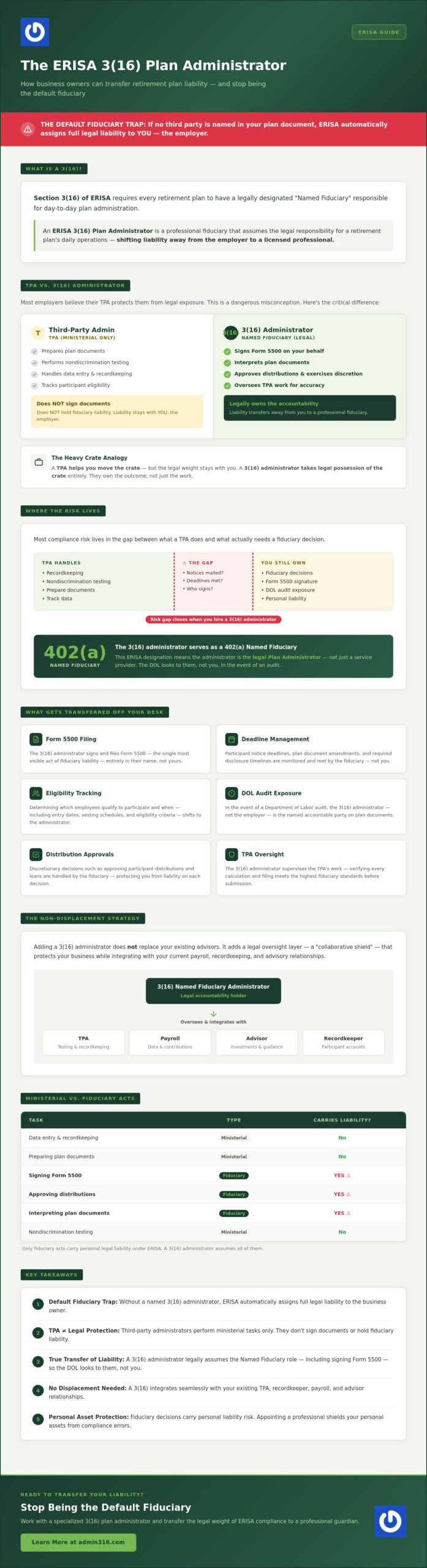
This is the “Default Fiduciary” trap. ERISA requires every plan to have a designated administrator responsible for day-to-day operations. If your plan document doesn’t name a third party for this role, the law defaults that responsibility to the employer. You become the person legally accountable for every filing, every notice, and every compliance error. If you’ve ever asked yourself what is a 3(16) fiduciary and what they actually do, the answer starts here: an ERISA 3(16) plan administrator is a professional fiduciary that assumes the legal responsibility for a retirement plan’s daily operations, shifting the burden of liability away from the employer to a professional fiduciary.
The Legal Gravity of Section 3(16)
Section 3(16) of the law is not just a technicality; it’s the anchor of plan compliance. ERISA mandates that every plan has a “Named Fiduciary” to oversee its administration. There’s a critical distinction here between ministerial tasks and fiduciary acts. While a staff member might handle data entry, the person who signs the Form 5500 is performing a fiduciary act. This distinction is vital because fiduciary acts carry personal liability. If the Department of Labor finds an error, they don’t just look at the company. They look at the individuals who signed the documents. We assume these roles so that your personal assets remain protected.
Why Most Employers Are Unknowingly Liable
A common misconception persists that having a Third-Party Administrator (TPA) or a Recordkeeper means the plan is “handled.” In reality, most TPAs perform ministerial functions only. They prepare the documents, but they don’t sign them. They track eligibility, but they don’t ensure the notices are mailed on time. Your liability begins exactly where their service contract ends. This gap is where most compliance risks live. By acting as a Specialized Guardian, a 3(16) fiduciary closes this gap.
Not sure where your plan’s fiduciary liability actually sits?
Admin316 serves as your named 3(16) plan administrator and takes the filing, notice and compliance work off your desk — along with the liability that comes with it. A 15-minute call is usually enough to tell you where you stand.
3(16) Plan Administrator vs. TPA: Who Actually Carries the Liability?
Many employers believe their Third-Party Administrator (TPA) is the one answerable to the Department of Labor. This is a dangerous misconception. Think of your plan’s administration like a heavy crate. A TPA is a service provider hired to help you move that crate from point A to point B. They do the heavy lifting of data entry and compliance testing. However, the legal weight of the crate, which includes the ultimate ownership of its contents and its safe arrival, still stays with you. An ERISA 3(16) plan administrator doesn’t just help you move the crate; they legally take possession of it.
The Ministerial vs. Fiduciary Distinction
The law makes a clear distinction between ministerial duties and fiduciary ones. Most TPA contracts are strictly ministerial. This means they are responsible for recordkeeping, nondiscrimination testing, and preparing plan documents. They follow instructions; they don’t make decisions. Fiduciary duties involve interpreting plan documents, approving distributions, and exercising discretion. A TPA “does the math,” but you “take the blame” if that math is based on incorrect interpretations or delayed data. Doing the work is not the same as owning the result.
Hiring an ERISA 3(16) plan administrator changes this dynamic by adding a layer of protection. While the TPA continues their ministerial work, the 3(16) administrator acts as a 402(a) Named Fiduciary. This role, defined under ERISA section 3(16)(B), means the administrator is the legal “Plan Administrator.” They don’t just coordinate with your TPA; they oversee their work to ensure every calculation and filing meets the highest fiduciary standards. If you want to see how this fiduciary oversight integrates with your current team, it’s helpful to look at the most visible mark of liability: your signature.
Form 5500: The Ultimate Signature of Responsibility
Every year, the Form 5500 must be filed with the Department of Labor. For many business owners, signing this document is the most stressful part of the year. This signature is a formal declaration that you take personal responsibility for the plan’s compliance. If the filing is incomplete or late, the DOL can assess penalties of up to $2,739 per day. This is a significant financial risk that rests entirely on the individual who signs the document.
When you appoint a professional fiduciary, you hand off the pen. The 3(16) administrator signs the Form 5500 as the Plan Administrator. This simple act transfers the primary target for DOL inquiries from your office to theirs. It provides immediate relief, knowing that a seasoned expert is now the one legally standing between your company and regulatory scrutiny. This coordination ensures that your TPA’s work is verified and your business is shielded. If your current setup is leaving you exposed, switching 3(16) plan administrator services can be a straightforward path to transferring that legal burden without disrupting your existing team.
Core Responsibilities: From Eligibility Tracking to Compliance Oversight
The daily management of a retirement plan involves a constant stream of administrative decisions. Each decision carries legal weight. An ERISA 3(16) plan administrator acts as a proactive shield, catching potential errors before they become liabilities. While a TPA might provide the data, the 3(16) administrator owns the execution. This involves a comprehensive approach to mitigating risk to employers by overseeing every moving part of the plan’s lifecycle. We don’t just provide a service; we assume the duty of a Specialized Guardian, ensuring your plan remains in good standing with federal regulators.
Our role extends to managing plan expenses and performing fee benchmarking. We coordinate with service providers to ensure the costs your participants pay are reasonable. This proactive oversight prevents the “fee litigation” risks that have become common in recent years. We handle the heavy lifting so that your internal team can focus on their primary roles without the constant distraction of compliance deadlines.
Daily Operations and Participant Management
Eligibility tracking is often where plans fail. If you miss a newly eligible employee, you face “excluded employee” errors that require expensive corrective contributions. We track these dates meticulously. We also manage the distribution of required participant notices, such as Summary Plan Descriptions (SPDs) and Summary Annual Reports (SARs). Beyond simple mailings, we handle complex determinations for loans and distributions. This includes the technical work of approving Qualified Domestic Relations Orders (QDROs), a task many employers don’t realize is a fiduciary act that carries significant legal risk.
Government Filings and Audit Support
The annual Form 5500 is the most visible compliance requirement, and we take full ownership of its preparation and signing. By acting as the “Agent for Service,” an ERISA 3(16) plan administrator becomes the primary point of contact for the Department of Labor and the IRS. If your plan is selected for an audit, we provide the first line of defense. We coordinate the document requests, explain the administrative procedures, and stand between your company and the regulatory agencies. This shield ensures that an audit is a manageable process rather than a professional crisis.
The Non-Displacement Strategy: Integrating a 3(16) Into Your Team
A common concern when considering an ERISA 3(16) plan administrator is the fear of disrupting established professional relationships. You’ve spent years building trust with your financial advisor, your payroll provider, and your TPA. The thought of replacing them just to gain fiduciary protection feels like a step backward. However, our approach is built on a “non-displacement” narrative. We don’t seek to replace your current team; we aim to fortify it. Think of adding a 3(16) fiduciary as installing a high-tech security system in a building you already love. You keep the architecture and the people, but you finally gain the protection you need.
This “Collaborative Shield” model allows us to work as a silent partner in the background. We assume the legal weight of the plan’s administration, which actually makes the jobs of your other partners easier. By taking the compliance burden off your desk, we also take it off theirs. This creates a seamless flow of information where everyone knows their role, and your business remains protected from the gravity of regulatory risks. You can fortify your retirement plan team today without losing the professional bonds you’ve worked hard to preserve.
Working Alongside Your Financial Advisor
It’s vital to understand that an ERISA 3(16) plan administrator handles the administrative side of the plan, not the investment side. We don’t provide investment advice, and we don’t act in 3(38) or 3(21) investment fiduciary roles. This distinction is important because it allows your financial advisor to focus entirely on wealth management and participant outcomes. While they manage the assets, we manage the compliance. To fully understand how these roles complement each other, it helps to explore the differences between a 3(16) administrator vs 3(38) fiduciary and how each protects a different dimension of your plan. We coordinate directly with your investment team to ensure that the plan’s governing documents align with their strategies, creating a unified front that protects the employer from every angle.
Seamless Payroll and Recordkeeper Integration
The “HR headache” of retirement plans usually stems from data silos. Payroll systems, recordkeepers, and TPAs often don’t speak the same language, leaving you to bridge the gap. We act as that data bridge. By integrating directly with your existing payroll and recordkeeping platforms, we automate the oversight of employee data. We monitor contributions, track eligibility, and oversee the TPA’s work without requiring you to change your software or your process. This integration ensures that the “heavy lifting” of data oversight happens behind the scenes, allowing your HR department to reclaim their time and focus on your people rather than your paperwork.
Admin316: Your Specialized Guardian for ERISA Compliance
Admin316 has operated as a seasoned, methodical expert in the fiduciary space since 1997. We don’t just offer a service; we offer an advocacy-based partnership. Our burden-lifting mission is rooted in the belief that business owners shouldn’t have to be legal experts to offer a quality retirement plan. When we assume the full ERISA 3(16) plan administrator and 402(a) Named Fiduciary roles, we take on the personal liability that otherwise rests on your shoulders. This transfer of accountability is the ultimate source of relief for overwhelmed HR departments and company officers. We serve as a national partner with a quiet, professional personality, fortifying your team without displacing the local advisors you already trust and value.
Why Independence Matters in Fiduciary Services
Independence is vital when you’re looking for a specialized guardian for your plan. Because we aren’t tied to any specific recordkeeping software or investment platform, our oversight remains entirely objective. We coordinate with your current providers to ensure they’re performing their duties while we monitor plan fees and service benchmarks. This objectivity allows us to act as a true shield, protecting your interests and those of your participants without the distraction of conflicting business motives. Our established tenure since 1997 means we’ve navigated decades of regulatory shifts, providing a sense of stability and institutional permanence that newer, tech-only firms simply cannot match. As an independent ERISA 3(16) plan administrator, we focus solely on your protection.
Taking the First Step Toward Relief
The process of handing off your administrative duties is designed to be seamless and highly organized. We move methodically from identifying your specific pain points to establishing a comprehensive service as the antidote to your compliance concerns. Onboarding isn’t a disruption; it’s a transition toward long-term stability for your business. Once we take the pen to sign your Form 5500 and oversee the distribution of your participant notices, the professional anxiety that once defined your plan management vanishes. You retain the savings benefits of the plan while we carry the legal weight. You shouldn’t have to carry the burden of fiduciary risk alone when a seasoned partner is ready to stand alongside you. Lifting your compliance burden starts with a conversation.
Secure Your Business with Professional Fiduciary Protection
Managing a retirement plan shouldn’t feel like a constant struggle with legal gravity. You’ve learned that while a TPA handles the paperwork, only an ERISA 3(16) plan administrator assumes the actual legal weight of the plan’s operations. By appointing a specialized guardian, you create a shield between your company and the Department of Labor. This ensures that your personal liability is mitigated while your existing advisor relationships remain perfectly intact. It’s a strategic move that fortifies your team without disrupting the professional bonds you’ve already built.
Admin316 has served as a stable anchor for plan sponsors since 1997. We provide national coverage across all states and maintain full-scope 402(a) fiduciary status to protect your business. You don’t have to carry the heavy lifting of compliance alone; you can choose to collaborate with a partner that values your stability as much as you do. It’s time to reclaim your focus and lead your company with total confidence. Transfer your fiduciary liability to the experts at Admin316 today and experience the peace of mind that comes with true administrative relief. Your path to a secure, compliant future is just one step away.
Frequently Asked Questions
What is the primary difference between a TPA and a 3(16) plan administrator?
The primary difference lies in the assumption of legal liability. A Third-Party Administrator (TPA) typically performs ministerial tasks like recordkeeping and nondiscrimination testing but doesn’t take on fiduciary responsibility. An ERISA 3(16) plan administrator assumes full legal accountability for the plan’s daily operations. While a TPA prepares the work, the 3(16) fiduciary owns the result and stands as a shield between the employer and regulatory entities.
Who signs the Form 5500 for a 401(k) plan?
The designated Plan Administrator is the individual or entity legally required to sign the Form 5500. For most businesses, this defaults to the owner or a company officer, which carries significant personal liability. When you appoint a professional 3(16) fiduciary, they sign the government filing on your behalf. This transfer of responsibility removes the weight of personal penalties for filing errors or missed deadlines from your desk.
Can I hire a 3(16) fiduciary without changing my current 401(k) advisor?
Yes, you can integrate a 3(16) fiduciary without displacing your current financial advisor. Our “non-displacement” strategy ensures that we work alongside your existing team as a specialized guardian. We coordinate the administrative compliance and legal oversight, allowing your advisor to focus entirely on investment management and participant outcomes without the distraction of regulatory paperwork or complex government filings.
Does a 3(16) plan administrator take on personal liability for my retirement plan?
An ERISA 3(16) plan administrator assumes the legal liability for the specific administrative duties outlined in their service agreement. By taking on the role of a named fiduciary, they mitigate the financial risks associated with day-to-day plan mismanagement. This transfer of weight provides a layer of protection for the business owner, ensuring that a seasoned professional is the one accountable for compliance and operational accuracy.
How much does it cost to outsource ERISA 3(16) administration?
The cost of outsourcing 3(16) administration depends on the size of your plan and the specific fiduciary duties assumed by the administrator. Fees are typically structured as a base amount plus a per-participant charge. While we don’t quote specific industry prices, many business owners find the investment is far lower than the potential $2,739 per day penalty the Department of Labor can assess for filing failures.
What happens if my 401(k) plan is audited and I don’t have a 3(16) fiduciary?
If your plan is audited without a 3(16) fiduciary, you are the primary point of contact for the Department of Labor. You must personally defend every administrative decision, distribution approval, and notice delivery. Without a professional shield, you carry the full weight of proving compliance. This often leads to significant professional anxiety and consumes valuable time that should be spent on your core business operations.
Does a 3(16) administrator handle payroll processing for my company?
A 3(16) administrator does not provide payroll processing services. Instead, we coordinate with your existing payroll provider to ensure that employee data is accurate and contributions are deposited in a timely manner. We act as a data bridge that oversees the flow of information between your payroll system and the plan’s recordkeeper. This partnership prevents common errors like missed eligibility dates or late deposits.
Is a 3(16) fiduciary the same as a 3(38) investment manager?
No, a 3(16) fiduciary and a 3(38) investment manager handle entirely different aspects of your retirement plan. A 3(16) administrator oversees the operational and administrative compliance of the plan. A 3(38) manager takes on the fiduciary responsibility for selecting and monitoring the plan’s investment options. One manages the “paperwork” and operations, while the other manages the “money” and assets to ensure total plan protection. For a deeper look at how these two roles compare and which your plan may need, see our guide on the 3(16) administrator vs 3(38) fiduciary distinction.
Transfer this responsibility to a professional fiduciary.
Every item in this article is work Admin316 does for plan sponsors every day as an ERISA 3(16) administrator. Bring us your plan documents and we’ll show you exactly which risks move off your shoulders.