401(k) Plan Audit Support
A DOL or IRS audit of your retirement plan doesn’t have to be stressful. Admin316 prepares, guides, and supports plan sponsors through every stage of the audit process, protecting your organization and ensuring a compliant, confident response.
Three Different Things People Call "The Audit"
Sponsors use one word for three very different events, and the response to each is different. Knowing which one you are in is the first step.
1. The independent Form 5500 audit
Required for large plans and performed by an independent qualified public accountant. Since the 2023 plan year, the participant count that triggers it is based on participants with account balances at the beginning of the plan year, generally 100 or more, subject to the 80–120 rule that lets a plan keep filing as it did the prior year.
2. A DOL / EBSA investigation
Fiduciary-focused. Late deposits, prohibited transactions, imprudent process, fees, missing participants and bonding. Can arise from a 5500 answer, a participant complaint, or a national enforcement project.
3. An IRS examination
Qualification-focused. Document compliance, eligibility, compensation definitions, testing, limits and distributions. The risk is operational failure and, in the extreme, plan disqualification.
What Examiners Actually Ask For
| Request | What they are testing | Where files usually fall apart |
|---|---|---|
| Signed plan document, amendments, restatements | Whether the plan is current and operated as written | Missing interim amendments; unsigned adoption agreements |
| Payroll registers and deposit records | Deferral timeliness under 29 CFR 2510.3-102 | No pattern analysis; a few late payrolls nobody noticed |
| Census with hire, termination and rehire dates | Eligibility, entry dates, exclusions | Eligible employees never enrolled |
| Compensation detail | Plan-definition compensation vs. what payroll used | Bonuses and commissions treated inconsistently |
| Testing packages | ADP/ACP, coverage, top-heavy, 415 | Results produced but corrections never executed |
| Notices with proof of delivery | Safe harbor, QDIA, auto-enrollment, 404a-5 | No evidence of delivery, only an assumption |
| Distribution and loan files | Documented approval consistent with the plan | Missing spousal consent, undocumented hardships, defaulted loans |
| Fiduciary governance file | Prudent process | No committee charter, minutes or benchmarking |
| ERISA fidelity bond | ERISA 412 bonding, generally 10% of plan assets | Bond never increased as the plan grew |
How Admin316 Runs Audit Support
1. Scope and clock
Identify exactly what has been requested, the deadline, and what the request implies the examiner already suspects.
2. Internal file review first
We test the same items before the examiner does, so findings surface on our schedule instead of theirs.
3. Correction strategy
Self-correction under IRS EPCRS or a DOL VFCP filing where it applies. Voluntary correction is almost always far cheaper than the same issue found on examination.
4. Document production
Organized, complete, responsive — and nothing beyond what was asked.
5. Examiner communication
We handle correspondence and questions so your staff is not improvising answers about ERISA on a phone call.
6. Close-out and prevention
Resolve the finding, then change the process that produced it so the next cycle is clean.
Where Plan Sponsors Get Hurt
Answering informally. Off-the-cuff answers become findings. Everything should be reviewed before it leaves the building.
Over-producing. Volunteering years or categories nobody asked for expands the examination.
Waiting to correct. Voluntary correction programs generally close once an examination begins.
No proof of notice delivery. The most common "we did that" item with no evidence behind it.
Underfunded fidelity bond. A cheap, fast fix that is nonetheless a standard finding.
Who This Fits
- Plans that just received a DOL or IRS letter and need an experienced hand on the response.
- Plans approaching the large-plan threshold that want to be audit-ready before the first independent audit.
- Sponsors who suspect prior-year problems and want them quantified and voluntarily corrected before anyone else finds them.
The First 30 Days of a DOL or IRS Letter
| Day | What should happen | Why |
|---|---|---|
| 1–2 | Log the deadline, identify the exact scope and years, and stop informal communication with the examiner | Scope and tone are set in the first exchange |
| 3–7 | Assemble the document inventory and identify what does not exist | Gaps take the longest to resolve and should surface immediately |
| 7–14 | Test the high-risk items internally: deposit timing, eligibility, compensation, notices, testing corrections, bond | Findings you identify first can often still be corrected voluntarily |
| 14–21 | Decide the correction path and quantify exposure; involve counsel where privilege matters | Correction posture shapes the entire response |
| 21–30 | Produce a complete, organized, responsive package; request an extension if it is needed | Organized production narrows the examination; partial production invites expansion |
Preparing for the Independent Form 5500 Audit
Know your count
The audit requirement generally turns on participants with account balances at the beginning of the plan year, and the 80–120 rule can let a plan continue filing in its prior category.
Deposit evidence
A payroll-to-deposit log for the full year is the first item requested and the most common source of findings.
Census integrity
Hire, termination and rehire dates, hours, and compensation by pay type — reconciled to payroll reports.
Participant files
Distribution, loan and hardship documentation with the approvals that support each transaction.
Plan document set
Signed document, all amendments, restatements, SPD and any determination or opinion letter.
Governance evidence
Minutes, benchmarking, provider reviews, fee disclosures and the fidelity bond.
Correction Programs, and When the Door Closes
IRS EPCRS (Rev. Proc. 2021-30) covers qualification and operational failures through self-correction, the Voluntary Correction Program, or Audit CAP once an examination is underway — at materially higher cost.
DOL VFCP covers specified fiduciary breaches, most commonly late deferral deposits, with relief when the application is complete and the transaction is fully corrected with lost earnings.
DOL DFVCP covers delinquent Form 5500 filings with a capped program fee instead of penalties that otherwise accrue for each day late.
Timing is the whole game. These programs generally require that the plan is not already under examination. Waiting to "see if they ask" is how a manageable correction becomes a negotiated settlement.
Who This Fits
- Sponsors holding a DOL or IRS letter right now who need the response handled by someone who has done it repeatedly.
- Plans crossing the large-plan threshold that want a clean first audit rather than a list of findings.
- Sponsors who suspect prior-year problems and want them quantified and voluntarily corrected while the programs are still available.
- Companies in a transaction where plan compliance is about to be examined by someone else's counsel.
Where It Falls Short
- We are not your legal counsel; where litigation, privilege or negotiated settlements are involved, an ERISA attorney should lead and we support.
- Audit support addresses what happened. Preventing the next cycle is administrative work — the 3(16) role.
Frequently Asked Questions
When does our plan need an independent Form 5500 audit?
Generally when the plan has 100 or more participants with account balances at the beginning of the plan year. The 80-120 rule allows a plan in that range to continue filing in the same category as the prior year, which can defer a first audit.
What triggers a DOL investigation?
Common triggers include Form 5500 answers indicating late deferral deposits or a missing fidelity bond, participant complaints, referrals from an accountant's audit report, and DOL national enforcement priorities.
Should we correct problems before we respond?
Usually yes, and quickly. IRS EPCRS self-correction and the DOL Voluntary Fiduciary Correction Program are typically unavailable once an examination is underway, so the window is narrow and valuable.
Can Admin316 talk to the examiner for us?
Yes. We manage the document production and correspondence, and coordinate with your accountant and counsel, so responses are consistent and complete.
What does an audit finding actually cost?
It depends on the failure. Late deposits require lost earnings plus an excise tax filing. Missed deferral opportunities require corrective employer contributions. Late Form 5500 filings carry daily DOL penalties. Voluntary correction is consistently the cheaper path.
Should we involve an ERISA attorney?
Often yes, particularly where privilege, potential litigation or a negotiated resolution is in play. We work alongside counsel and handle the plan-operations analysis and document production.
How far back can an examination go?
Practically, examiners commonly focus on recent plan years but may expand where a failure appears systemic. Some qualification issues carry no practical time limit because the failure repeats every year until corrected.
Does a clean audit report mean we have no problems?
No. An independent accountant's audit tests financial statements and specified compliance items; it is not a full ERISA fiduciary review. Plans with clean audit reports are still cited by the DOL for process failures.
What is the single most common finding you see?
Late deferral deposits, followed by notices with no proof of delivery and testing results that were produced but never corrected.
Educational information only. Fiduciary status, plan operations and correction options depend on your plan document, service agreements and specific facts. Nothing here is legal, tax, investment or actuarial advice, and reading it does not create a fiduciary or client relationship.
Pre-Audit Preparation & Readiness
Admin316 conducts a thorough pre-audit review of your plan’s documents, operations, and compliance history, identifying and correcting vulnerabilities before a DOL or IRS auditor ever arrives, so your organization enters the audit process fully prepared and protected.

Plan Document Review
- Compliance
- Readiness
Operational Compliance Check
- IRS
- DOL Standards
Vulnerability Identification
- Risk
- Prevention
Audit Response & Documentation
Admin316 proactively manages and mitigates investment-related risks by following ERISA standards and implementing rigorous compliance measures, staying current on regulatory changes and adapting investment strategies to minimize penalties and keep your plan fully protected.

Auditor Inquiry Responses
- Documentation
- Accuracy
Form 5500 Audit Support
- Filing
- Compliance
Plan Record Organization
- Submission
- Records
Post-Audit Correction & Remediation
If an audit uncovers compliance deficiencies, Admin316 works swiftly to correct them, implementing corrective action plans, coordinating with plan counsel, and rebuilding governance frameworks that prevent future audit exposure and strengthen your plan’s long-term compliance posture.

Corrective Action Planning
- Remediation
- Strategy
IRS Voluntary Correction Program
- VCP
- Penalty Reduction
Governance Rebuilding
- Compliance
- Long-Term
Navigate Every Audit With Confidence
An audit without expert support is a significant liability risk. Admin316 brings over 25 years of ERISA experience to every audit engagement, preparing your plan, protecting your organization, and guiding you through the process from start to finish.

Proactive Preparation
We identify and resolve compliance gaps before an audit begins, giving your organization the strongest possible foundation and eliminating surprises that lead to costly penalties.

Expert Audit Guidance
Admin316 manages every stage of the audit process on your behalf, organizing records, preparing responses, and communicating with auditors so your team stays focused on the business.

Penalty Risk Reduction
Our deep knowledge of IRS and DOL audit procedures allows us to craft precise, compliant responses that significantly reduce your organization’s exposure to penalties and plan disqualification.

Stronger Compliance Posture
Every audit engagement leaves your plan in a stronger position, with corrected deficiencies, improved documentation, and a governance framework built to withstand future regulatory scrutiny.

- In Business Since 1997
- 975+ Plans Administered
- 100% Independent & Conflict-Free
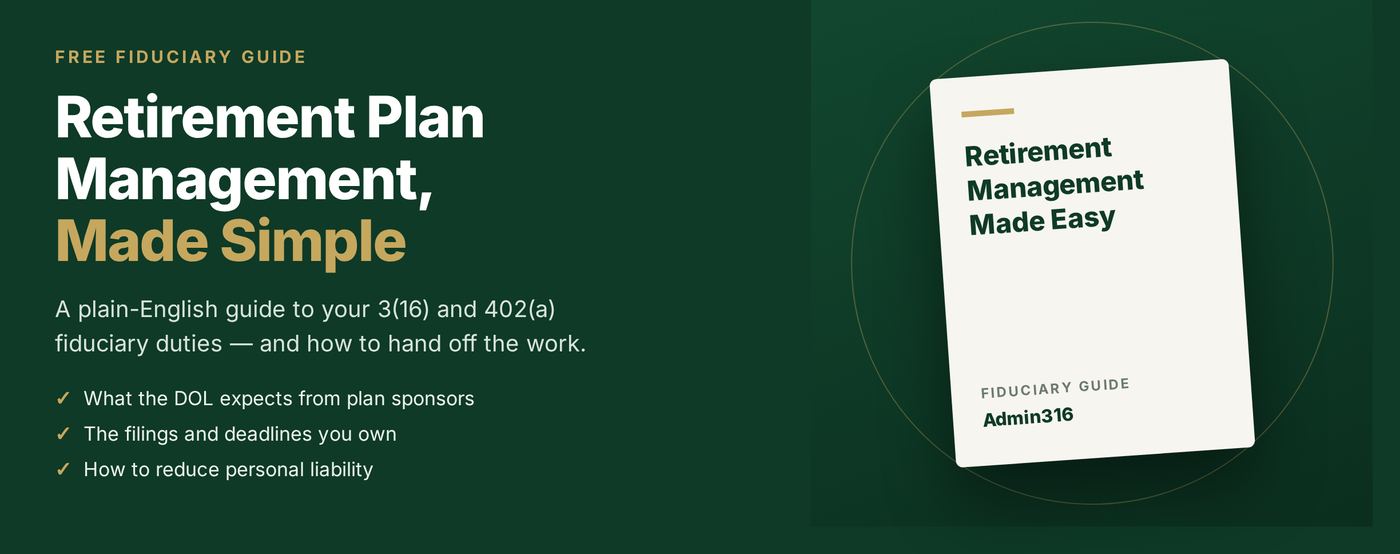
Get Your Free Fiduciary GuideA plain-English guide to what ERISA actually puts on the plan sponsor — including DOL and IRS plan audits — and which of those duties can be transferred to an independent fiduciary. No cost, no call required.
Get the guide →We Work Alongside Leading Recordkeepers & Plan Providers


Admin316 Client Result
Plan Sponsor · Admin316 Client
Over $142,000 in Client Penalties Avoided
"Admin316's analysis of our DOL filings uncovered excessive fees and saved our company more than $142,000 annually."
"Admin316 has made managing our retirement plan significantly easier. Their team is responsive, knowledgeable, and proactive about the administrative responsibilities that used to take time away from our internal team. Having experienced professionals helping oversee the plan gives us greater confidence that important details aren't being overlooked."
"Working with Admin316 has taken a tremendous amount of administrative work off our plate. They understand the responsibilities that come with sponsoring a retirement plan and help make sure things get handled correctly and on time. The biggest benefit for us has been having a team we can rely on instead of trying to manage everything internally."
"Admin316 brought structure and accountability to the way we manage our retirement plan. They helped us better understand who was responsible for what and took over many of the administrative responsibilities our team had been handling. Their knowledge and responsiveness have made them a valuable partner to our organization."
"One of the best things about working with Admin316 is knowing there is a team focused on the details of our retirement plan every day. They are proactive, accessible, and willing to explain issues in plain English. It has allowed our management team to spend less time worrying about plan administration and more time running our business."
"Admin316 helped simplify what had become a complicated and time-consuming responsibility for our company. Their team has been professional, responsive, and easy to work with. I especially appreciate having a clear process and knowing exactly who is responsible for getting things done."