If you believe your investment advisor is shielding your company from every possible ERISA mistake, you’re likely carrying a much heavier burden than you realize. Most business owners feel a constant sense of anxiety over the alphabet soup of regulatory sections, wondering if a single paperwork error could lead to personal liability. It’s frustrating to spend your valuable time on plan administration when you should be focused on the growth of your business. When evaluating a 3(16) administrator vs 3(38) fiduciary, the distinction isn’t just technical; it’s the difference between managing the money and managing the legal risk.
We understand that you need total relief from the administrative heavy lifting that distracts from your primary mission. This article will help you discover the critical differences between administrative and investment fiduciaries so you can shield your business from ERISA liability and the stress of DOL audits. We’ll show you how to layer these protections to create a methodical safety net, allowing you to preserve your existing professional relationships while handing off the legal accountability to a specialized guardian. You’ll gain a clear roadmap for removing the weight of compliance once and for all.
Key Takeaways
- Distinguish between operational management and asset oversight to ensure every aspect of your retirement plan is professionally protected.
- Learn how an ERISA 3(16) administrator assumes the weight of day-to-day compliance, shielding your business from DOL audits and costly paperwork errors.
- Understand the specific role of a 3(38) fiduciary in managing the Investment Policy Statement and mitigating risk through discretionary asset oversight.
- Evaluate the synergy between a 3(16) administrator vs 3(38) fiduciary to determine why layering these distinct protections provides the most robust legal defense for your firm.
- Discover how partnering with a seasoned guardian allows you to preserve your existing relationships while transferring the burden of fiduciary accountability.
3(16) Administrator vs. 3(38) Fiduciary: Defining the Fiduciary Divide
Fiduciary duty isn’t just a corporate label; it’s a heavy legal weight that rests squarely on the shoulders of the plan sponsor. Under the Employee Retirement Income Security Act of 1974 (ERISA), this responsibility is a legal obligation that requires constant vigilance. Many business owners carry this burden alone, unaware that ERISA actually allows for the transfer of these duties to professional partners. By understanding the roles of a 3(16) administrator vs 3(38) fiduciary, you can begin to transition that weight from your own desk to a specialized guardian who assumes the legal accountability on your behalf.
This division of labor creates a shield between your business and the complex regulatory entities that oversee retirement plans. While one partner oversees the assets, the other oversees the operations. Neither replaces your current team; instead, they fortify your existing structure by adding a layer of professional protection that mitigates risk and preserves your time for business growth.
What is a 3(16) Plan Administrator?
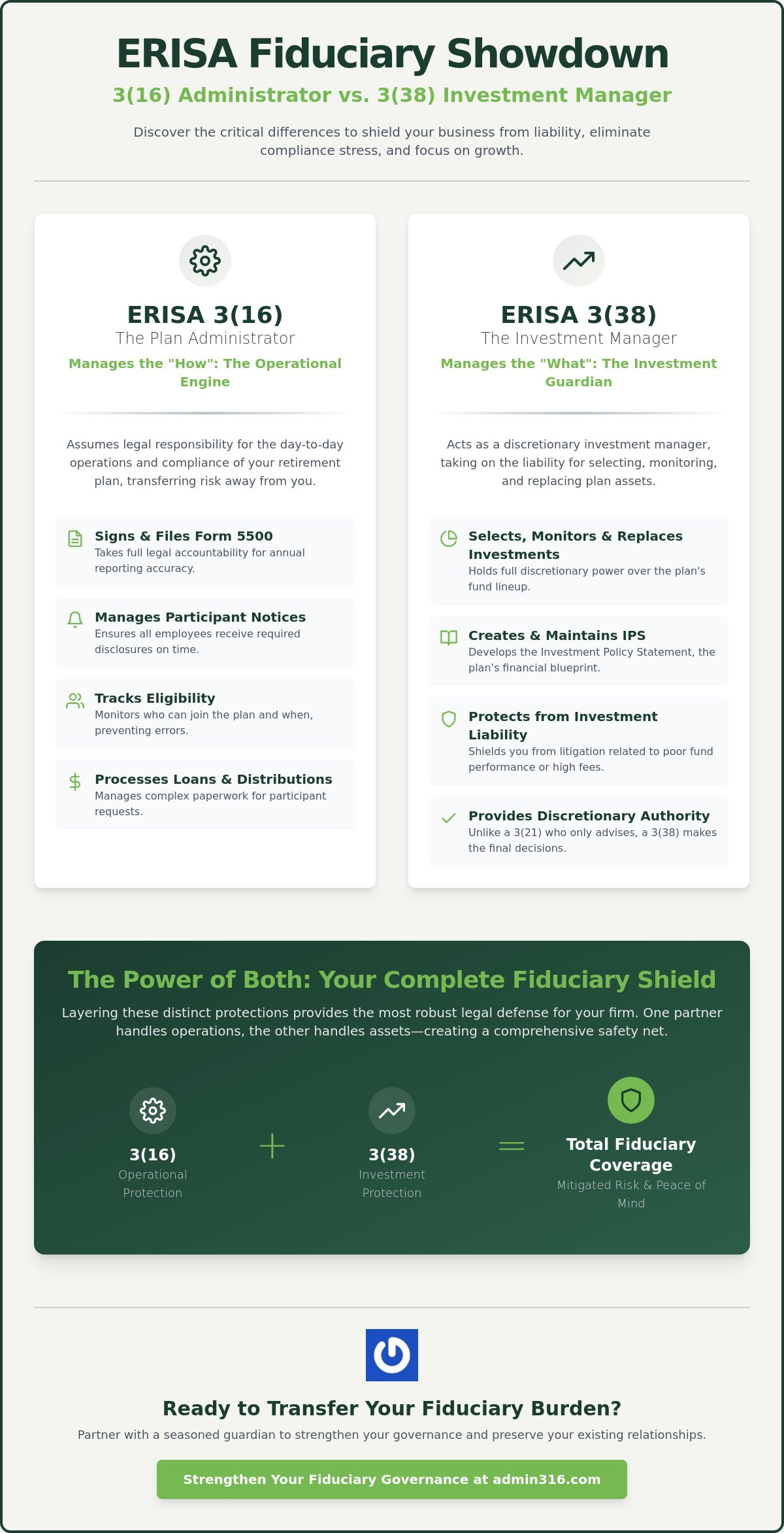
The 3(16) administrator serves as the “Named Fiduciary” for the day-to-day operations of your retirement plan. Think of this role as the operational engine that handles the heavy lifting of compliance. If you’ve ever wondered what is a 3(16) fiduciary and how it differs from a standard service provider, the key distinction is that a 3(16) partner actually assumes the legal responsibility for those tasks rather than simply preparing reports for you to sign. They don’t just tell you what to do; they do it for you. Core duties include:
- Signing and filing the Form 5500: Taking full legal accountability for the accuracy of your annual reporting.
- Participant notices: Ensuring every employee receives required disclosures on time, every time.
- Eligibility tracking: Monitoring who can join the plan and when, preventing common census errors.
- Loan and distribution processing: Managing the complex paperwork and approvals for participant requests.
By delegating these tasks, you aren’t just offloading paperwork. You’re transferring the risk of compliance errors that often trigger Department of Labor (DOL) audits.
What is a 3(38) Investment Fiduciary?
While the 3(16) manages the “how” of the plan, the 3(38) fiduciary manages the “what.” This partner is a discretionary investment manager with the power to select, monitor, and replace the plan’s investment options. They take the lead on creating and maintaining the Investment Policy Statement (IPS), which serves as the blueprint for all financial decisions within the plan.
A 3(38) fiduciary protects the plan sponsor from liability related to poor investment choices or a lack of investment oversight. If a fund underperforms or becomes too expensive, the 3(38) has the authority to swap it out without waiting for your approval. This discretionary authority is what separates them from a 3(21) advisor, who only provides recommendations. The 3(38) assumes the investment risk so that you don’t have to spend your weekends analyzing mutual fund performance or worrying about fiduciary litigation related to asset management.
Not sure where your plan’s fiduciary liability actually sits?
Admin316 serves as your named 3(16) plan administrator and takes the filing, notice and compliance work off your desk — along with the liability that comes with it. A 15-minute call is usually enough to tell you where you stand.
The ERISA 3(16) Plan Administrator: Assuming the Burden of Operations
For most business owners, the retirement plan is a secondary concern until a Department of Labor notice arrives in the mail. At that moment, the weight of every missed signature and every late participant notice becomes a physical pressure. While a standard Third Party Administrator (TPA) might provide the reports, the legal responsibility to ensure those reports are accurate remains with you. Choosing between a 3(16) administrator vs 3(38) fiduciary requires understanding who actually holds the legal pen. When you appoint a 3(16) partner, you aren’t just hiring a service provider; you are transferring the legal liability for the plan’s daily operations to a specialized guardian.
This transition of liability creates a robust shield against Department of Labor (DOL) audits. Because the 3(16) partner assumes the role of the plan’s operational head, they are the first line of defense if a regulator questions your compliance history. We do the heavy lifting of administrative oversight so that you can focus on the growth and stability of your company. This is a non-displacement model. We don’t replace your recordkeeper or your payroll processor. Instead, we work alongside them to ensure their data is used correctly and that no compliance gaps are left open.
Compliance and Form 5500 Oversight
An ERISA 3(16) partner serves as the legal signer of the Form 5500, taking full accountability for its timely and accurate filing. This role involves a meticulous process of eligibility tracking and the distribution of participant notices, ensuring every employee is informed and every deadline is met. Many “software-only” solutions marketed today often fail to provide true fiduciary protection because they lack the human oversight necessary to catch census errors or payroll discrepancies. True protection requires a partner who doesn’t just provide a tool, but who assumes the legal weight of the results. If you’re uncertain whether your current setup is adequate, reviewing the signs you need a 3(16) fiduciary to protect your plan’s compliance can help you identify critical gaps before a DOL audit does.
The Named Fiduciary and 402(a) Protection
The ERISA 3(16) plan administrator acts as a core governance component by serving as a Named Fiduciary. Under ERISA Section 402(a), this status provides the highest level of fiduciary shielding available for plan operations. It establishes a clear, legal hierarchy where the administrative partner is responsible for the plan’s health. This collaborative approach allows you to preserve your existing professional bonds while adding a layer of institutional permanence to your governance structure. If you are ready to fortify your plan, you may want to explore how a dedicated fiduciary partner can streamline your internal processes.
The ERISA 3(38) Investment Fiduciary: Managing the Plan Assets
If the 3(16) administrator is the engine of the plan, the 3(38) investment fiduciary is the navigator. While your company focuses on its core mission, a 3(38) partner assumes the specific responsibility for the Investment Policy Statement (IPS). This document serves as the legal blueprint for how plan assets are managed, monitored, and replaced. By appointing a 3(38) manager, you effectively shift the investment liability from your own desk to a professional who possesses the technical expertise to handle complex market decisions. This arrangement simplifies the advisor-client relationship because it removes the need for you to oversee every individual fund change or market adjustment.
It is vital to understand that while a 3(38) partner manages the “money,” the plan sponsor is still legally on the hook for the “admin.” Many business owners feel a false sense of security after hiring an investment manager, only to realize later that their operational duties remain untouched. The 3(38) fiduciary provides a specialized layer of protection for the assets, but they do not assume the weight of compliance paperwork or regulatory filings. Understanding the boundary between a 3(16) administrator vs 3(38) fiduciary is the first step in building a complete defense for your business.
Discretionary Investment Management
A 3(38) fiduciary operates with “discretionary” authority, which is the legal right to make changes to the plan’s investment lineup without seeking your prior approval. This is a powerful tool for risk mitigation. By removing the employer from the investment committee, you eliminate the risk of a “fiduciary breach” related to fund selection. You no longer have to spend hours debating fund performance or worrying if a specific mutual fund is meeting ERISA’s prudence standards. The 3(38) manager takes full legal accountability for these choices, providing you with a seamless resolution to the burden of asset oversight.
The Limits of 3(38) Protection
Hiring only a 3(38) fiduciary is like carrying a shield with a hole in the center; your investments are protected, but your operations remain exposed to the elements. A 3(38) does not track employee eligibility, they do not distribute participant notices, and they certainly do not sign the Form 5500. This “administrative gap” is where many DOL audits find their footing. If you only have investment protection, you are still carrying the heavy lifting of compliance on your own. True peace of mind requires a partner who can fill that gap, ensuring that both the assets and the administration are shielded from liability.
Key Differences and Why Most Employers Need Both Layers
Choosing between a 3(16) administrator vs 3(38) fiduciary is often framed as an “either/or” decision, but for most businesses, that approach leaves a critical flank exposed. While one manages the assets, the other manages the operations. Without both, you’re still carrying half the weight of fiduciary liability on your own desk. High-growth companies prioritize both layers because they understand that true professional peace only comes when every regulatory angle is covered. This dual-layer approach doesn’t replace your existing team; it fortifies it, acting as a shield between your leadership and the complexities of ERISA.
| Feature | ERISA 3(16) Administrator | ERISA 3(38) Fiduciary |
|---|---|---|
| Primary Scope | Plan Operations and Compliance | Plan Assets and Investments |
| Legal Section | Section 3(16) | Section 3(38) |
| Key Responsibility | Signing Form 5500 and Participant Notices | Investment Policy Statement (IPS) Oversight |
The synergy between these roles is clear. The 3(38) fiduciary handles the “what,” which includes the specific funds and investment strategies that drive participant returns. The 3(16) administrator handles the “how,” consisting of the intricate compliance workflows and filings that keep the plan legal. By layering these protections, you eliminate the professional anxiety that stems from the “alphabet soup” of ERISA sections. This strategy allows you to keep your trusted investment advisor in place while adding a specialized guardian to handle the administrative heavy lifting.
The Synergistic Fiduciary Model
At Admin316, we work alongside your 3(38) investment advisor to create a seamless experience. We follow a rhythmic sense of delegation: we do the paperwork so that you can do the business growth. This collaborative model typically results in a significant reduction in internal HR hours, as the complex coordination between payroll, recordkeepers, and the DOL is handled by us. When both roles are filled, the plan sponsor experiences a total removal of administrative burden, moving from a state of constant worry to a state of long-term stability.
Addressing the #1 Objection: Cost vs. Risk
Many business owners hesitate due to the perceived cost of dual-layer protection. However, professional fees are a calculated investment in mitigation, especially when compared to the cost of a single DOL audit error or a fiduciary litigation claim. A business owner’s time is their most valuable asset, and it shouldn’t be spent on eligibility tracking or census corrections. We position our 3(16) service as a layer of protection that fortifies your plan without replacing your current partners. If you’re ready to see how this synergy can work for your firm, you can request a plan benchmarking analysis to evaluate your current coverage.
Partnering with Admin316: Strengthening Your Fiduciary Governance
Our onboarding process is designed to be seamless and non-disruptive. We don’t require you to replace your current recordkeeper, payroll processor, or investment advisor. Instead, we coordinate with your existing partners to create a unified layer of protection. We assume the weight of administrative duties so that your internal teams don’t have to carry the burden of liability. This collaborative approach preserves your professional relationships while adding a level of expertise that mitigates the risk of compliance errors and DOL audits. We’re the quiet professionals working behind the scenes to ensure your plan remains stable and secure.
Independent 3(16) Fiduciary Services
When you partner with Admin316, you gain a dedicated fiduciary that provides specific, high-level deliverables. We oversee the entire administrative lifecycle of your plan, from meticulous notice distribution to the legal signing and filing of the Form 5500. If your plan faces an audit, we provide comprehensive support, acting as a shield between your business and regulatory entities. Our national scope and institutional reliability mean that we have the resources to handle plans of any size with precision. We coordinate the intricate details of eligibility tracking and participant communication so that you can preserve your time for high-level decision-making. We act as an independent partner that fortifies your current team, ensuring that no operational gap is left open to litigation or fines.
Ready to Shield Your Business?
The transition from professional anxiety to compliance peace begins with a single step. If you’re currently managing your plan’s administration in-house, you’re likely carrying a level of risk that doesn’t align with your long-term goals. Understanding the synergy of a 3(16) administrator vs 3(38) fiduciary is the first step toward a more secure future. We invite you to explore how our specialized oversight can transform your plan governance from a source of stress into a source of stability. Our team is ready to provide a clear roadmap for removing the heavy lifting of compliance from your desk once and for all. Request a consultation to see how we can lift your administrative burden.
Fortifying Your Plan for Long-Term Stability
The decision between a 3(16) administrator vs 3(38) fiduciary isn’t a choice between two equal services; it’s a choice of where you want to place your legal protection. While an investment manager oversees the assets, the operational head handles the daily compliance that often leads to personal liability. By layering these roles, you create a fortress of protection that allows you to focus on business growth while your fiduciary partners handle the heavy lifting. You deserve the relief that comes from knowing every regulatory detail is overseen by a meticulous professional.
Admin316 has specialized in fiduciary administration since 1997. We serve as an independent partner with a national reach, working alongside any recordkeeper or investment advisor you choose to keep in place. We don’t seek to disrupt your current team; we seek to fortify it with high-formality compliance expertise. You can hand off the physical weight of ERISA paperwork to a guardian who assumes full legal accountability. Let Admin316 assume your fiduciary liability; request a consultation today. We look forward to helping you achieve total peace of mind for your retirement plan.
Common Questions Regarding Fiduciary Roles
Can one company serve as both the 3(16) and 3(38) fiduciary?
Yes, some providers offer bundled services that cover both administration and investment management. However, many plan sponsors prefer to hire specialized partners for each role to maintain a clear system of checks and balances. Separating these duties ensures that your operational oversight is independent from your asset management, providing a more robust governance structure for your firm.
Is a TPA (Third Party Administrator) the same as a 3(16) Plan Administrator?
A standard TPA is not the same as a 3(16) administrator. While a TPA performs back-office calculations and prepares reports, the legal responsibility for those tasks remains with the employer. A 3(16) partner actually assumes the legal weight of the plan’s operations. We don’t just prepare the paperwork; we take the legal accountability for its accuracy and timely execution.
Who is legally responsible for signing the Form 5500 if I hire a 3(16)?
The 3(16) administrator becomes the legal signer of the Form 5500 once they are appointed to the plan. This is a primary factor in the 3(16) administrator vs 3(38) fiduciary decision. By signing this document, the 3(16) partner assumes the risk of filing errors and ensures that the plan remains in good standing with the Department of Labor.
Does hiring a 3(38) fiduciary mean I no longer have any investment liability?
Hiring a 3(38) fiduciary shifts the discretionary investment liability to the manager, but it doesn’t eliminate your duty to monitor that provider. You still carry the responsibility of ensuring the 3(38) partner is fulfilling their obligations according to the plan’s Investment Policy Statement. You’ve transferred the heavy lifting of fund selection, but the ultimate oversight of the partner remains with you.
Can I keep my current 401(k) advisor if I hire Admin316 for 3(16) services?
You can absolutely keep your current 401(k) advisor and recordkeeper. Admin316 is an independent partner that operates on a non-displacement model, meaning we fortify your existing team rather than replacing it. We coordinate with your current partners to add a layer of protection that preserves your professional bonds while removing your administrative burden.
What happens if there is a compliance error while a 3(16) is on the plan?
If a compliance error occurs, the 3(16) administrator is responsible for the oversight and coordination of the correction process. Because we assume the legal liability for the plan’s operations, we act as the shield between your business and regulatory entities. We handle the resolution so that you don’t have to carry the stress of a potential audit or penalty.
How much does a 3(16) fiduciary cost compared to a standard TPA?
A 3(16) fiduciary typically carries a higher fee than a standard TPA because they are assuming your legal risk and liability. While a TPA provides a service, a 3(16) partner provides a shield. This cost is often offset by the significant reduction in internal HR hours and the mitigation of expensive audit errors that could otherwise impact your bottom line. To better understand the full scope of what this role entails, reviewing a comprehensive guide on what is a 3(16) fiduciary and the protections it provides can help you evaluate whether this investment is right for your plan.
Is 3(16) protection necessary for a small business retirement plan?
Fiduciary protection is often even more critical for small businesses that lack dedicated HR or compliance departments. A single administrative error can carry a heavy financial weight that a smaller firm might struggle to absorb. Outsourcing these duties ensures your plan meets institutional standards, allowing you to focus your limited time on business growth rather than paperwork. Plan sponsors who are unsure whether their current arrangement is sufficient may benefit from reviewing the key signs you need a 3(16) fiduciary to close compliance gaps before those gaps become costly liabilities.
Transfer this responsibility to a professional fiduciary.
Every item in this article is work Admin316 does for plan sponsors every day as an ERISA 3(16) administrator. Bring us your plan documents and we’ll show you exactly which risks move off your shoulders.