As of 2026, cash balance plans outnumber traditional defined benefit plans by nearly two to one, yet the legal weight of these hybrid vehicles has never been heavier. Most business owners adopt these plans for the substantial tax benefits, only to find themselves buried under a mountain of eligibility tracking and complex interest crediting calculations. You shouldn’t have to choose between the $360,000 compensation limit and your peace of mind. Effective cash balance plan administration is no longer just about moving numbers; it’s about transferring the liability of those numbers to a specialized guardian.
It’s natural to feel overwhelmed by the prospect of a DOL audit or the technicalities of the new $111 PBGC flat-rate premiums. You want the maximum tax deferral possible, but you don’t want the administrative headache that usually follows. This guide provides a clear roadmap for navigating the 2026 regulatory landscape, including FASB accounting shifts and critical filing deadlines. You’ll learn how to shield your company from ERISA liability while maintaining the trusted relationships you’ve built with your current financial advisors. We’ll show you how to hand off the heavy lifting so you can focus on your professional goals.
Key Takeaways
- Leverage the hybrid structure of cash balance plans to achieve maximum tax deferrals for high earners while maintaining the portability of a 401(k).
- Understand how an ERISA 3(16) Plan Administrator acts as a legal shield, assuming the operational duties and fiduciary weight that usually fall on the business owner.
- Master the complexities of cash balance plan administration by following a proven compliance calendar that secures your Form 5500 filings and PBGC premium payments.
- Evaluate your management options using a buyer’s framework that compares the risks of internal administration against the safety of a full fiduciary partnership.
- Discover how to fortify your current financial team with a specialized guardian that takes full legal accountability without displacing your trusted investment advisor.
Navigating the Complexity of Cash Balance Plan Administration in 2026
The landscape of retirement planning has shifted significantly. High-income professionals are increasingly looking beyond traditional 401(k) plans to secure their financial futures. In 2026, the number of cash balance plans continues to outpace traditional defined benefit plans by nearly two to one. This growth is driven by the desire for massive tax deductions, but it comes with a significant administrative burden. What is a Cash Balance Plan? At its core, it’s a hybrid vehicle that combines the high contribution limits of a defined benefit plan with the account-style portability of a 401(k). For a business owner, this means carrying the weight of two distinct regulatory frameworks simultaneously.
Standard recordkeeping software, while helpful for simple deferrals, often fails to meet the rigorous demands of cash balance plan administration. These plans require specialized actuarial oversight that goes far beyond what a typical payroll provider or investment platform offers. When you pair a 401(k) with a cash balance plan, you aren’t just adding a second account; you’re creating a complex ecosystem where every contribution affects the compliance status of the other. Without a professional shield to oversee these interactions, the weight of legal responsibility stays firmly on your shoulders.
The Hybrid Nature: Why Administration is Doubly Difficult
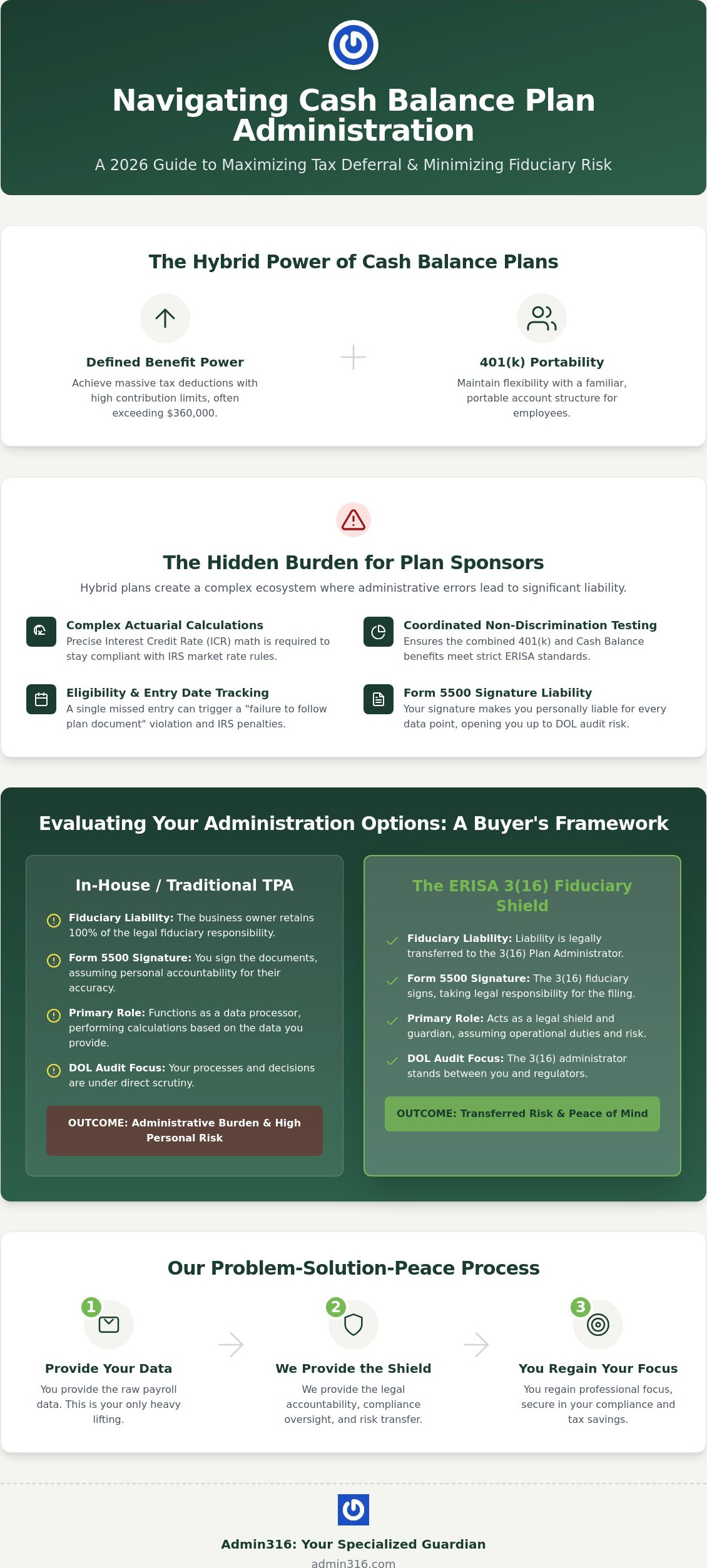
The primary challenge lies in the “hypothetical account.” Unlike a 401(k) where the balance is based on actual investment returns, a cash balance plan uses an Interest Credit Rate (ICR). Calculating these credits requires precise actuarial math to ensure the plan remains funded and compliant with the IRS “market rate of return” rules updated in July 2026. You must also perform coordinated non-discrimination testing. This ensures that the combined benefits provided to highly compensated employees and the general staff meet ERISA standards. We manage these intricate calculations so that your plan remains a source of tax relief rather than a source of professional anxiety.
Common Administrative Pitfalls for Plan Sponsors
Many business owners stumble when tracking participant entry dates across multiple plans. If an employee becomes eligible for the 401(k) but is missed for the cash balance plan, the resulting “failure to follow plan document” error can lead to costly IRS penalties. 2026 also brings new regulatory updates, such as the $111 PBGC flat-rate premium and updated FASB accounting standards for market-return plans. The greatest risk remains the act of signing the Form 5500. When you sign that document, you assume full legal responsibility for every data point. If you don’t have a fiduciary partner to mitigate this risk, you’re carrying the full weight of potential DOL audits alone.
Not sure where your plan’s fiduciary liability actually sits?
Admin316 serves as your named 3(16) plan administrator and takes the filing, notice and compliance work off your desk — along with the liability that comes with it. A 15-minute call is usually enough to tell you where you stand.
The ERISA 3(16) Fiduciary Shield: Transferring the Burden
The complexity of cash balance plan administration doesn’t have to rest on your shoulders. While the technical hurdles of hybrid plans are significant, the ERISA Section 3(16) Plan Administrator serves as the antidote. Think of this role as a legal shield. It sits directly between your business and the regulatory scrutiny of the IRS and Department of Labor. When you appoint a 3(16) fiduciary, you aren’t just hiring a service provider. You’re transferring the physical weight of legal accountability from your desk to ours. We assume the specific duties that the Plan Sponsor usually carries alone.
This is the logical conclusion for owners who want the significant tax advantages of a cash balance pension plan without the secondary job of becoming a compliance expert. According to the Department of Labor Fact Sheet on Cash Balance Plans, these vehicles are subject to strict fiduciary standards that require expert oversight. Effective cash balance plan administration requires more than just accurate math; it requires a total transfer of risk. Our “Problem-Solution-Peace” logic is simple. You provide the raw payroll data, we provide the legal accountability, and you regain your professional focus.
The Difference Between a TPA and a 3(16) Fiduciary
The distinction is critical for your protection. Most Third-Party Administrators (TPAs) function as data processors. They produce the necessary reports and the Form 5500, but they hand them back to you to sign. By signing, you certify the accuracy of that data under penalty of perjury. A 3(16) fiduciary acts as the “Specialized Guardian.” We don’t just prepare the documents; we sign them under our own liability. We also assume the role of the ERISA 402(a) named fiduciary under ERISA. This creates a definitive layer of protection for your personal assets against plan-related lawsuits. If you’re looking to secure your plan’s future, understanding who actually carries the blame is the first step toward true relief.
Lifting the Liability: What We Carry for You
Transferring your burden is a methodical and organized process. We oversee the day-to-day operations that typically trigger Department of Labor audits. We manage the heavy lifting so your internal team doesn’t have to. Our responsibilities include:
- Form 5500 Filings: We sign as the administrator, taking full legal responsibility for the accuracy of the filing.
- Mandatory Notices: We ensure every participant receives their required disclosures on time, every time.
- Eligibility Tracking: We coordinate across your 401(k) and cash balance plans to prevent the entry-date errors that often lead to penalties.
We work alongside your existing recordkeepers and advisors to fortify your plan. This non-displacement approach ensures your investment relationships remain intact while we provide the necessary fiduciary shield. By handing off these duties, you remove the professional anxiety associated with complex cash balance plan administration.
Evaluating Administration Options: A Buyer’s Framework
Choosing the right partner for cash balance plan administration is a high-stakes decision that dictates your level of personal exposure. While a Tax Policy Center analysis of cash balance plans emphasizes the powerful tax-saving potential of these vehicles, it also underscores the rigorous compliance standards they must meet. You essentially have three choices: handle the work internally, hire a standard Third-Party Administrator (TPA), or appoint a full ERISA 3(16) fiduciary. Each path carries a different weight of responsibility.
Weighing professional fees against the cost of a single compliance error is a simple exercise in risk mitigation. A standard TPA handles the math but leaves the legal liability on your desk. In contrast, a 3(16) fiduciary assumes the role of the “Specialized Guardian,” carrying the weight of legal accountability so you don’t have to. This allows you to enjoy the benefits of the plan without the constant threat of a regulatory audit. Before you commit, it’s vital to ask any potential ERISA 3(16) plan administrator if they sign the Form 5500 and if they assume the role of the ERISA 402(a) named fiduciary with full personal liability for plan operations.
In-House vs. Outsourced Fiduciary Services
Many firms mistakenly believe their internal HR staff can manage the complexities of hybrid plan administration. This often leads to hidden costs, as staff time is diverted from core business functions to deciphering interest crediting rates or eligibility rules. It’s also vital to understand that fiduciary liability insurance is not a substitute for professional administration. Insurance might pay for a loss, but it won’t prevent the audit or the professional anxiety that follows. Evaluating your firm’s current exposure to ERISA violations is the first step toward a more stable future. We take over these duties so your team can focus on what they do best.
Integration: Keeping Your Advisory Team Intact
A common fear among business owners is that hiring a new administrator means replacing their trusted financial advisor. We operate on a “non-displacement” principle. We act as a layer of protection that works alongside your existing recordkeeper and investment team. This partnership ensures a seamless data flow from your payroll system to the plan administrator without disrupting your established investment strategy. We coordinate the “heavy lifting” between the recordkeeper and the actuary, providing a shield that fortifies your current team rather than replacing it. This collaborative approach preserves your professional bonds while removing the administrative drag from your daily operations. Business owners who also maintain employer contribution arrangements may find that the same fiduciary principles apply to profit sharing plan administration, where eligibility tracking and nondiscrimination testing create an equally demanding compliance burden. Similarly, employers evaluating whether to complement their cash balance strategy with a defined contribution plan will find that the fiduciary obligations and SECURE 2.0 amendment deadlines demand the same level of specialized oversight.
Key Compliance Milestones: The Administrative Lifecycle
While the tax advantages of hybrid plans are often the primary focus, the clerical grind of the plan year is where most sponsors feel the heaviest burden. Successful cash balance plan administration requires a methodical, organized approach to a recurring series of legal deadlines. It’s not enough to simply fund the plan; you must also oversee a lifecycle of filings, notices, and testing. We assume the responsibility for this calendar so that you can maintain your focus on firm growth without the constant fear of a missed milestone.
The administrative year typically begins with data collection for non-discrimination testing and the calculation of the $111 PBGC per-participant flat-rate premium. By the time July 31, 2026, arrives, calendar-year plans must have their Form 5500 finalized and filed. This cycle repeats annually, requiring a steady hand to coordinate between payroll data, actuarial math, and participant communications. We act as your specialized guardian throughout this process, ensuring that every task is completed with meticulous precision.
The Form 5500 Filing Process
The signature on the Form 5500 is the most important part of the entire compliance process. Who signs this document is a multi-million dollar question for plan sponsors, as it represents the point where legal liability is officially accepted. If you sign as the administrator, you are personally responsible for any errors or omissions. Missing the July 31 deadline can trigger Department of Labor penalties that exceed $2,500 per day. We lift this physical weight from your desk by signing the form under our own liability as the 3(16) Plan Administrator. For larger plans requiring an independent audit, we coordinate the entire engagement, acting as the shield between your firm and the auditors.
Participant Notices and Disclosure Requirements
Transparency is a core requirement of ERISA, yet managing the distribution of mandatory notices is often a source of professional anxiety for internal HR staff. You must ensure that every qualified employee is invited to the plan on time and that Safe Harbor notices are distributed within strict regulatory windows. We automate the delivery of Summary of Material Modifications (SMM) and other hybrid-specific disclosures so you don’t have to track individual mailing dates. A 204(h) notice is a mandatory written disclosure provided to participants at least 45 days before an amendment takes effect that significantly reduces the rate of future benefit accruals. Managing these details is part of our commitment to your plan’s stability. If you’re ready to transfer your fiduciary liability before the next filing cycle begins, our team is prepared to step in as your legal shield.
Strengthening Your Firm with Admin316’s Specialized Guardianship
Since 1997, Admin316 has served as the specialized guardian for business owners who recognize that the physical weight of legal responsibility is a burden they no longer wish to carry. Effective cash balance plan administration is not a task that should be managed in the margins of a busy professional schedule. It requires a dedicated fiduciary partner who understands that your primary goal is to preserve your wealth and your time. We assume the role of the 3(16) Plan Administrator so that you can refocus on the growth and stability of your firm. Our presence provides a source of relief, acting as a definitive shield between your company and the complexities of regulatory oversight.
A Methodical Approach to Security
We implement a methodical workflow designed to move your firm from a state of professional anxiety to one of long-term security. Our “Problem-Solution-Peace” approach begins by identifying the specific liabilities within your current plan structure. We then assume the role of the ERISA 402(a) Named Fiduciary, effectively transferring the legal accountability for plan operations to our team. With a tenure of over 25 years as an independent fiduciary partner, we provide a level of institutional permanence that recordkeepers and software providers cannot match. We coordinate the heavy lifting behind the scenes, ensuring your plan remains a source of tax relief rather than a source of regulatory drag.
Ready to Offload the Burden?
Offloading your administrative burden is a straightforward process that doesn’t require you to replace your current investment team. We specialize in a “non-displacement” model, where we provide the protective shield while your existing financial advisor continues to manage your assets. This collaborative approach ensures that your established professional bonds remain intact while we fortify your compliance framework. If you’re concerned about your current level of exposure, you can request a fiduciary audit of your existing cash balance plan administration to identify potential gaps in your operational workflow.
Initiating a seamless fiduciary transition is the final step in protecting your firm’s future. We oversee the onboarding process with meticulous care, coordinating directly with your recordkeeper to ensure a smooth data transfer. Preserving your time and shielding your personal assets shouldn’t be a complex endeavor. We invite you to hand off the weight of compliance to a partner who has been assuming that responsibility for over a quarter-century. By letting us carry the legal duties, you gain the freedom to lead your business with total confidence.
Securing Your Professional Legacy with Fiduciary Certainty
The physical weight of compliance shouldn’t distract you from your firm’s core mission. We’ve explored how the 2026 regulatory environment demands a higher level of precision for cash balance plan administration. By transferring the legal accountability of the Form 5500 and participant disclosures to a specialized guardian, you remove the professional anxiety that often accompanies these high-reward plans. You preserve your existing advisory relationships while adding a robust layer of protection that fortifies your entire retirement strategy.
Admin316 has been serving plan sponsors since 1997, providing national coverage across all 50 states as a truly independent 3(16) fiduciary. We handle the technical heavy lifting so that you don’t have to. Let Admin316 assume the burden of your cash balance plan administration today. Your business deserves the stability that comes from expert oversight and a partner who stands as a shield between you and regulatory risk. Take the first step toward a lighter, more secure future today.
Frequently Asked Questions
What is the difference between a TPA and a 3(16) cash balance plan administrator?
A Third-Party Administrator (TPA) functions as a data processor that performs the math and prepares the necessary reports for your review. However, the legal duty to verify that data and the liability for any errors remain entirely with you. A 3(16) administrator assumes the legal responsibility for the plan’s daily operation. We sign the documents under our own liability so that you don’t have to carry the physical weight of regulatory accountability.
Can I keep my current financial advisor if I hire Admin316 for administration?
You can absolutely keep your current financial advisor and investment team. We operate on a non-displacement principle where we act as a protective layer alongside your existing professional bonds. Our role is to provide the fiduciary shield and handle the administrative heavy lifting while your advisor continues to manage your investment strategy and participant relationships without interruption.
Who is legally responsible for signing the Form 5500 for a cash balance plan?
The Plan Administrator is the party legally responsible for signing the Form 5500 and certifying its accuracy to the Department of Labor. If you haven’t appointed an external fiduciary, that responsibility falls directly on you as the business owner. When we step in as your 3(16) partner, we assume this specific duty and sign the form under our own liability to protect your personal assets from filing errors.
What happens if my cash balance plan fails a non-discrimination test?
Failing a test requires immediate corrective action to preserve the plan’s tax-qualified status and avoid IRS penalties. This process often involves making additional contributions to non-highly compensated employees or returning excess amounts to highly compensated participants. Professional cash balance plan administration includes monitoring these levels throughout the year to mitigate the risk of a failed test before the filing deadline arrives.
Is a cash balance plan administration fee tax-deductible for my business?
Fees paid for the administration and fiduciary oversight of a qualified retirement plan are generally considered ordinary and necessary business expenses. This means they’re typically tax-deductible for your company, which helps offset the cost of professional compliance services. You should consult with your tax professional to confirm how these specific deductions apply to your firm’s unique tax situation.
How does a 3(16) fiduciary help during a Department of Labor (DOL) audit?
A 3(16) fiduciary acts as the primary point of contact for the Department of Labor during an audit. We provide the requested records and defend the administrative decisions made under our oversight, acting as a shield between you and the regulatory agency. We handle the clerical grind and legal responses required by the DOL so that the audit doesn’t disrupt your daily business operations.
Can a cash balance plan be combined with an existing 401(k) plan?
Combining these plans is a standard strategy used by high earners to maximize their total tax deferrals. The 401(k) allows for employee deferrals and profit-sharing, while the cash balance plan provides a vehicle for much larger employer contributions. We coordinate the cash balance plan administration alongside your 401(k) to ensure that both plans remain compliant with combined deduction limits and testing requirements.
How much time does it take to transition to an outsourced fiduciary model?
Transitioning your plan to an outsourced fiduciary model typically takes between 30 and 60 days. This timeline allows us to collect your existing plan documents, establish a secure data flow with your payroll provider, and coordinate with your current recordkeeper. We manage the entire transition process to ensure it’s seamless and doesn’t create any administrative downtime for your internal HR staff.
Transfer this responsibility to a professional fiduciary.
Every item in this article is work Admin316 does for plan sponsors every day as an ERISA 3(16) administrator. Bring us your plan documents and we’ll show you exactly which risks move off your shoulders.