Most plan sponsors treat record storage as a simple administrative task, but in reality, your filing cabinet is a legal fortress that either protects or exposes your organization. Maintaining a rigorous 401k document retention policy is a fundamental fiduciary duty that carries significant weight under ERISA guidelines. You likely feel the constant pressure of disorganized records and the nagging fear that a DOL or IRS audit could uncover a missing file from years ago. It’s a heavy burden to carry when you’re already overseeing complex daily operations.
This guide will help you master the nuances of ERISA record-keeping so you can shield your company from liability and finally clear the administrative clutter. We provide a structured approach to the 2026 landscape, including the critical distinctions between Section 107 and Section 209 requirements. You’ll learn exactly what can be safely shredded, how to handle new SECURE 2.0 paper statement rules, and how to maintain an audit-ready environment that offers long-term stability for your plan and your participants.
Key Takeaways
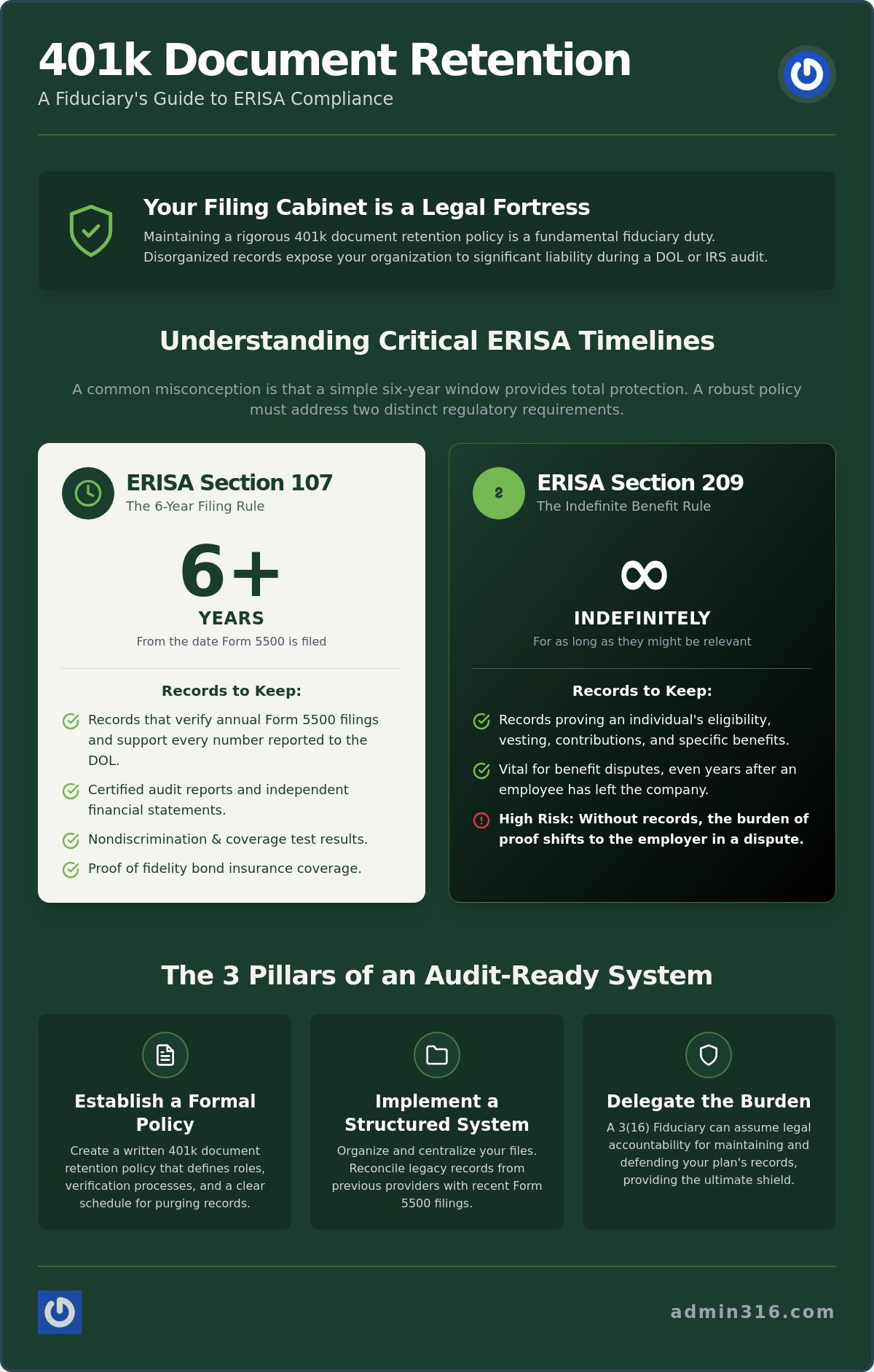
- Distinguish between ERISA Section 107’s six-year storage mandate and Section 209’s indefinite requirements for participant benefit records.
- Establish a formal 401k document retention policy that serves as a legal shield by defining clear roles for record verification and purging.
- Implement a structured organization system to reconcile legacy storage with recent Form 5500 filings for total audit readiness.
- Learn how a 3(16) Plan Administrator assumes the weight of legal accountability by taking responsibility for the data supporting your plan filings.
Understanding ERISA Document Retention: Section 107 vs. Section 209
Managing a retirement plan involves a series of legal obligations that extend far beyond the close of a plan year. The Employee Retirement Income Security Act of 1974 (ERISA) establishes the framework for how long you must preserve your files. Many plan sponsors operate under the assumption that a simple six-year window provides total protection. This is a common, and potentially costly, misconception. A robust 401k document retention policy must address two very different regulatory requirements to truly shield the organization from liability.
When you act as your own administrator, you carry the full legal weight of these archives. Every missing signature or lost testing result represents a gap in your fiduciary defense. We provide a layer of protection by assuming these duties, ensuring your records are organized and defensible. Understanding the distinction between plan-level and participant-level records is the first step in lifting that administrative burden.
ERISA Section 107: The 6-Year Filing Rule
This specific section governs the documents used to verify your annual filings. The rule dictates that records must be held for at least six years from the date the Form 5500 is filed. It’s vital to remember that the clock doesn’t start on the last day of the plan year. If you file an extension, your retention period extends accordingly. You must preserve the evidence that supports every number reported to the Department of Labor.
- Audit Reports: Certified financial statements and independent audit results.
- Compliance Testing: Nondiscrimination and coverage test results that prove the plan doesn’t favor highly compensated employees.
- Fidelity Bonds: Evidence of required insurance coverage for those handling plan assets.
Corporate tax returns are also relevant to your 401k document retention policy. The IRS often cross-references corporate deductions for plan contributions against the plan’s own records. If these figures don’t align during a corporate audit, the lack of supporting 401k documentation can trigger a much deeper investigation into your retirement plan’s compliance.
ERISA Section 209: The Indefinite Benefit Rule
Compliance with Section 209 is significantly more demanding. It requires you to keep records that determine an individual’s eligibility, vesting, and specific benefits for as long as they might be relevant. In practice, this often means keeping records indefinitely. If a participant claims a benefit 30 years after they left the company, you must have the data to prove exactly what they’re owed. Maintaining an indefinite 401k document retention policy for participant data is the only way to ensure audit-readiness in the face of a benefit dispute.
The risk of “missing participants” makes this rule a heavy responsibility. If you can’t produce the record during a dispute, the Department of Labor typically sides with the participant. The burden of proof shifts entirely to the employer. You must be able to prove when an employee started, when they became eligible, and exactly how much they contributed. Without these records, you’re essentially defenseless against claims of unpaid benefits or incorrect vesting schedules.
Taking on the role of a specialized guardian for your plan data is what we do. We mitigate the risk of lost records by assuming the legal accountability for the data supporting your plan. We oversee the retention process so that your records remain a source of stability rather than a source of professional anxiety.
Not sure where your plan’s fiduciary liability actually sits?
Admin316 serves as your named 3(16) plan administrator and takes the filing, notice and compliance work off your desk — along with the liability that comes with it. A 15-minute call is usually enough to tell you where you stand.
Categorizing Your 401k Records: The 3-File Organization System
A pile of unorganized files is more than just a source of administrative clutter. It is a significant legal liability that can leave your organization vulnerable. To protect your company during a Department of Labor (DOL) audit, you must maintain a “defensible” filing system. This means your records are not just present; they are categorized, accessible, and verified for accuracy. A well-structured 401k document retention policy relies on a centralized approach where every document has a dedicated home. In 2026, relying on decentralized records scattered across various payroll providers and old filing cabinets is a risk you don’t need to take. It creates gaps that auditors are trained to find.
Your role as a plan sponsor is to oversee this categorization, even if you delegate the daily tasks. You must ensure that legacy records from previous recordkeepers or TPAs are integrated into your current system. When you switch providers, the legal duty to produce those old records doesn’t vanish; it stays with your company. We help you carry this weight by organizing these disparate data points into a cohesive, audit-ready structure. We act as a specialized guardian, ensuring that transitions between service providers don’t result in lost data or broken compliance chains.
The Plan Document File
This file acts as the legal constitution of your retirement plan. It must contain the current Adoption Agreement and the Basic Plan Document. However, simply having the latest version isn’t enough. You must preserve a history of all prior versions and amendments to prove compliance during any specific period of the plan’s life. According to ERISA guidelines, you should also include the Summary Plan Description (SPD) and any Summary of Material Modifications (SMM) provided to employees. These documents define the rules we follow to keep your plan in good standing.
The Participant-Level File
This category is the most granular and often the most disorganized. It includes census data, beneficiary designations, and deferral election forms. You also need to track specialized documentation for loans, hardships, and Qualified Domestic Relations Orders (QDROs). Since these records often determine benefit payouts, they fall under the indefinite retention requirements we discussed previously. Keeping clean copies of 1099-R forms and distribution records is essential to prove that every dollar was handled correctly. Disorganized participant files are the primary cause of friction during benefit disputes.
The Annual Compliance File
The annual file is your proof of operational health. It should house the Form 5500 along with all required schedules and independent auditor reports. You must also include nondiscrimination testing results, such as ADP/ACP and Top-Heavy tests, which demonstrate the plan’s fairness. Trust reports and brokerage statements provide the financial trail, while evidence of your ERISA Fidelity Bond proves you’ve met insurance mandates. If this list feels overwhelming, you can outsource these administrative burdens to a partner that specializes in carrying the heavy lifting of fiduciary compliance.
How to Build a Formal 401k Document Retention Policy
Establishing a formal 401k document retention policy is the difference between having records and having a defensible fiduciary process. While many sponsors understand which documents to keep, they often fail to document the specific procedures for managing them. A written policy acts as a shield during a Department of Labor audit by proving that your organization follows a consistent, prudent routine. It transforms record-keeping from a reactive chore into a controlled professional standard, providing the long-term stability your plan requires.
To build this framework, you must define clear roles within your team. When responsibility is shared vaguely among HR, payroll, and your TPA, critical files inevitably slip through the cracks. Your policy should specify who is responsible for uploading new files, who verifies their accuracy against IRS record-keeping requirements, and who has the authority to purge data once retention periods expire. We assume these administrative weights for our partners, acting as the primary coordinator to ensure no gap exists in your defense.
Electronic Record-Keeping Standards
The Department of Labor allows for digital storage, but it sets a high bar for compliance. Records must be legible, organized, and protected by a system that prevents unauthorized alterations. You need a verified backup system and a disaster recovery plan to ensure data isn’t lost to technical failure. Your policy should also guarantee that these electronic records can be converted to hard copies immediately if a regulator or participant requests them. This structure removes professional anxiety by ensuring that your digital archives are just as valid as a physical paper trail.
The Purge Protocol: When is it Safe to Destroy?
The fear of shredding the wrong document often leads to unnecessary administrative clutter. A structured purge protocol mitigates this risk by using a “Benefits Paid plus Statute of Limitations” calculation. For participant-level files, the clock typically starts only after the final benefit has been distributed and the potential for a claim has passed. You should never destroy records if your plan is currently under investigation or audit. When it’s finally time to dispose of files, use secure methods that protect sensitive participant information from identity theft, ensuring that the “heavy lifting” of data management concludes with total security.
 The Ultimate 401k Document Retention Policy Checklist for 2026” loading=”eager” decoding=”async” data-no-lazy=”1″ data-skip-lazy=”1″ srcset=”https://admin316.com/wp-content/uploads/2026/07/getautoseocom_1783705730_cplGyROm.jpg 1200w, https://admin316.com/wp-content/uploads/2026/07/getautoseocom_1783705730_cplGyROm-191×300.jpg 191w, https://admin316.com/wp-content/uploads/2026/07/getautoseocom_1783705730_cplGyROm-653×1024.jpg 653w, https://admin316.com/wp-content/uploads/2026/07/getautoseocom_1783705730_cplGyROm-768×1205.jpg 768w, https://admin316.com/wp-content/uploads/2026/07/getautoseocom_1783705730_cplGyROm-979×1536.jpg 979w” sizes=”(max-width: 1200px) 100vw, 1200px” />
The 401k Compliance Checklist for Plan Sponsors in 2026
Executing a 401k document retention policy requires a transition from theory to methodical action. In 2026, the complexity of retirement plan oversight has increased with new mandates, making a standardized checklist your most effective defense. By following these steps, you can transform a disorganized collection of files into a structured asset that demonstrates total compliance. We coordinate these moving parts so that you can maintain a sense of relief, knowing your fiduciary obligations are fully met.
- Step 1: Inventory Storage Locations. Identify every physical and digital site where plan records reside. This includes legacy servers, off-site storage facilities, and the portals of previous service providers.
- Step 2: Reconcile Against Form 5500. Review your records for the last six years and ensure you have the supporting data for every number reported on your Form 5500 filings. This is the primary trail an auditor will follow.
- Step 3: Resolve Data Gaps. Focus specifically on missing beneficiary designations and eligibility records. For 2026, ensure you have documentation proving compliance with the new annual paper benefit statement requirements for participants who haven’t opted into electronic delivery.
- Step 4: Verify the ERISA Fidelity Bond. Confirm that your bond amount is sufficient for the current year and that the policy is active. This is a common oversight that triggers immediate red flags during an investigation.
- Step 5: Document the Review Process. Keep a log of when you reviewed your files and what actions you took. This “procedural prudence” proves to the Department of Labor that you are actively managing your plan with care.
Audit-Ready Verification
True audit readiness is measured by your ability to produce a complete participant history within 48 hours. If a regulator requests a specific file, a delay suggests a lack of oversight. You must verify that all plan amendments are signed and dated by an authorized officer; an unsigned amendment is often treated as if it doesn’t exist. Additionally, you need proof that all required participant notices were distributed on time, including the evidence of mailing or electronic delivery confirmations.
Managing Service Provider Records
A dangerous misconception is the belief that your TPA or recordkeeper is handling all your retention needs. You must review your service contracts to see who is actually responsible for retaining specific data sets. The risk of lost data is highest during a “service provider handoff.” When you move to a new provider, the legacy data often remains in a dormant account that you may lose access to over time. We act as a shield during these transitions, ensuring that your historical data remains preserved and accessible. To understand how to transfer these high-stakes duties, you can explore our strategies for an ERISA 3(16) Plan Administrator: Lifting Compliance Burdens. If the weight of this checklist feels like a distraction from your core business, you can delegate these responsibilities to our specialized team today.
Delegating the Burden: Why a 3(16) Fiduciary is Your Ultimate Shield
Understanding the requirements of a 401k document retention policy is a necessary first step, but the true challenge lies in the ongoing execution of those rules. Most guides focus on what you should keep, yet they often ignore the most critical question: who is legally responsible for those records when an auditor knocks? For many business owners, this weight remains a constant source of professional anxiety. While a Third-Party Administrator (TPA) provides the tools and reports to manage your plan, they don’t typically carry the legal accountability for the data. You are still the one standing between your company and regulatory entities.
This is where the role of an ERISA Section 3(16) Plan Administrator becomes your organization’s ultimate shield. We don’t just offer advice; we assume the legal and administrative responsibility for your plan’s daily operations. When we act as your specialized guardian, we take the heavy lifting of record-keeping off your desk. Perhaps the most significant relief comes when we sign your Form 5500. By signing this document, we become responsible for the data supporting it, effectively transferring the administrative liability away from your internal team.
Lifting the Administrative Weight
Managing a 401k document retention policy involves constant vigilance over eligibility tracking and the timely distribution of participant notices. We oversee these granular details so that your HR team can refocus on growth and culture rather than compliance paperwork. This “burden-lifting” effect doesn’t require you to dismantle your current professional circle. We work alongside your existing investment advisors and payroll providers, adding a layer of protection without replacing the relationships you’ve built. We coordinate the data flow between all parties to ensure no record is ever misplaced during a service provider transition.
The Admin316 Advantage
Since 1997, we’ve specialized in assuming administrative responsibilities for employers across the country. Our role as an ERISA Section 3(16) Plan Administrator and 402(a) Named Fiduciary allows us to mitigate your risk through methodical oversight. We ensure your files are always audit-ready by maintaining a rigorous, defensible filing system that meets both Section 107 and Section 209 standards. Our commitment is to provide quiet, professional advocacy that handles the complexities of ERISA behind the scenes. By transferring your administrative duties to a seasoned expert, you replace uncertainty with the stability of institutional permanence.
Securing Your Plan’s Future through Proactive Compliance
A rigorous 401k document retention policy is more than a storage protocol; it’s the foundation of your fiduciary defense. By distinguishing between the six-year filing rules and the indefinite requirements for participant benefit data, you establish a clear path toward audit-readiness. A formal, written procedure removes professional anxiety and provides the long-term stability your organization needs to weather regulatory scrutiny or potential benefit disputes.
The administrative weight of these duties is significant, but it doesn’t have to rest on your shoulders. Since 1997, Admin316 has acted as a specialized guardian for US-based organizations, providing national coverage as independent 3(16) Plan Administrator specialists. We coordinate the heavy lifting of compliance so that your team can refocus on growth and core operations without the fear of a missing file causing a legal setback.
Let Admin316 assume the burden of your 401k administration and record-keeping. We provide a layer of protection that shields your company from liability while preserving your existing advisor partnerships. You can move forward with peace of mind, knowing your records are meticulous and your fiduciary risks are mitigated.
Frequently Asked Questions
How long must 401k records be kept under ERISA?
Records that support plan filings must be kept for at least six years from the date the Form 5500 is filed. However, documents required to determine a participant’s benefits must often be held indefinitely. A comprehensive 401k document retention policy must account for both of these distinct timelines to ensure total compliance and protection.
Do I need to keep paper copies of 401k documents?
You don’t need to keep original paper copies if your electronic records meet specific Department of Labor standards. Digital files must be legible, organized, and protected against unauthorized alterations or tampering. You must also have the capability to reproduce them in hard copy format if a regulator or participant requests them during an audit or dispute.
What happens if I lose my 401k plan records?
Losing records creates a significant legal vulnerability because the burden of proof shifts entirely to the employer during participant disputes. If you cannot produce documentation to support a benefit calculation, the Department of Labor or the courts will generally side with the participant. This can lead to costly settlements and mandatory corrective payments from your corporate assets.
Is a TPA responsible for my 401k document retention?
Most Third-Party Administrators (TPAs) provide record-keeping tools but don’t assume the legal responsibility for document retention. Unless you have formally delegated these duties to a 3(16) fiduciary, the legal weight of maintaining a compliant 401k document retention policy remains with the employer. We act as a shield by assuming this specific administrative accountability on your behalf.
Which records must be kept indefinitely for a 401k plan?
Records necessary to determine an individual’s eligibility, vesting status, and specific benefit amount must be kept for as long as the plan exists. This includes employee census data, deferral election forms, and distribution history. These documents are vital for proving that a participant received exactly what they were owed, even if the claim arises decades after they left the company.
Can I destroy 401k records after a plan merger or termination?
Plan termination or merger doesn’t end your record-keeping obligations. You must continue to maintain all records for the required ERISA periods, including the six-year window for final filings and the indefinite window for benefit determinations. This ensures you are protected if a participant from a defunct or merged plan makes a claim in the future.
What is the penalty for not maintaining 401k records?
Penalties for failing to maintain records can include Department of Labor fines and the potential disqualification of the plan’s tax-exempt status by the IRS. Beyond direct fines, you face increased fiduciary liability for any operational errors that cannot be verified or corrected due to missing data. These financial risks often far exceed the cost of professional administration.
How does a 3(16) fiduciary help with document retention?
A 3(16) fiduciary assumes the legal accountability for plan administration, including the meticulous oversight of your records. We coordinate the collection and preservation of all necessary files and sign the Form 5500 as the Plan Administrator. This process transfers the administrative burden and the associated legal risks away from your internal staff, providing long-term stability for your business.
Transfer this responsibility to a professional fiduciary.
Every item in this article is work Admin316 does for plan sponsors every day as an ERISA 3(16) administrator. Bring us your plan documents and we’ll show you exactly which risks move off your shoulders.