Most small business owners mistakenly believe their recordkeeper or payroll provider is the one legally responsible for plan errors. In reality, the weight of fiduciary liability often rests squarely on your shoulders. Managing 401k administration for small business in 2026 has become even more complex with new mandates like the Roth catch-up requirements for high earners and the July 31st Form 5500 filing deadline. It’s a heavy burden to carry while you’re trying to grow a company. You shouldn’t have to choose between scaling your operations and staying out of the Department of Labor’s crosshairs.
We recognize the frustration of losing hours to eligibility tracking and the persistent fear of a regulatory audit. This article explains how to navigate these shifting regulations while shielding your staff from administrative burnout. You’ll learn how to transfer the legal weight of your plan’s oversight to a professional who assumes the role of named fiduciary. By the end of this guide, you’ll understand how to preserve your existing professional relationships while adding a layer of protection that ensures documented compliance and a significantly reduced workload.
Key Takeaways
- Understand why 401k administration is the operational engine of your plan and how it must function to maintain strict ERISA compliance.
- Identify the critical gaps in your coverage by distinguishing between the roles of recordkeeping software and a professional 3(16) Plan Administrator.
- Mitigate the personal legal liability inherent in 401k administration for small business by transferring the burden of Form 5500 filings and eligibility tracking to a specialized guardian.
- Learn how to evaluate providers based on their willingness to assume the role of a Named Fiduciary and act as a shield between your company and regulatory entities.
- Discover how to fortify your internal team with professional fiduciary support that handles the heavy lifting without displacing your existing advisor or recordkeeper.
What is 401k Administration for Small Business?
While a 401(k) plan is often viewed through the lens of tax-advantaged savings and recruitment, the underlying mechanics are purely operational. 401k administration for small business is the mandatory engine that ensures your company’s retirement plan remains compliant with federal law. It isn’t a financial perk or an investment strategy; it’s a rigid legal obligation that demands meticulous attention to detail. This administrative framework manages the flow of data between your payroll, your employees, and the federal government.
For many entrepreneurs, this responsibility is a heavy object they didn’t realize they were carrying until it became too late to put down. By default, the Department of Labor (DOL) and the IRS view the employer as the primary steward of the plan’s integrity. This means you aren’t just the sponsor; you’re the one legally accountable for every data point and deadline. We believe that professional oversight should act as a shield, protecting your business from the friction of regulatory complexity.
The Core Duties of a Plan Administrator
Administration involves a constant cycle of data management and regulatory reporting. It’s the process of translating complex ERISA statutes into daily actions. These duties include:
- Eligibility tracking: You must determine precisely when each employee qualifies to join the plan based on their age and tenure. This requires constant monitoring of census data to avoid excluding eligible participants.
- Participant notices: Federal law requires the distribution of specific legal disclosures on a strict, non-negotiable schedule. Missing a single mailing can trigger compliance failures.
- Government filings: You’re responsible for the accuracy of the annual Form 5500. For calendar year plans, the 2026 filing deadline is July 31st. We oversee these filings so that you can maintain a clean record with the DOL.
Why Small Businesses Struggle with Administration
Most small firms lack a dedicated compliance department, leaving the owner to act as their own compliance officer. This creates a “silent” liability where errors, like late payroll deferrals, accumulate unnoticed until a DOL audit reveals the damage. The drain on productivity is significant. Every hour your staff spends cross-referencing eligibility dates is an hour taken away from revenue-generating activities. We assume the weight of these technical tasks so that your internal team can focus on their core competencies without the shadow of professional anxiety.
Not sure where your plan’s fiduciary liability actually sits?
Admin316 serves as your named 3(16) plan administrator and takes the filing, notice and compliance work off your desk — along with the liability that comes with it. A 15-minute call is usually enough to tell you where you stand.
The Three Pillars of 401k Management: Recordkeepers, TPAs, and 3(16) Fiduciaries
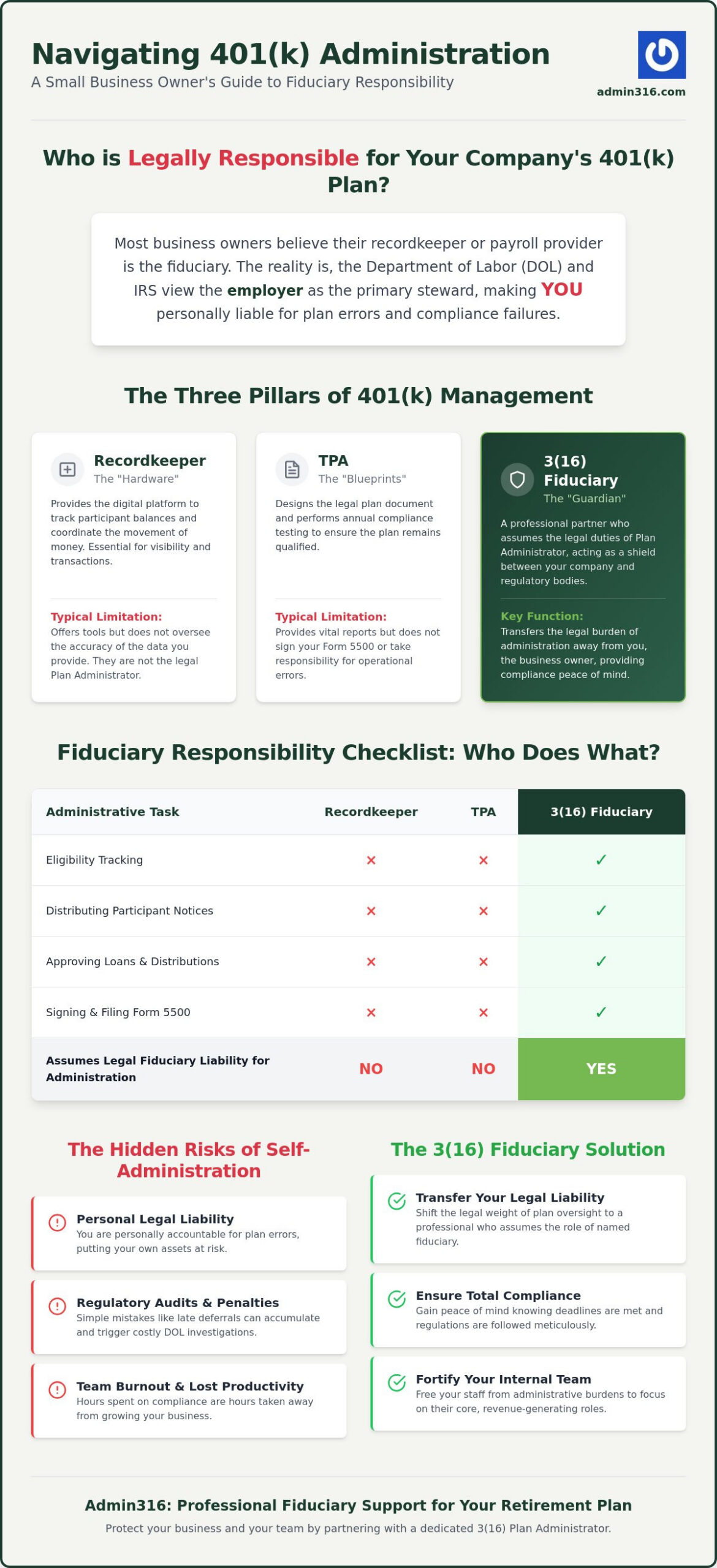
Many small business owners operate under the dangerous assumption that their retirement plan provider handles every legal requirement. They see a sleek software interface and assume compliance is automated. However, effective 401k administration for small business requires a clear division of labor. Without understanding the specific roles of your service providers, you may be unknowingly carrying the full weight of legal liability. Identifying the gaps in your current coverage is the only way to ensure your business is truly protected.
Recordkeepers vs. Third-Party Administrators (TPAs)
Think of your recordkeeper as the “hardware” of your plan. They provide the digital platform, track individual participant balances, and coordinate the movement of money. They’re essential for visibility, but their scope is limited to the data on the screen. Most recordkeepers offer excellent tools, but they don’t oversee the accuracy of the information you feed into their systems.
TPAs, on the other hand, provide the “blueprints.” They design the legal plan document and perform annual compliance testing to ensure the plan doesn’t unfairly favor highly compensated employees. While these roles are vital, neither the recordkeeper nor the TPA typically assumes the legal title of “Plan Administrator” under ERISA. They provide tools and reports, but they don’t sign your Form 5500 or take responsibility for errors in participant data. The legal burden of meeting your fiduciary responsibilities remains squarely on your shoulders.
The ERISA 3(16) Fiduciary: The Missing Layer of Protection
The ERISA 3(16) Plan Administrator is the professional partner that steps into the gap. Unlike a software-only approach, a 3(16) fiduciary assumes the actual legal duties mandated by the plan document. We act as a Specialized Guardian, overseeing the daily operations and coordinating between your payroll and your recordkeeper. We don’t just provide a platform; we provide a shield.
By assuming this role, we mitigate the day-to-day administrative liability that often leads to burnout for internal HR staff. We don’t just point out what needs to be done; we execute the tasks and take legal accountability for the results. This specialized support functions alongside existing 401k advisors and recordkeepers rather than replacing them. It’s a non-disruptive layer of protection that allows you to preserve your current professional bonds while transferring the administrative weight to our team. If you’re ready to stop managing paperwork and start mitigating fiduciary risk, adding this layer of fiduciary oversight is the most effective path to peace of mind.
The Hidden Risks of Self-Administering Your Small Business 401k
Choosing a retirement plan is only the first step. The real danger lies in the ongoing execution of the plan’s requirements. Under ERISA, plan sponsors are held personally liable for plan mismanagement. This means your personal assets could be at risk if the plan is found to be out of compliance. Fiduciary liability is a physical weight that remains firmly on the owner’s shoulders until it’s legally transferred to a professional administrator. We assume this burden so that you don’t have to carry the risk of regulatory failure alone. Our role is to provide a source of relief for overwhelmed business owners who find themselves buried under technical duties.
The Department of Labor has increased its focus on auditing small business plans. They’re looking for specific operational failures that often occur when 401k administration for small business is handled internally by overextended staff. We act as a shield between your company and these regulatory entities, ensuring that every detail is overseen with meticulous care. By layering our protection over your existing operations, we preserve your peace of mind while mitigating the gravity of legal exposure. This doesn’t mean replacing your current team; it means fortifying them with a seasoned expert who takes full legal accountability.
Top Compliance Mistakes for Small Businesses
Errors often stem from a lack of specialized knowledge rather than intentional neglect. One of the most common failures is the incorrect tracking of employee eligibility. When an employee is eligible but not invited to join, they become an “omitted participant.” Correcting this error often requires the employer to make expensive “missed opportunity” contributions. Additionally, many businesses fail to distribute Summary Plan Descriptions on the required schedule. Even minor inaccuracies on Form 5500 filings can act as red flags. For calendar year plans, the July 31, 2026, filing deadline is a critical milestone that requires precise data to avoid inviting unwanted scrutiny from the DOL. We coordinate these details to ensure your plan remains invisible to auditors for all the right reasons.
The Cost of Non-Compliance
The financial consequences of administrative errors are immediate and severe. The DOL can impose daily fines for late or incomplete filings, and these penalties accumulate quickly. For example, failing to file a Form 5500 can result in penalties that far exceed the cost of professional administration. Beyond government sanctions, there is the rising threat of participant lawsuits. Employees are more aware of their rights than ever, and errors in deferral timing or fee disclosures can lead to costly litigation. Perhaps the greatest cost is the emotional toll of professional anxiety. Constant worry about a potential audit drains the energy you need to lead your company. We provide the stability required to remove this anxiety, allowing you to focus on growth while we handle the heavy lifting of compliance.
How to Evaluate 401k Administration Providers
Evaluating 401k administration for small business requires looking past the dashboard. While a sleek software interface is helpful for data entry, it does nothing to mitigate your legal risk. When reviewing potential partners, you must scrutinize the legal contract rather than the marketing materials. Many providers offer “automated compliance,” yet their fine print explicitly leaves the role of Plan Administrator in your hands. You need a partner willing to assume the role of a Named Fiduciary, effectively lifting the weight of legal accountability from your shoulders.
The goal shouldn’t just be cost-cutting; it should be burden-lifting. A low-cost provider often achieves their price point by leaving the “heavy lifting” to your internal staff. This results in a hidden cost of lost productivity and increased professional anxiety. Instead, look for a framework that prioritizes the transfer of liability. A true partner acts as a Specialized Guardian, coordinating the complex interactions between payroll and the recordkeeper so that you don’t have to. If you are ready to secure your plan’s future, you can assume the role of ERISA Section 3(16) Plan Administrator through our specialized services.
Key Questions to Ask Your Current Provider
Transparency is the foundation of a secure partnership. You shouldn’t settle for vague promises of support. Ask these direct questions to determine if your current provider is actually shielding your business:
- “Do you sign my Form 5500 as the Plan Administrator?” If they don’t, you are still the one legally responsible for the accuracy of that filing.
- “Do you assume legal liability for participant notice distribution?” Tracking these deadlines is a meticulous task that should be handled by a professional, not your HR manager.
- “Will you defend the plan in the event of a DOL audit?” A provider that disappears when the Department of Labor arrives isn’t a partner; they’re just a software vendor.
Assessing the “Non-Displacement” Factor
You shouldn’t have to fire your trusted investment advisor to get better administration. Many large recordkeepers try to bundle their services, forcing you to use their proprietary tools and advisors. We believe in a non-displacement philosophy. A specialized 3(16) fiduciary should fortify your current team, not replace it. We work alongside your existing financial advisor and recordkeeper, providing an independent layer of protection without disrupting established professional bonds.
This unbiased oversight is invaluable. Because an independent fiduciary doesn’t sell investment products or recordkeeping software, their only focus is your plan’s compliance and stability. They provide the quiet, methodical expertise needed to manage the background operations while your advisor focuses on investment performance. This collaborative approach ensures that every aspect of your plan is handled by an expert in that specific field.
Admin316: Professional Fiduciary Support for Your Retirement Plan
Managing 401k administration for small business shouldn’t be a source of professional anxiety or a drain on your company’s productivity. Since 1997, Admin316 has served as a specialized guardian for employers across the nation, providing the methodical expertise required to manage complex retirement plans. We recognize that the regulatory environment of 2026 demands a level of precision that internal HR teams often can’t provide. By assuming the legal responsibility for your plan, we allow you to hand off the heavy lifting of compliance. We act as a shield between your company and the Department of Labor, ensuring that the weight of fiduciary duty never rests solely on your shoulders.
Our approach follows a clear “Problem-Solution-Peace” logic. The problem is the overwhelming liability and administrative burnout associated with ERISA compliance. The solution is our comprehensive fiduciary oversight. The result is total peace of mind, knowing that your legal obligations are being met by a partner who takes full accountability. We coordinate the intricate details of your plan so that you can focus on scaling your business without the shadow of a potential audit looming over your operations.
This peace of mind allows you to focus on your family as much as your business.
Independent 3(16) Fiduciary Services
We don’t just offer a software platform; we provide a source of relief. Our team assumes the role of ERISA Section 3(16) Plan Administrator and 402(a) Named Fiduciary. This means we take legal accountability for the operational integrity of your plan. Our services include:
- Automated eligibility tracking: We monitor your census data to ensure every eligible employee is enrolled on time, preventing costly “omitted participant” errors.
- Participant notice management: We oversee the distribution of all required legal disclosures, ensuring they reach your staff on a strict regulatory schedule.
- Form 5500 oversight: We don’t just prepare the paperwork; we sign it. We assume the responsibility for the accuracy of your annual filings, including meeting the critical July 31, 2026, deadline for calendar year plans.
The Benefit of an Independent Fiduciary Partner
Unlike some large recordkeepers who may demand you switch your entire financial ecosystem to their platform, we prioritize a non-displacement narrative. We work alongside your current team to fortify plan governance. You don’t have to change your recordkeeper or fire your trusted investment advisor to gain professional protection. We preserve your existing professional bonds while adding a layer of safety that didn’t exist before. This independent oversight ensures that your plan is governed without bias, focusing solely on compliance and stability. You can get started by benchmarking your 401k today to identify where your current plan may be exposed to unnecessary risk.
Secure Your Plan’s Future with Professional Oversight
Navigating the complexities of ERISA compliance shouldn’t be a source of professional anxiety for you or your staff. You’ve seen how the weight of fiduciary responsibility is a physical burden that remains on the employer until it is legally transferred to a professional. By distinguishing between recordkeeping software and true legal accountability, you can finally identify the gaps in your compliance coverage. A professional 3(16) administrator doesn’t just offer tools; they sign the filings and assume the legal risk on your behalf.
Since 1997, Admin316 has acted as a specialized guardian for businesses nationwide. We provide independent oversight and Named Fiduciary protection without requiring you to replace your existing investment advisor or recordkeeper. We oversee the heavy lifting of 401k administration for small business so that you can focus on your company’s growth. It’s time to preserve your peace of mind and fortify your plan governance with a partner who takes full legal accountability. We do the work so that you can enjoy the relief of a documented, verifiable compliance record.
Lift the burden of 401k administration-Contact Admin316 today. We’re here to provide the stability and support your business deserves.
Frequently Asked Questions
What is the difference between a 401k recordkeeper and a 3(16) administrator?
A recordkeeper provides the digital platform and tracks participant balances, acting as the system of record for the plan’s assets. In contrast, a 3(16) administrator assumes the legal responsibility for the plan’s daily operations. While the recordkeeper manages the digital “hardware” of the money, the 3(16) fiduciary handles the execution of legal duties like eligibility tracking and notice distribution.
Who is legally responsible for signing the Form 5500 for a small business?
The legal Plan Administrator is responsible for signing and submitting Form 5500 to the Department of Labor. By default, this role falls to the business owner or a designated internal employee. When you hire a professional 3(16) fiduciary, they assume this title and sign the filing on your behalf, taking full legal accountability for the document’s accuracy and timely submission.
Can I outsource my fiduciary liability as a small business owner?
Yes, you can transfer specific administrative and legal liabilities to a professional fiduciary partner. By appointing an ERISA Section 3(16) Plan Administrator and a 402(a) Named Fiduciary, you shift the legal weight of plan management to an expert. This creates a shield between your company and regulatory entities, ensuring that the burden of compliance doesn’t rest solely on your shoulders.
Does a 3(16) fiduciary replace my current financial advisor?
No, a professional 3(16) fiduciary is designed to work alongside your existing financial advisor and recordkeeper. This non-displacement model ensures that your investment strategy and current professional relationships remain intact. The fiduciary adds a layer of protection for the plan’s administration, fortifying your current team rather than replacing the advisors you already trust.
What happens if my small business 401k is out of compliance?
Non-compliance can lead to severe financial penalties and significant legal exposure. The Department of Labor may impose daily fines for late filings, and employees could file lawsuits over plan mismanagement or lost investment earnings. You might also be required to make expensive corrective contributions to rectify common errors like missed eligibility or late payroll deferrals.
How much does professional 401k administration typically cost?
Industry data indicates that annual costs for 401k administration for small business can range from $5,000 to $10,000 for plans with under $1 million in assets. These fees often include setup costs between $500 and $3,000, along with ongoing per-participant charges. Investing in professional oversight is often more cost-effective than paying a single regulatory penalty for an administrative error.
Is fiduciary liability insurance the same as hiring a 3(16) administrator?
No, fiduciary insurance and 3(16) administration serve entirely different purposes. Insurance is a reactive tool that provides financial reimbursement after a loss or lawsuit occurs. Hiring a 3(16) administrator is a proactive strategy where the professional assumes the legal duty itself. They work to prevent errors and mitigate risk before problems arise, rather than just paying for them later.
What are the most common 401k compliance mistakes for small businesses?
The most frequent errors include failing to track employee eligibility correctly and depositing payroll deferrals late. Missing deadlines for mandatory participant notices and submitting inaccurate data on Form 5500 are also high on the list. These operational failures often trigger Department of Labor audits and require formal, often expensive, correction programs to resolve with the IRS.
Transfer this responsibility to a professional fiduciary.
Every item in this article is work Admin316 does for plan sponsors every day as an ERISA 3(16) administrator. Bring us your plan documents and we’ll show you exactly which risks move off your shoulders.