Would you intentionally ask your most dedicated managers to put their personal savings on the line for a corporate administrative task? For many companies, appointing employees as retirement plan fiduciaries does exactly that, often without anyone realizing the gravity of the legal weight being transferred. You likely chose these individuals because you trust them. However, that trust can inadvertently expose them to Department of Labor audits and personal financial liability for even minor administrative mistakes. It’s a heavy burden for any staff member to carry alongside their daily professional responsibilities.
We recognize that you want to maintain your internal culture while ensuring your plan remains compliant and secure. You shouldn’t have to choose between employee protection and regulatory excellence. This guide will help you clearly identify which staff members are actually functioning as fiduciaries and the specific risks they face under ERISA. We’ll outline a strategy to shield your team from personal liability and explain how to determine when it’s time to hand off these complex administrative duties to a specialized partner. By the end, you’ll have a clear path to lifting the weight of compliance from your team’s shoulders so they can focus on what they do best.
Key Takeaways
- Identify the “compliance gap” where standard job titles fail to shield staff members from being legally classified as functional fiduciaries under ERISA.
- Understand the “Prudent Expert” standard and why regulatory entities expect professional-grade oversight from your internal team regardless of their primary job duties.
- Recognize the specific personal financial liabilities faced by employees as retirement plan fiduciaries that are often left uncovered by standard corporate insurance policies.
- Evaluate a strategy to transfer the legal weight of plan administration to a Section 3(16) partner while preserving your existing investment advisor relationships.
- Learn how to mitigate the risk of unintentional compliance failures by effectively separating corporate interests from retirement plan obligations.
Identifying Your Internal Fiduciaries: Roles vs. Functions
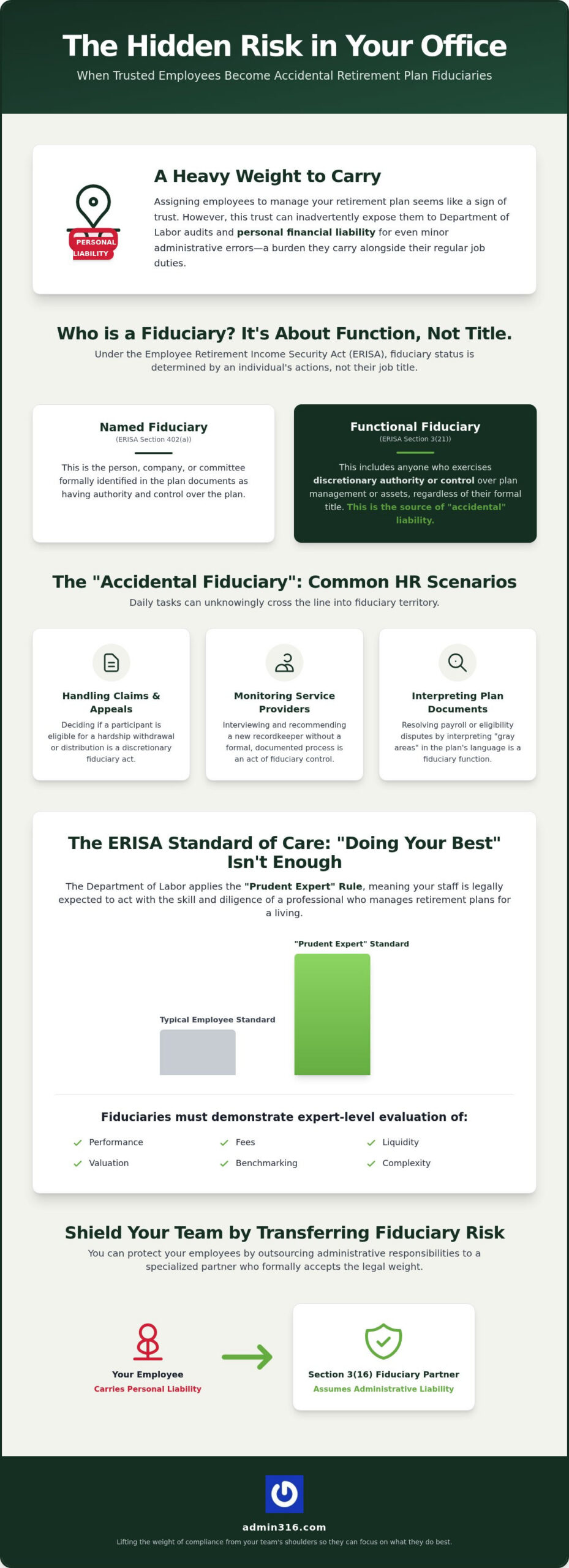
Many business owners believe that fiduciary status is a formal title reserved for corporate officers or those specifically named in a plan document. In reality, the law applies a functional test that looks at what an individual actually does rather than what their business card says. Under the Employee Retirement Income Security Act of 1974 (ERISA), fiduciary status is often a matter of conduct. If an employee exercises discretionary authority or control over plan management or the disposition of plan assets, they’re legally a fiduciary. This means that employees as retirement plan fiduciaries may be carrying a heavy legal load without ever signing a formal appointment letter.
Your plan document identifies a “Named Fiduciary” under Section 402(a), which is typically the company itself or a specific committee. However, Section 3(21) creates a broader category known as functional fiduciaries. These are the people who handle the day-to-day discretionary decisions that keep the plan running. While ministerial tasks like data entry or preparing reports don’t trigger this status, the moment a staff member uses their own judgment to resolve a plan issue, they’ve crossed the line into fiduciary territory. We identify these roles early so you can shield your staff from the personal liability that follows these actions.
The Accidental Fiduciary: Common HR Scenarios
Human Resources professionals are the most likely candidates to become accidental fiduciaries. Their daily helpfulness often masks the legal weight of their decisions. Common scenarios where an employee’s actions trigger fiduciary responsibility include:
- Handling participant claims and appeals: Deciding whether a participant is eligible for a hardship withdrawal or a distribution is a discretionary act.
- Selecting or monitoring service providers: If an HR manager interviews and recommends a new recordkeeper without a documented, formal process, they’re exercising fiduciary control.
- Interpreting plan documents: Resolving payroll or eligibility disputes by interpreting “gray areas” in the plan’s language constitutes a fiduciary function.
Business Decisions vs. Fiduciary Acts
It’s vital to distinguish between “settlor” functions and fiduciary acts. Settlor functions are pure business decisions, such as the initial choice to establish a plan, changing the plan’s design, or deciding to terminate it. These aren’t fiduciary acts because they relate to the business’s interests rather than the participants’ interests. However, the moment you begin to implement those decisions, such as choosing which assets to transfer or how to communicate changes to staff, the act becomes fiduciary in nature. Under 2026 regulatory standards, a functional fiduciary is any individual who exercises discretionary control over plan assets or administration, regardless of whether their formal job description includes these responsibilities. We assume the weight of these implementation tasks so that your employees as retirement plan fiduciaries don’t have to navigate these legal complexities alone.
Not sure where your plan’s fiduciary liability actually sits?
Admin316 serves as your named 3(16) plan administrator and takes the filing, notice and compliance work off your desk — along with the liability that comes with it. A 15-minute call is usually enough to tell you where you stand.
The ERISA Standard of Care: Why “Doing Your Best” Isn’t Enough
The law doesn’t weigh a fiduciary’s intentions; it weighs their actions against a professional benchmark. When employees as retirement plan fiduciaries manage a company’s 401(k), they aren’t judged by the standard of a typical office worker. Instead, the Department of Labor applies the “Prudent Expert” rule. This means the government expects your staff to act with the care, skill, and diligence of a professional who manages retirement plans for a living. If a compliance mistake happens, “I did my best” is not a valid legal defense in the eyes of federal regulators.
As of 2026, regulatory focus has intensified regarding the duty of prudence. A proposed regulation from March 31, 2026, introduces a six-factor safe harbor that prioritizes a documented, reasoned decision-making process. Fiduciaries must now show they evaluated performance, fees, liquidity, valuation, benchmarking, and complexity with expert-level precision. This level of Fiduciary Responsibilities creates a massive administrative burden for individuals who already have full-time roles. We find that many businesses achieve true relief when they outsource these administrative liabilities to a partner that assumes the legal weight of these decisions.
The Duty of Loyalty adds another layer of complexity. It requires fiduciaries to act solely in the interest of plan participants and their beneficiaries. This often creates a conflict when a company’s financial goals clash with plan expenses. For instance, choosing a service provider based on a corporate relationship rather than the best interests of the participants can be viewed as a breach. Procedural prudence is your only shield. It requires a meticulous paper trail for every decision, proving that the process was sound even if the market outcome was unfavorable. Employers who want a structured approach to meeting these standards will find that reviewing a comprehensive ERISA fiduciary duties employer compliance checklist is an essential starting point for 2026.
The Personal Liability Component of ERISA
ERISA Section 409(a) makes fiduciary duty unique in the corporate world. Unlike most business roles where the company’s “corporate veil” protects individuals, fiduciaries can be held personally liable for plan losses. This means an employee’s personal bank account, home, or savings could be at risk. Even worse, fiduciaries can be held responsible for the “co-fiduciary” breaches of their colleagues if they knew of a mistake and failed to act. The Department of Labor has the authority to demand the full restoration of losses and apply significant financial penalties.
Compliance Burdens for Staff Fiduciaries
The technical weight of plan administration is immense. Staff must manage participant notices, ensuring every employee receives the correct disclosures at the exact right time. Missing these deadlines triggers “failure to provide” penalties that accumulate quickly. Then there is the Form 5500. Signing this document is a legal attestation of accuracy. Mistakes in tracking eligibility or failing to find “lost participants” in a mobile workforce can lead to failed audits. We oversee these granular details so your team is never left exposed to these operational risks.
Risks of Using Internal Employees as Retirement Plan Fiduciaries
Relying on internal staff to manage your 401(k) often creates a structural conflict that is difficult to resolve without specialized oversight. While your team is undoubtedly loyal to the company, employees as retirement plan fiduciaries are legally required to put the interests of plan participants above the corporate budget. This “Conflict of Interest” trap is particularly dangerous during fee negotiations. An HR director might feel pressured to select a recordkeeper that offers the lowest cost to the company, even if that provider charges participants higher internal investment fees. Under ERISA, this is a clear breach of the duty of loyalty, yet it remains one of the most common mistakes in internal plan management.
The lack of specialized ERISA knowledge is another significant liability. Most staff members are experts in their primary roles, whether in finance, operations, or human resources, but they aren’t professional plan administrators. Unintentional compliance failures often stem from simply not knowing that a specific regulation has changed. Additionally, the distraction factor cannot be ignored. Every hour a key employee spends researching 401(k) compliance is an hour taken away from your core business goals. We provide a layer of protection that allows your team to focus on growth while we handle the heavy lifting of regulatory adherence.
Employee turnover represents a silent threat to your plan’s stability. When a committee member leaves the company, they often take “institutional knowledge” with them. If fiduciary records aren’t meticulously organized, a new staff member may have no idea why certain investment choices were made or when the last fee benchmarking occurred. This gap in continuity is exactly what Department of Labor auditors look for when assessing plan oversight. Understanding how to transfer fiduciary liability to a professional partner is one of the most effective ways to eliminate this continuity risk entirely.
The Documentation Gap
Internal committees frequently fail to maintain legally defensible meeting minutes. In the event of an audit, “we discussed it in the hallway” does not constitute proof of procedural prudence. A robust Fiduciary Audit File is essential, yet staff rarely have the time to maintain one to the necessary standard. While the ERISA 402(a) named fiduciary holds the ultimate plan authority, the functional fiduciaries on your team are the ones who must produce the paper trail to justify their actions. We coordinate this documentation process to ensure your “shield” is always ready.
Monitoring Service Providers
A common pitfall for internal committees is the “set it and forget it” mentality regarding third-party providers. As industry experts at PLANSPONSOR ask, What Does It Mean to Be a Fiduciary?, it involves an active, ongoing duty to monitor every service provider. With more than 500 excessive-fee lawsuits filed since 2016, and average settlements ranging from $500,000 to $5 million, the risk of failing to benchmark your recordkeeper is too high to ignore. Internal employees often lack the specialized tools to evaluate if fees remain “reasonable” compared to current market rates. We assume this monitoring responsibility, providing the benchmarking data needed to preserve the integrity of your plan.
Mitigating Fiduciary Risk: Insurance vs. Outsourcing
Many business owners mistakenly believe that their corporate insurance policies provide a complete shield for staff members. In reality, there is a significant difference between the mandatory ERISA Fidelity Bond and elective Fiduciary Liability Insurance. The fidelity bond is a legal requirement that protects the plan itself from acts of fraud or dishonesty. It does not protect the individual. Fiduciary liability insurance, while highly recommended, only serves as a financial safety net after a breach has occurred. It pays for legal defense and settlements, but it doesn’t stop a Department of Labor audit, nor does it fix the underlying compliance errors that triggered the investigation in the first place.
To truly protect employees as retirement plan fiduciaries, companies are increasingly moving toward a “Transfer of Responsibility” model. This involves shifting from a 3(21) investment advice structure to a 3(16) administrative partnership. While insurance reacts to failure, outsourcing proactively prevents it. By transferring the legal weight of plan administration to a professional partner, you ensure that the complex “physical objects” of compliance, such as Form 5500 filings and participant disclosures, are handled by experts. Plan sponsors who want to understand the full legal framework behind this approach will benefit from reviewing a detailed guide on transferring fiduciary liability under ERISA Sections 3(16) and 402(a). This transition allows your staff to step back from the line of fire while the plan remains in professional hands.
The Role of ERISA 3(16) Outsourcing
When you appoint a 3(16) administrator, they assume the legal title of “Plan Administrator” as defined by ERISA. This is a critical distinction because it moves the primary legal responsibility for daily operations away from your internal team. ERISA 3(16) plan administrators shield employees from daily liability by taking full accountability for participant communications, government filings, and eligibility tracking. We coordinate these administrative tasks so that your HR and finance teams can refocus on their core business objectives without the constant worry of a regulatory misstep.
Best Practices for Internal Committees
If you choose to maintain an internal committee, a formal “fiduciary check-up” is essential for 2026. With the SECURE 2.0 Act plan amendment deadline of December 31, 2026, approaching, your team must ensure all required changes are documented. Best practices include:
- Establishing a Committee Charter: Clearly define the roles, meeting frequency, and decision-making authority of all members.
- Regular Fiduciary Training: Staff members need annual updates on regulatory shifts, such as the new Roth catch-up contribution mandates.
- Annual Plan Benchmarking: Conduct a formal review of recordkeeper fees and service levels to ensure they remain reasonable for participants.
Maintaining this level of meticulous oversight is a full-time job. If your internal team is struggling to keep up with these evolving standards, we can help. We invite you to explore our fiduciary administration services to see how we can fortify your plan and protect your people.
Securing Your Staff with Professional Fiduciary Administration
The decision to appoint employees as retirement plan fiduciaries is often rooted in a desire for internal control and trust. However, as we have explored, this trust can inadvertently place those same loyal employees in the crosshairs of personal financial liability and complex regulatory scrutiny. Admin316 acts as a “Specialized Guardian” for your retirement plan, stepping in to carry the legal weight that your staff was never meant to bear. We don’t seek to replace your current team or disrupt your established professional relationships. Instead, we fortify your plan by assuming the high-stakes administrative duties that often lead to compliance failures.
One of the most significant benefits of our model is the non-displacement narrative. We work alongside your existing investment advisors and recordkeepers, providing a layer of protection without requiring you to switch providers. We assume the legal responsibility for signing the Form 5500 and overseeing the distribution of participant notices. By lifting these specific “objects” of liability from your staff, we ensure that the plan remains compliant while your employees are shielded from the risks of administrative oversight. This partnership preserves your internal culture while establishing a professional-grade compliance framework.
Furthermore, professional fiduciary administration provides institutional stability that internal committees simply cannot match. When key staff members leave your organization, the institutional knowledge of your retirement plan often goes with them. This creates a dangerous “documentation gap” that can lead to failed audits years later. Because we serve as a permanent anchor for your plan, we ensure that fiduciary records, meeting minutes, and benchmarking data remain intact regardless of internal turnover. We coordinate the heavy lifting behind the scenes so that your plan’s integrity is never dependent on a single individual’s tenure.
A Seamless Layer of Protection
Admin316 integrates directly with your current payroll and recordkeeping systems to ensure a frictionless experience. This integration allows us to oversee eligibility tracking and contribution timing with meticulous precision, removing the manual burden from your HR department. For organizations with more complex needs, such as Cash Balance Plan Administration, we provide the specialized expertise required to navigate those unique regulatory requirements. You gain the peace of mind that comes with professional-grade oversight, while your team regains the time to focus on your core business objectives.
Next Steps for Plan Sponsors
Protecting your staff starts with a clear-eyed assessment of your current liability exposure. We recommend taking the following steps to secure your organization’s future:
- Review Your Plan Document: Identify exactly who is named as a fiduciary and compare that to who is performing functional fiduciary acts in your daily operations.
- Calculate the Compliance Cost: Evaluate the true cost of the internal staff time currently dedicated to plan administration and the potential cost of a fiduciary breach.
- Consult with a 3(16) Expert: Schedule a review to determine how much of your current administrative burden can be safely transferred to a professional partner.
You shouldn’t have to choose between the success of your retirement plan and the personal security of your employees. We assume the burden so that you can provide a world-class benefit with absolute confidence.
Securing Your Staff with a Permanent Fiduciary Shield
Many organizations operate under the assumption that internal trust is enough to satisfy federal oversight. However, the legal weight of managing a retirement plan requires professional-grade precision that goes far beyond a standard job description. You’ve seen how functional roles can inadvertently create employees as retirement plan fiduciaries, exposing them to personal financial liability and the complexities of the Prudent Expert rule. This burden is often too heavy for even the most loyal staff members to carry alongside their primary professional duties.
We assume the full legal responsibility of ERISA Section 3(16) and 402(a) so that your team doesn’t have to carry that burden alone. Since 1997, we’ve specialized in acting as an independent guardian that works seamlessly alongside your existing 401(k) advisor and recordkeeper. This non-displacement approach ensures your professional bonds remain intact while adding a critical layer of protection between your staff and regulatory entities. It’s a methodical way to lift the administrative load while maintaining the high standards of compliance your participants deserve.
Protect your staff and your business with professional 3(16) fiduciary services from Admin316.
Establishing this level of institutional stability is the most effective way to preserve your company’s legacy and your employees’ financial well-being. We’re here to fortify your plan and provide the steady, expert oversight your team needs to thrive.
Frequently Asked Questions
Can an employee be held personally liable for 401(k) plan errors?
Yes, an employee can be held personally responsible for 401(k) errors. Under ERISA Section 409(a), individuals who act as fiduciaries are personally liable to make good any losses to the plan resulting from a breach of duty. This means their personal assets, including homes and savings, could be at risk if a court or the Department of Labor determines they failed to meet the Prudent Expert standard.
What is the difference between a plan sponsor and a plan fiduciary?
A plan sponsor is the employer that establishes the retirement plan, while a plan fiduciary is any person or entity that exercises discretionary control over the plan’s management or assets. While the sponsor performs settlor functions like choosing to start or end a plan, the fiduciary handles the operational decisions. Often, the same individual acts in both capacities, which is where many compliance risks begin.
Does fiduciary liability insurance protect employees from DOL fines?
Fiduciary liability insurance provides a financial safety net for legal defense and settlements, but it rarely protects employees from direct government fines. Most policies exclude coverage for Department of Labor penalties or excise taxes. While insurance is a necessary layer of protection, it does not fix the underlying compliance errors that lead to audits. We focus on proactive administration to prevent these liabilities from arising.
What specific tasks make an employee a “functional fiduciary”?
Specific tasks that trigger fiduciary status include selecting service providers, deciding on participant benefit claims, and interpreting plan documents. When individuals perform these discretionary acts, they are legally classified as functional fiduciaries. We identify employees as retirement plan fiduciaries by their actions rather than their job titles to ensure that everyone involved understands the legal weight they are carrying.
How does hiring a 3(16) administrator protect my internal staff?
Hiring a Section 3(16) administrator transfers the legal title of Plan Administrator from your staff to a professional partner. This shift allows the external expert to assume the legal responsibility for signing the Form 5500 and distributing participant notices. By handing off these physical objects of liability, your internal team is shielded from the daily operational risks that lead to personal exposure.
Is an HR Director always a fiduciary for the company retirement plan?
An HR Director is not a fiduciary simply because of their job title, but they almost always become one through their daily functions. If they have the authority to resolve payroll disputes, approve hardship withdrawals, or monitor the recordkeeper, they are acting as a fiduciary. We help organizations formalize these roles so that HR professionals aren’t left carrying undocumented legal responsibilities.
Can fiduciaries be liable for the actions of other committee members?
Yes, fiduciaries can be held liable for the actions of other committee members under the co-fiduciary rules of ERISA. If a fiduciary knows that a colleague has committed a breach and fails to make reasonable efforts to remedy the situation, they share the legal responsibility. This is why formalizing employees as retirement plan fiduciaries through rigorous training and documented processes is so vital for collective protection.
What are the penalties for a breach of fiduciary duty under ERISA?
The penalties for a breach of fiduciary duty include the full restoration of plan losses plus an additional 20% penalty assessed by the Department of Labor on any recovered amounts. Fiduciaries may also face removal from their positions or permanent bans from serving other ERISA plans. These consequences underscore the gravity of plan oversight and the importance of establishing a professional shield between your staff and regulatory entities.
Transfer this responsibility to a professional fiduciary.
Every item in this article is work Admin316 does for plan sponsors every day as an ERISA 3(16) administrator. Bring us your plan documents and we’ll show you exactly which risks move off your shoulders.