Most business owners view their retirement plan as a valuable employee benefit, but under federal law, it’s actually a personal legal weight that rests squarely on your shoulders. When it comes to your ERISA fiduciary duties employer obligations, the Department of Labor doesn’t just hold the company accountable; they look at you personally. It’s a heavy responsibility that carries the risk of personal financial liability, yet many leaders remain unsure if they’re truly meeting every technical standard.
It’s natural to feel overwhelmed by technical jargon and the constant threat of audits. Between tracking participant eligibility and meeting the Form 5500 filing deadline on July 31, 2026, the administrative burden is significant. This guide provides a clear roadmap for your compliance and offers a practical checklist to ensure your plan meets federal standards. We’ll examine the 2026 regulatory landscape, show you how to verify your plan’s health, and explain how a specialized guardian can shield you by assuming these legal duties on your behalf.
Key Takeaways
- Identify the specific actions that trigger personal liability and learn why federal law holds you to a professional expert standard.
- Discover the five essential pillars of ERISA fiduciary duties employer mandates to ensure your plan administration remains beyond reproach.
- Implement a step-by-step compliance checklist to verify that your governance documentation and participant disclosures meet strict 2026 standards.
- Clarify the dangerous misconceptions regarding TPA and 3(38) delegation that frequently leave plan sponsors vulnerable to Department of Labor audits.
- Explore how partnering with a specialized 3(16) administrator allows you to transfer the weight of legal responsibility and secure a layer of professional protection.
Understanding the Personal Weight of ERISA Fiduciary Duties
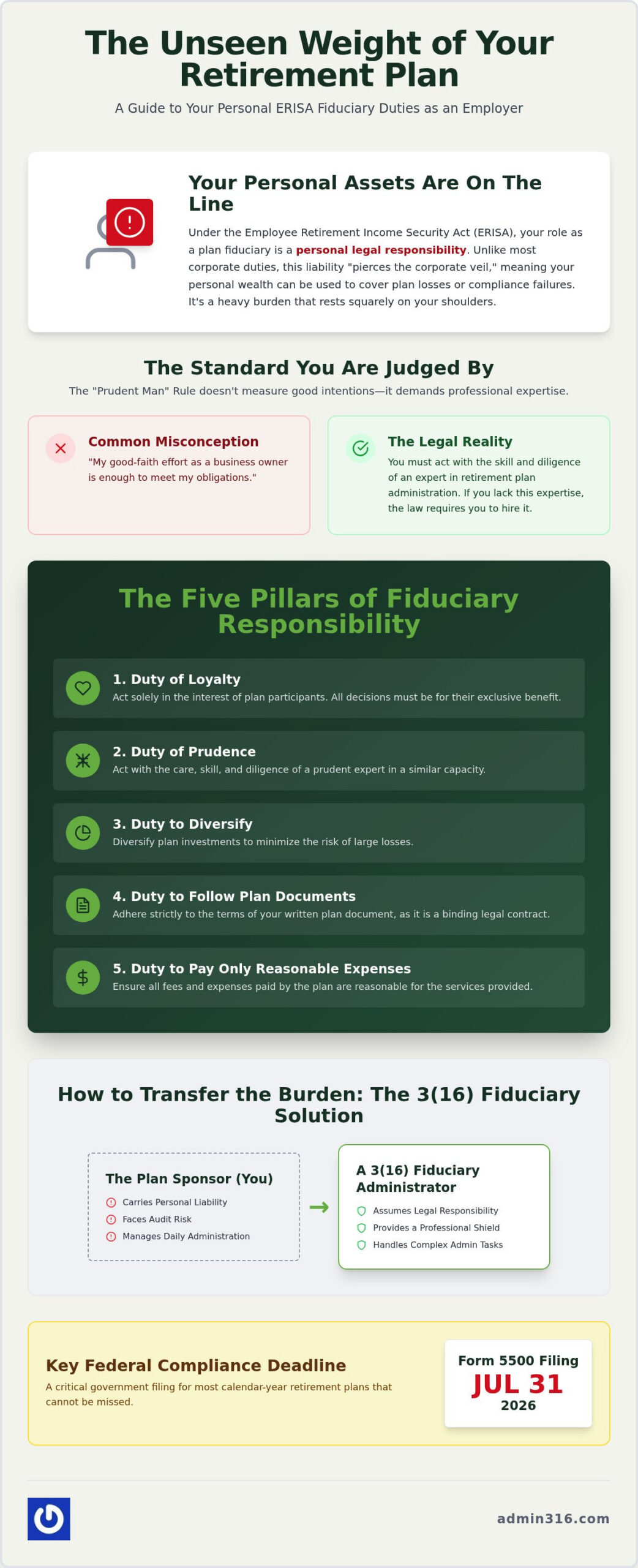
Under the Employee Retirement Income Security Act of 1974 (ERISA), fiduciary status isn’t just a title; it’s a function. If you exercise discretionary authority over plan management or control its assets, you’re a fiduciary. This legal framework creates a unique environment where the ERISA fiduciary duties employer obligations are inseparable from the individual. Unlike most corporate responsibilities, these duties pierce the corporate veil. This means your personal assets can be held liable for plan losses or compliance failures. It’s a heavy legal weight that remains attached to you regardless of your company’s corporate structure.
The law uses the ‘Prudent Man’ Rule to measure your performance. This standard doesn’t ask if you acted with good intentions or as a “well-meaning” business owner. Instead, it holds you to the standard of a professional expert who is deeply familiar with retirement plan administration. If you don’t possess that expertise, the law expects you to hire it. It’s a significant burden to carry, especially when your primary focus is running a successful company. Recognizing this weight is the first step toward finding a specialized guardian who can carry it for you.
Who is a Fiduciary? It’s More People Than You Think
Many organizations mistakenly believe only the person who signed the plan document is at risk. In reality, ERISA distinguishes between ‘Named Fiduciaries’ and ‘Functional Fiduciaries.’ If an HR manager makes decisions about eligibility or a company officer selects the recordkeeper, they’ve likely assumed fiduciary status through their actions. Understanding how Employees as Retirement Plan Fiduciaries: Navigating Internal Roles and Risks affects your team is vital for protecting your staff and your business. We help you identify these roles to ensure no one is left exposed to unintended liability.
The Limits of Fiduciary Liability Insurance
Compliance requires a clear distinction between two types of protection. A fidelity bond is a mandatory requirement that protects the plan itself against fraud or dishonesty. In contrast, fiduciary liability insurance is an optional policy designed to protect the fiduciaries’ personal assets from legal claims. Fiduciary liability insurance provides a financial safety net for legal costs and settlements, but it does not remove your underlying legal responsibility to act with professional prudence. Even with a policy in place, the Department of Labor can still demand corrective actions and impose penalties for failing to meet ERISA fiduciary duties employer standards. We act as a shield, assuming these responsibilities so that you don’t have to rely on insurance alone for peace of mind.
Not sure where your plan’s fiduciary liability actually sits?
Admin316 serves as your named 3(16) plan administrator and takes the filing, notice and compliance work off your desk — along with the liability that comes with it. A 15-minute call is usually enough to tell you where you stand.
The Five Pillars of Fiduciary Responsibility Under ERISA
Fiduciary obligations are not vague concepts or suggestions; they are structured around five core pillars designed to protect the retirement assets of your employees. Successfully managing these ERISA fiduciary duties employer requirements is the only way to shield yourself from the personal liability discussed earlier. These pillars represent the standard of conduct that the Department of Labor (DOL) uses to measure your performance during an audit.
- Duty of Loyalty: You must act solely in the interest of plan participants and their beneficiaries. Every decision, from selecting a service provider to choosing an investment menu, must be made for the exclusive purpose of providing benefits and defraying reasonable expenses.
- Duty of Prudence: This is the centerpiece of the DOL’s Meeting Your Fiduciary Responsibilities guidelines. It requires you to act with the care, skill, and diligence of a “prudent person” acting in a like capacity.
- Duty to Diversify: You are legally required to diversify plan investments to minimize the risk of large losses, unless it is clearly prudent not to do so.
- Duty to Follow Plan Documents: Your plan document is a binding legal contract. Adhering strictly to your own written rules is a legal necessity.
- Duty to Pay Only Reasonable Expenses: You have a mandate to ensure that the fees paid by the plan are reasonable for the services provided.
The Prudent Man Standard in 2026
The “expert” standard doesn’t just apply to selecting stocks or mutual funds. In 2026, regulatory focus has intensified on administrative prudence. This includes how you track participant eligibility and how you handle sensitive data. In a DOL audit, “I didn’t know” is never an acceptable defense. You must prove procedural prudence by documenting the “why” behind every decision. If you lack the internal expertise to meet this high bar, the law expects you to hire professional support to oversee these functions.
Managing Plan Expenses and Fee Transparency
A critical part of your ERISA fiduciary duties employer role is evaluating recordkeeper and advisor fees. You should perform formal benchmarking at least every few years to prove fees remain reasonable. Hidden revenue sharing can lead to excessive costs that erode participant balances over time. We provide professional 401(k) benchmarking to help you identify these costs and ensure your plan remains a stable, cost-effective benefit for your team.
The Employer’s ERISA Compliance Checklist: Assessing Your Risk
The weight of plan management often feels heaviest during the annual compliance cycle. For many business owners, the fear of an unexpected Department of Labor (DOL) audit is a constant source of professional anxiety. To mitigate this risk, you must move beyond a general understanding of ERISA fiduciary duties employer requirements and implement a rigorous health check of your internal processes. We provide this roadmap to help you evaluate your current risk profile and identify where the burden of liability may be slipping through the cracks.
- Step 1: Documenting Fiduciary Governance. If a decision isn’t documented, it didn’t happen in the eyes of the law. You must maintain detailed meeting minutes, formal committee charters, and clear records of why specific service providers were selected or retained.
- Step 2: Participant Disclosure Review. Verify that every eligible employee has received a Summary Plan Description (SPD) and all required notices. You can reference the Department of Labor’s Guide to Fiduciary Duties to ensure your distribution methods meet federal standards.
- Step 3: Eligibility and Enrollment Tracking. This remains the primary source of plan errors. Miscalculating entry dates or failing to track hours for part-time staff can lead to costly corrective contributions and penalties.
- Step 4: Form 5500 Accuracy and Timeliness. For 2025 calendar year plans, the filing deadline is July 31, 2026. Ensure the individual signing this document understands they are taking the ultimate heat for its accuracy.
- Step 5: Investment Policy Statement (IPS) Compliance. Having an IPS is only the first step. You must prove your committee actually follows the script when monitoring and replacing investment options.
Administrative Compliance: The Hidden Trap
Tracking employee hours and entry dates is a meticulous task that often overwhelms internal HR teams. Automation is a fiduciary’s best friend in this regard, as it removes the risk of human error in eligibility calculations. Another growing concern is the duty to find “lost participants” who have left the company but still hold balances. We help you automate participant notices to ensure 100% compliance with DOL mailing windows, shifting the heavy lifting of coordination away from your desk.
Reporting and Disclosure Requirements
The Summary Plan Description (SPD) is far more than an informational booklet; it functions as a legal contract between the plan and its participants. You must also coordinate the delivery of annual disclosures, such as the Summary Annual Report (SAR) and various fee disclosures, within strict regulatory timelines. Precision is vital here because the consequences of oversight are severe. Failing to file Form 5500 on time can result in civil monetary penalties of up to $2,739 per day. By assuming these reporting duties, we act as a shield, preserving your time and protecting your personal assets from the fallout of administrative delays.
Common Misconceptions About Fiduciary Delegation and Liability
Many business owners believe they’ve already handed off the heavy lifting of plan management to their service providers. This assumption often stems from a misunderstanding of how the law views delegation. In the eyes of the Department of Labor, you cannot simply “set it and forget it.” Even when you hire outside help, your ERISA fiduciary duties employer obligations include a residual “duty to monitor.” This means you remain legally responsible for ensuring that your service providers are performing their tasks prudently and in the best interest of your participants.
A common myth is that a Third-Party Administrator (TPA) handles everything. In reality, most TPAs operate as non-fiduciary service providers. They perform the calculations and prepare the forms, but they don’t assume the legal risk for the accuracy of that data. If a participant is missed during enrollment or a filing is delayed, the TPA’s contract usually shifts the liability back to you. Understanding how to transfer fiduciary liability to a specialized partner is the key to closing this gap and moving beyond mere calculation to full legal accountability for the results.
- The TPA Reality: Most contracts explicitly state they are not fiduciaries, leaving the employer to carry the weight of any administrative errors.
- The 3(38) Gap: Investment managers protect you from investment selection risks, but they offer no shield against administrative or reporting failures.
- The Oversight Mandate: You must have a documented process for vetting and overseeing every partner you hire to prove you’ve met your fiduciary obligations.
3(16) vs. 3(38): Understanding the Fiduciary Landscape
The fiduciary landscape is divided into two distinct territories: the “what” and the “how.” An ERISA 3(38) investment fiduciary manages the “what” by selecting and monitoring the plan’s investment menu. An ERISA 3(16) Plan Administrator manages the “how” by overseeing the day-to-day operations and participant coordination. Relying on an investment manager alone leaves a massive gap in your liability shield, as the majority of DOL audits focus on the administrative functions that only a 3(16) partner assumes.
The ‘Non-Displacement’ Strategy: Keeping Your Team, Shedding the Risk
We believe in fortifying your existing team, not replacing it. Our specialized guardian approach utilizes a non-displacement strategy that allows you to preserve your relationships with your current financial advisor and recordkeeper. We sit alongside your trusted partners to provide the layer of legal protection they are not designed to carry. By assuming the role of 402(a) Named Fiduciary, we coordinate the heavy lifting behind the scenes so that you can focus on your business with total peace of mind. If you’re ready to transfer the weight of your plan’s legal risk, contact Admin316 today to learn how we shield plan sponsors from ERISA liability.
Transferring the Burden: How a 3(16) Fiduciary Shields Plan Sponsors
Transitioning from a Plan Sponsor to a protected leader requires more than just hiring help; it requires a structural shift in how your plan is governed. When you engage a 3(16) fiduciary, you aren’t just buying administrative support. You’re handing off the legal weight of your ERISA fiduciary duties employer obligations to a professional expert. This process transforms your role from an overwhelmed administrator into a focused executive, allowing you to oversee the plan’s success without being buried in its technical execution.
By assuming the role of ERISA Section 402(a) Named Fiduciary, we take the ultimate legal responsibility off your plate. We don’t just prepare the paperwork; we sign it. This means that when it comes to the Form 5500 or Department of Labor inquiries, we stand at the front line as your advocate. We act as the specialized guardian that shields your personal assets and your company from the gravity of regulatory scrutiny, providing a layer of protection that allows you to breathe easier.
What to Look for in a 3(16) Fiduciary Partner
Selecting a partner to carry your legal liability is a decision that requires meticulous vetting. Independence is the most critical factor. Your fiduciary shouldn’t be the same entity as your recordkeeper; having an independent party provide oversight ensures that no one is “grading their own homework.” You should also prioritize tenure and experience. We have specialized in fiduciary administration since 1997, navigating decades of shifting regulations and complex audit environments. Finally, ensure the scope of service includes the actual assumption of legal liability, rather than just offering administrative assistance that leaves the risk on your shoulders.
The ROI of Fiduciary Outsourcing
The return on investment for fiduciary outsourcing is measured in both time and safety. When you calculate the hours your internal HR team spends on eligibility tracking, notice distribution, and data reconciliation, the cost of professional administration is often lower than the internal drain on resources. There is also the “audit insurance” value to consider. Avoiding the massive civil penalties associated with non-compliance provides a level of stability that insurance policies alone cannot match. We coordinate the heavy lifting alongside your existing team so that your professional bonds remain intact while your risk is mitigated. Discover how Admin316 assumes your fiduciary burden and shields your business.
Secure Your Personal Assets and Your Company’s Future
The weight of fiduciary responsibility is a constant presence in the life of a plan sponsor. As we have examined, the 2026 regulatory environment requires a level of administrative precision that few business owners have the time to master. By understanding your ERISA fiduciary duties employer requirements, you’ve taken the first step toward mitigating risk. However, knowledge alone doesn’t remove the burden of personal liability or the risk of a DOL audit.
Real protection comes from having a specialized guardian who assumes these duties on your behalf. Since 1997, we have specialized in lifting this weight for employers. We act as an independent 3(16) and 402(a) fiduciary, stepping in to take full legal accountability for your plan’s administration. We don’t replace your current advisors or recordkeepers; instead, we work alongside them to provide a necessary layer of protection. It’s time to transition from an overwhelmed sponsor to a protected leader.
Reduce your liability and outsource your ERISA administration with Admin316.
You don’t have to carry this legal weight alone. Let us handle the heavy lifting so you can focus on leading your business with confidence and peace of mind.
Frequently Asked Questions
What is the difference between a 3(16) and a 3(38) fiduciary?
A 3(38) fiduciary is an investment manager who takes responsibility for selecting and monitoring the plan’s investment menu. In contrast, a 3(16) fiduciary is a plan administrator who manages daily operations, such as participant notices and eligibility tracking. While a 3(38) manager shields you from investment selection risk, they do not cover administrative failures. We provide 3(16) services to assume the legal weight of these operational tasks and close the gap in your liability shield.
Can an employer be held personally liable for ERISA violations?
Yes, an employer can be held personally liable for ERISA violations because the law specifically allows for the piercing of the corporate veil. This means your personal assets are at risk if the Department of Labor finds a breach of ERISA fiduciary duties employer mandates. We mitigate this danger by assuming the role of 402(a) Named Fiduciary, acting as a shield between you and the regulatory entities that enforce these strict financial standards.
Does fiduciary liability insurance fulfill the ERISA bond requirement?
No, fiduciary liability insurance does not fulfill the ERISA fidelity bond requirement. The law mandates a fidelity bond to protect the plan itself against losses caused by fraud or dishonesty. Liability insurance is an optional policy that protects your personal assets from the costs of legal claims. We ensure you understand these distinctions so that you maintain the correct layer of protection for both the retirement plan and your leadership team.
Who is responsible for signing the Form 5500?
The designated Plan Administrator is responsible for signing the Form 5500. This individual takes legal responsibility for the accuracy of the plan’s financial reporting and compliance status. When you outsource this role to a professional 3(16) fiduciary, we sign the document on your behalf. This transfer of duty removes the ultimate legal heat from your desk and ensures the filing meets the July 31, 2026, deadline for calendar year plans.
How often should an employer benchmark their 401(k) plan fees?
You should benchmark your 401(k) plan fees every two to three years to prove that expenses remain reasonable. Regular benchmarking is a legal requirement under the duty to pay only reasonable plan expenses. We provide detailed benchmarking reports to help you evaluate recordkeeper and advisor costs. This methodical process provides the evidence needed to satisfy a DOL auditor that you are acting solely in the best interest of your participants.
What happens if a participant notice is sent late or missed?
A late or missed participant notice can trigger Department of Labor penalties and may require a formal correction process. For example, failing to provide a Summary of Benefits and Coverage can result in penalties of up to $1,406 per failure in 2026. We oversee the entire distribution process to ensure 100% compliance with mailing windows. By automating these tasks, we remove the risk of oversight that often leads to professional anxiety for HR managers.
Can I outsource my fiduciary duties without firing my current 401(k) advisor?
Yes, you can outsource your fiduciary duties without replacing your current 401(k) advisor or recordkeeper. Our specialized guardian approach is designed for non-displacement, meaning we work alongside your existing team to add a layer of legal protection. We coordinate with your trusted partners to handle the heavy lifting of administration while they continue to manage your investments. This collaborative model preserves your established professional bonds while shedding your legal risk.
What are the most common fiduciary mistakes found during a DOL audit?
The most common mistakes found during a DOL audit include miscalculating employee eligibility, late remittance of participant contributions, and insufficient documentation of fiduciary meetings. These errors often stem from manual administrative processes that are prone to human oversight. We assume these meticulous responsibilities to ensure your records are always audit-ready. Our methodical oversight protects you from the fines and corrective actions that often follow these frequent compliance lapses.
Transfer this responsibility to a professional fiduciary.
Every item in this article is work Admin316 does for plan sponsors every day as an ERISA 3(16) administrator. Bring us your plan documents and we’ll show you exactly which risks move off your shoulders.
How much of this risk are you personally carrying?
Answer 5 questions about how your plan is actually administered and get your fiduciary risk score in about two minutes. No email required to see the result.
Take the 3(16) risk check