Most business owners view their retirement plan as a benefit, but for the person signing the Form 5500, it’s often a heavy weight of legal liability that never quite goes away. Effective profit sharing plan administration shouldn’t feel like a second full-time job or a constant source of professional anxiety. It’s understandable if you feel overwhelmed by the manual effort of tracking eligibility or the rising complexity of nondiscrimination testing as we move through 2026.
You likely started this plan to reward your team, not to spend your nights worrying about whether you’ve correctly applied the $160,000 HCE threshold or the new Super Catch-up limits. This guide will show you how to maintain a high-performing plan while physically transferring the administrative and fiduciary burdens to a specialized partner. You’ll learn how to secure documented compliance and create a clear shield against liability. We will cover the critical 2026 regulatory updates, the specific roles of Section 3(16) administrators, and the methodical steps to offload the heavy lifting without displacing your trusted investment advisors.
Key Takeaways
- Understand the unique “weight” of profit sharing responsibilities and why these plans require more rigorous oversight than a standard 401(k).
- Discover how to navigate the 2026 compliance landscape, including the specific steps needed to master profit sharing plan administration without internal staff burnout.
- Uncover the truth about the “TPA myth” and learn how a Named Fiduciary (402a) provides the actual legal shield your business needs.
- Identify hidden “leakage” in your current administrative workflow and see how modern recordkeeping software integrates with professional fiduciary oversight.
- Learn how to transfer your plan’s legal burdens to a specialized guardian without displacing your current team of trusted investment advisors.
What is Profit Sharing Plan Administration in 2026?
Profit sharing plan administration is the meticulous coordination of employer contributions, rigorous compliance testing, and annual government reporting. While a profit-sharing pension plan offers immense flexibility for business owners to reward their team, it also carries a significant “mass” of legal responsibility. Unlike a standard 401(k) where employees manage their own deferrals, a profit sharing plan rests entirely on the employer’s shoulders. This creates a physical burden of liability that grows every year as regulations shift.
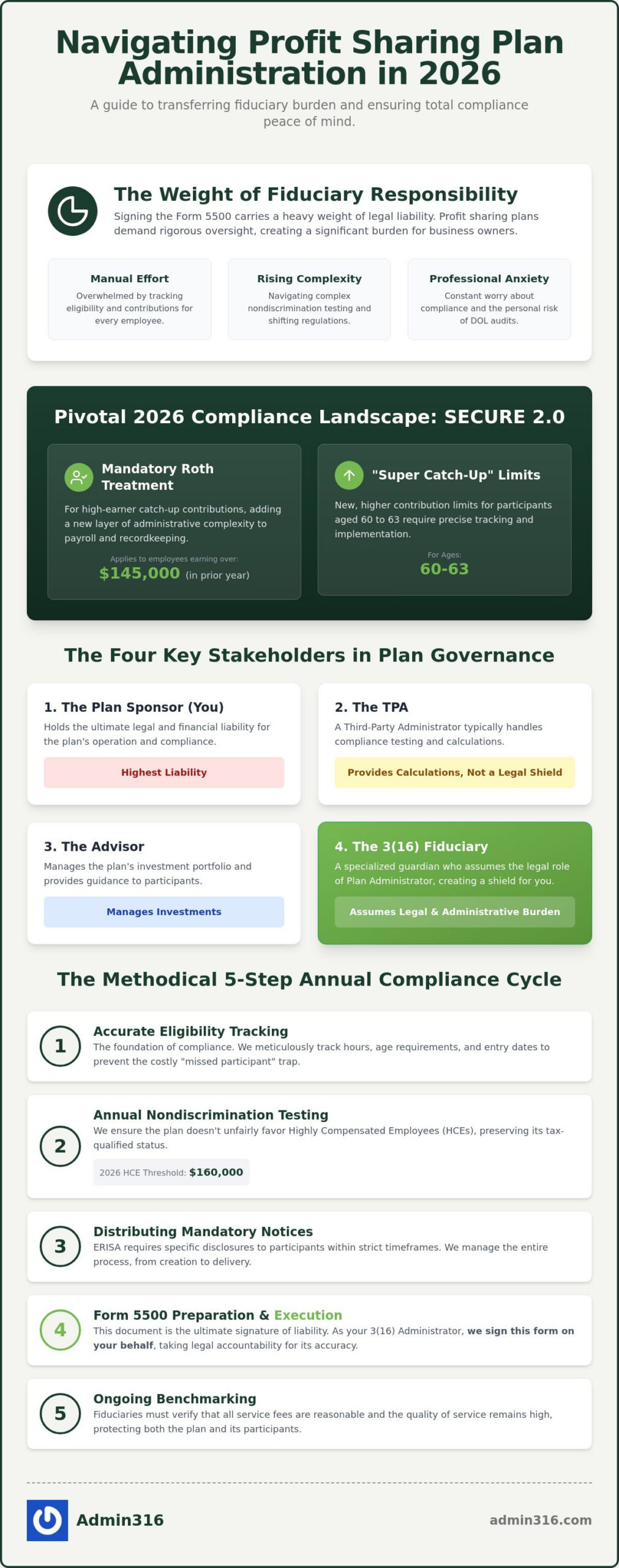
In 2026, the governance landscape involves four key stakeholders. The Plan Sponsor holds the ultimate liability. The TPA typically handles the calculations. The Advisor manages the investments. Finally, the 3(16) Fiduciary acts as the specialized guardian who assumes the legal role of Plan Administrator. This role is a shield between your company and regulatory entities like the Department of Labor. 2026 is a pivotal year because of the full implementation of SECURE 2.0 provisions. Specifically, the mandatory Roth treatment for high-earner catch-up contributions and the new “Super Catch-Up” limits for ages 60 to 63 add layers of complexity that internal staff shouldn’t be expected to carry alone.
The Core Duties of a Plan Administrator
The administrator’s primary task is to oversee the legal plan document. It isn’t enough to just have a document; it must be updated to reflect current laws. We coordinate the execution of your chosen contribution formula, whether you use a standard Comp-to-Comp model or a more complex Integrated approach. Beyond the paperwork, the administrator must oversee the trust that holds plan assets, ensuring every dollar is accounted for and every participant notice is delivered on time. It is a constant cycle of maintenance that requires institutional discipline.
The Difference Between Design and Administration
Think of plan design as the architecture and profit sharing plan administration as the plumbing. Design is the high-level strategy where you decide how much to contribute and who qualifies. Administration is the day-to-day maintenance that keeps the system from leaking. A brilliant plan design fails if the administrative oversight is sloppy. The focus in 2026 has shifted from simply “setting it up” to “keeping it clean” for the DOL. We assume these duties so that your plan remains a source of pride rather than a source of professional anxiety. Meticulous administration ensures that your tax deductions are preserved and your fiduciary record is spotless.
Not sure where your plan’s fiduciary liability actually sits?
Admin316 serves as your named 3(16) plan administrator and takes the filing, notice and compliance work off your desk — along with the liability that comes with it. A 15-minute call is usually enough to tell you where you stand.
How to Manage Profit Sharing Plan Compliance: A Step-by-Step Guide
Managing the compliance cycle of a profit sharing plan requires a methodical approach that leaves no room for error. While the 2026 total contribution limit has reached $72,000, the legal weight of ensuring every dollar is allocated correctly remains with the plan sponsor. Mastering profit sharing plan administration means moving through a disciplined sequence of events each year to preserve the plan’s tax-qualified status and shield the company from audit risk.
- Step 1: Accurate Eligibility Tracking. This is the foundation. Failing to include a single eligible employee can lead to costly corrective contributions and Department of Labor penalties.
- Step 2: Annual Nondiscrimination Testing. For 2026, the threshold for a Highly Compensated Employee (HCE) is $160,000. We oversee these tests to ensure the plan does not unfairly favor owners or executives at the expense of rank-and-file staff.
- Step 3: Distributing Mandatory Participant Notices. ERISA requires specific disclosures to be handed to participants within strict timeframes.
- Step 4: Form 5500 Preparation and Execution. This document is the ultimate signature of liability. When we assume the role of Plan Administrator, we sign this form on your behalf, taking legal accountability for its accuracy.
- Step 5: Ongoing Benchmarking. Fiduciaries must verify that service fees are reasonable and quality remains high.
This organized progression ensures that no detail is overlooked. By establishing a rhythm of compliance, we mitigate the risks associated with the manual effort of tracking complex employee data.
Mastering Eligibility and Enrollment
Tracking hours and age requirements requires surgical precision to avoid the “missed participant” trap. Entry dates are the primary point of administrative failure. If an employee meets the requirements but isn’t enrolled by the next entry date, the employer is often forced to make up for missed opportunities out of pocket. We coordinate automated data feeds from your payroll provider directly to our systems. This seamless flow of information ensures that eligibility is calculated in real-time, removing the manual effort that leads to human error. You can find more details on these requirements in this U.S. Department of Labor guide which outlines the rigorous standards expected of plan sponsors.
The Art of Participant Notices
The administrative mass of a plan is often felt most during notice season. You must provide a Summary Plan Description (SPD) to every new participant and a Summary of Material Modifications (SMM) whenever the plan rules change. Beyond these, fee disclosures and annual benefit statements must be delivered with documented proof. Handling “lost” participants is another critical area. If a former employee cannot be found, the fiduciary must take specific, documented steps to locate them to avoid a breach of duty. We manage this entire process, acting as a shield between your internal team and the complex web of profit sharing plan administration requirements. This allows your staff to focus on growth while we preserve the integrity of the plan’s records.
Fiduciary Liability: DIY vs. TPA vs. 3(16) Administration
Understanding who carries the legal weight of your retirement program is just as critical as the plan’s financial performance. In the landscape of profit sharing plan administration, many employers mistakenly believe their Third Party Administrator (TPA) is their shield. This is a common misconception that leaves businesses vulnerable. While a TPA is an essential partner for calculations, they rarely assume the legal role of Plan Administrator. If your company name appears on the signature line of the Form 5500, you are still carrying 100% of the fiduciary mass.
The ERISA Section 402(a) Named Fiduciary is the entity designated in the plan document as having ultimate authority. When you operate under a DIY or traditional TPA model, your business typically retains this role. This means you are legally accountable for every missed entry date and every testing error. Transitioning to a professional fiduciary model allows you to physically transfer this burden. By appointing a specialized guardian to assume these roles, you create a clear barrier between your company and regulatory scrutiny. This isn’t just about delegating tasks; it’s about transferring the accountability for those tasks.
Comparative risk can be viewed as a scale of responsibility:
- DIY Administration: The employer carries the full weight of calculations, testing, and legal liability.
- TPA Service: The TPA handles the “books,” but the employer still carries the legal weight of the signature and any errors.
- 3(16) Fiduciary: The fiduciary assumes the legal weight, signs the government filings, and shields the employer from administrative liability.
Why the TPA is Not Your Shield
TPAs provide the mathematical foundation for your plan, but the employer is still the one who signs the “tax return” of the retirement world: the Form 5500. This distinction is vital. A TPA’s role is ministerial, focusing on data processing and adherence to the plan’s formula. They don’t make fiduciary decisions. For a deeper look at how to move beyond this limited protection, consider the role of an ERISA 3(16) plan administrator. By hiring a professional to sign the 5500, you are delegating the legal accountability that otherwise stays on your desk. This is consistent with the U.S. Department of Labor guide on profit sharing plans, which emphasizes that while you can hire service providers, you remain responsible for their oversight unless you specifically transfer that fiduciary duty.
The 3(16) Fiduciary Advantage
The primary benefit of a 3(16) administrator is the assumption of legal responsibility for administrative errors. We don’t just help you with the paperwork; we take ownership of it. This model provides immediate relief for business owners who are tired of the manual effort and professional anxiety that comes with compliance. We work alongside your current advisor and recordkeeper to fortify your existing team. Instead of replacing your professional bonds, we add a layer of protection. This allows you to focus on your business goals while we handle the heavy lifting of government reporting and participant notices. We assume the risk so that you can maintain your peace of mind.
Practical Steps to Streamline Your Profit Sharing Plan
Streamlining your plan isn’t just about speed; it’s about removing the friction that leads to compliance failure. Start by auditing your current workflow for “leakage.” This often occurs when payroll data doesn’t sync perfectly with your recordkeeper, leading to missed participant entries or incorrect contribution amounts. In 2026, recordkeeping software provides a digital foundation, but the weight of profit sharing plan administration still requires a professional eye to verify the output. We coordinate these technical systems so that you don’t have to spend hours reconciling spreadsheets.
For business owners looking to maximize tax efficiency, integrating profit sharing with a cash balance pension plan can be a game-changer. This combination allows for total annual additions that far exceed standard 401(k) limits. However, managing multiple vehicles increases the administrative mass you must carry. We assume the oversight of these integrated plans, ensuring that contributions remain within the 2026 limits ($72,000 for those under 50, or up to $83,250 for those aged 60-63 with catch-ups) across all accounts. Business owners who want to explore guaranteed retirement income options for their key employees should also understand what is a defined benefit pension plan and how its $290,000 annual benefit limit can complement a profit sharing strategy.
Integrating Multiple Retirement Plans
Profit sharing and 401(k) plans often work in tandem to provide a robust benefit package. Managing these “paired” plans shouldn’t mean doubling your internal staff’s workload. We oversee the coordination between these accounts, shielding you from the risk of exceeding annual compensation limits, which sit at $360,000 for 2026. If your strategy includes more advanced vehicles, our expertise in cash balance plan administration ensures that your high-level tax goals are met without compromising compliance. Business owners evaluating their overall retirement strategy may also benefit from understanding how a defined contribution plan fits within a broader framework of tax-advantaged vehicles before deciding how to structure their profit sharing approach.
Preparing for the DOL Audit
The “Guardian” approach to audit preparation relies on meticulous documentation. Every participant notice, every testing result, and every fiduciary decision must be stored in a secure Fiduciary File. Common red flags that trigger DOL interest include late Form 5500 filings or inconsistencies in how you handle the new Roth catch-up requirements for employees earning over $150,000. When you partner with an independent fiduciary, a potential audit becomes a “non-event” for your company. We provide the documentation and assume the legal responsibility for the plan’s history. You can transfer your administrative liability to us and focus entirely on your core business operations.
Admin316: Your Specialized Guardian in Plan Administration
The legal mass of a retirement plan can often feel like a permanent fixture on a business owner’s desk. Since 1997, Admin316 has operated as a specialized guardian for employers who recognize that profit sharing plan administration is too heavy a burden to carry alone. We don’t just offer advice; we assume the physical weight of the legal role of Plan Administrator. Our institutional longevity provides a sense of permanence that allows you to move from a state of constant professional anxiety to one of long term stability.
We take on the heavy lifting of signing the Form 5500 and managing the complex cycle of participant notices. By acting as a shield between your company and regulatory entities, we mitigate the risks that lead to audits and penalties. Our team handles the granular details of eligibility tracking and nondiscrimination testing with the meticulous care your plan deserves. This shift doesn’t just reduce your workload; it transfers the legal accountability for administrative errors to us.
Assumed Responsibilities, Preserved Relationships
One of the hallmarks of our service is the non-displacement promise. We recognize that you’ve built valuable relationships with your investment advisors and recordkeepers, and we have no desire to replace them. We don’t manage the money; we manage the compliance burden. Our role is to fortify your existing team by adding a layer of protection that most TPAs simply cannot provide. We are the ERISA Section 402(a) Named Fiduciary so you don’t have to be. This allows your advisor to focus on growth while we oversee the safety and stability of the plan’s administrative framework.
Getting Started with Fiduciary Relief
The transition to a professional fiduciary model is methodical and organized. We begin with a comprehensive plan diagnostic and benchmarking process to identify any existing “leakage” or compliance gaps. During the first 90 days of our partnership, we coordinate with your payroll and recordkeeping providers to establish automated data feeds. This disciplined setup ensures that every participant notice and government filing is handled with surgical precision from day one. You don’t have to wait for an audit to seek protection. Transfer your administrative burden to Admin316 today and reclaim the time you need to lead your business with confidence.
Securing Your Legacy of Fiduciary Excellence
Managing a retirement plan shouldn’t feel like a physical weight that slows your company down. We’ve explored how 2026 regulatory changes have increased the mass of responsibility for plan sponsors. By distinguishing between simple delegation and actual liability transfer, you can protect your business from the risks of missed entry dates or testing errors. Professional profit sharing plan administration allows you to maintain your trusted advisor relationships while a specialized guardian handles the heavy lifting of Form 5500 and participant notices.
Admin316 has been protecting plans since 1997. As an independent 3(16) fiduciary with national coverage, we provide the shield you need to operate with confidence. We assume the legal accountability so that you can focus on leading your team. You don’t have to carry the burden of fiduciary liability alone. Our process is designed to fortify your existing bonds while removing the professional anxiety that keeps you awake at night.
Request a Fiduciary Diagnostic for Your Profit Sharing Plan
Your path to documented compliance starts with a single step toward professional stability. We’re ready to stand alongside you and assume the weight of your administrative duties.
Frequently Asked Questions
What is the primary role of a profit sharing plan administrator?
The primary role is to oversee the plan’s daily operations and ensure every contribution and notice complies with ERISA standards. This includes coordinating participant enrollment, managing the legal plan document, and executing the specific contribution formula chosen by the employer. They act as the central hub for the plan’s compliance and reporting requirements.
Does a Third Party Administrator (TPA) assume fiduciary liability for my plan?
Most TPAs do not assume fiduciary liability. They perform ministerial tasks like recordkeeping and basic calculations, but the legal weight of the plan’s decisions remains with the employer. To physically transfer this liability, you must specifically appoint an ERISA 3(16) Plan Administrator to take on the legal accountability for administrative errors.
Who is responsible for signing the Form 5500 for a profit sharing plan?
The designated Plan Administrator is responsible for signing the Form 5500. In a traditional setup, this is usually the business owner or a company executive. However, when you outsource profit sharing plan administration to a 3(16) fiduciary, they sign the form on your behalf. This shifts the legal accountability for the filing’s accuracy from your desk to theirs.
Can I outsource profit sharing plan administration without firing my current financial advisor?
Yes, you can outsource administration while keeping your current financial advisor. We operate under a non-displacement model, acting as a specialized guardian for the employer without interfering with investment management. We handle the compliance plumbing so that your advisor can focus on the plan’s financial growth and participant education.
What happens if our profit sharing plan fails a nondiscrimination test?
If a plan fails nondiscrimination testing, the employer must take corrective action to preserve the plan’s tax-qualified status. This usually involves refunding excess contributions to Highly Compensated Employees (HCEs) or making additional contributions to non-HCEs. For 2026, the HCE threshold is $160,000. We oversee this process to ensure all corrections meet strict IRS deadlines.
What are the 2026 contribution limits for profit sharing plans?
For 2026, the total annual contribution limit is $72,000. Participants aged 50 and older can contribute up to $80,000 including catch-ups. Those in the Super Catch-Up bracket, ages 60 to 63, have a total limit of $83,250. These limits apply to the combination of employer and employee contributions and are subject to the $360,000 annual compensation limit.
Is a 3(16) fiduciary administrator the same as a 3(38) investment manager?
No, they are different roles. A 3(16) fiduciary is the Plan Administrator responsible for operations, compliance, and government reporting. A 3(38) fiduciary is an Investment Manager with discretionary authority over plan assets. We assume the 3(16) role to lift the administrative burden, while a 3(38) manager handles the investment strategy and fund selection.
How much does professional profit sharing plan administration typically cost?
The cost for professional oversight is structured based on the size of the plan and the number of active participants. Instead of viewing it as a standalone expense, many business owners evaluate it as a risk-mitigation strategy that replaces the cost of internal labor. You can request a personalized diagnostic to understand how professional administration fits into your specific budget and operational goals.
Transfer this responsibility to a professional fiduciary.
Every item in this article is work Admin316 does for plan sponsors every day as an ERISA 3(16) administrator. Bring us your plan documents and we’ll show you exactly which risks move off your shoulders.