Did you know that the Department of Labor can assess a penalty of up to $2,739 per day for a late Form 5500 filing, and unlike many other regulatory fines, there is no maximum limit? For most business owners, the annual audit feels like a heavy weight added to an already full plate. You likely dread the weeks of data collection and the nagging fear that a single oversight could trigger an IRS audit or a massive financial penalty. Selecting the right 401k audit services shouldn’t feel like a high-stakes gamble with your company’s financial health.
Utilizing specialized support doesn’t just check a compliance box; it transfers the legal and administrative burden from your shoulders to a dedicated fiduciary. You deserve a process that is seamless and silent in the background. This guide explains how an ERISA 3(16) Plan Administrator acts as a shield for your company, ensuring an error-free process that protects your corporate and personal liability. We will show you how to meet 2026 requirements and ensure your Form 5500 is filed accurately and on time.
Key Takeaways
- Determine your 2026 filing status by applying the 80-120 participant rule to ensure you meet Department of Labor requirements without overspending.
- Identify the critical data points auditors scrutinize, such as enrollment timing and contribution accuracy, to prevent common compliance deficiencies.
- Implement mid-year reviews to resolve payroll and census data bottlenecks before they create a significant administrative burden for your HR staff.
- Utilize specialized 401k audit services to act as a shield between your company and regulatory entities, effectively mitigating the risk of daily penalties.
- Transfer the legal weight of the audit process to an ERISA 3(16) Plan Administrator who signs the Form 5500 and assumes full fiduciary accountability.
Understanding the 2026 401k Audit Requirement
Fulfilling the annual audit requirement is a significant regulatory hurdle for growing companies. Under the Employee Retirement Income Security Act of 1974 (ERISA), the Department of Labor (DOL) mandates that “large” retirement plans undergo an independent examination. This process ensures that your plan’s financial statements are accurate and that your operations align with the written plan document. For business owners, this isn’t just about bookkeeping. It’s a high-stakes legal obligation where your personal and corporate signatures carry immense weight.
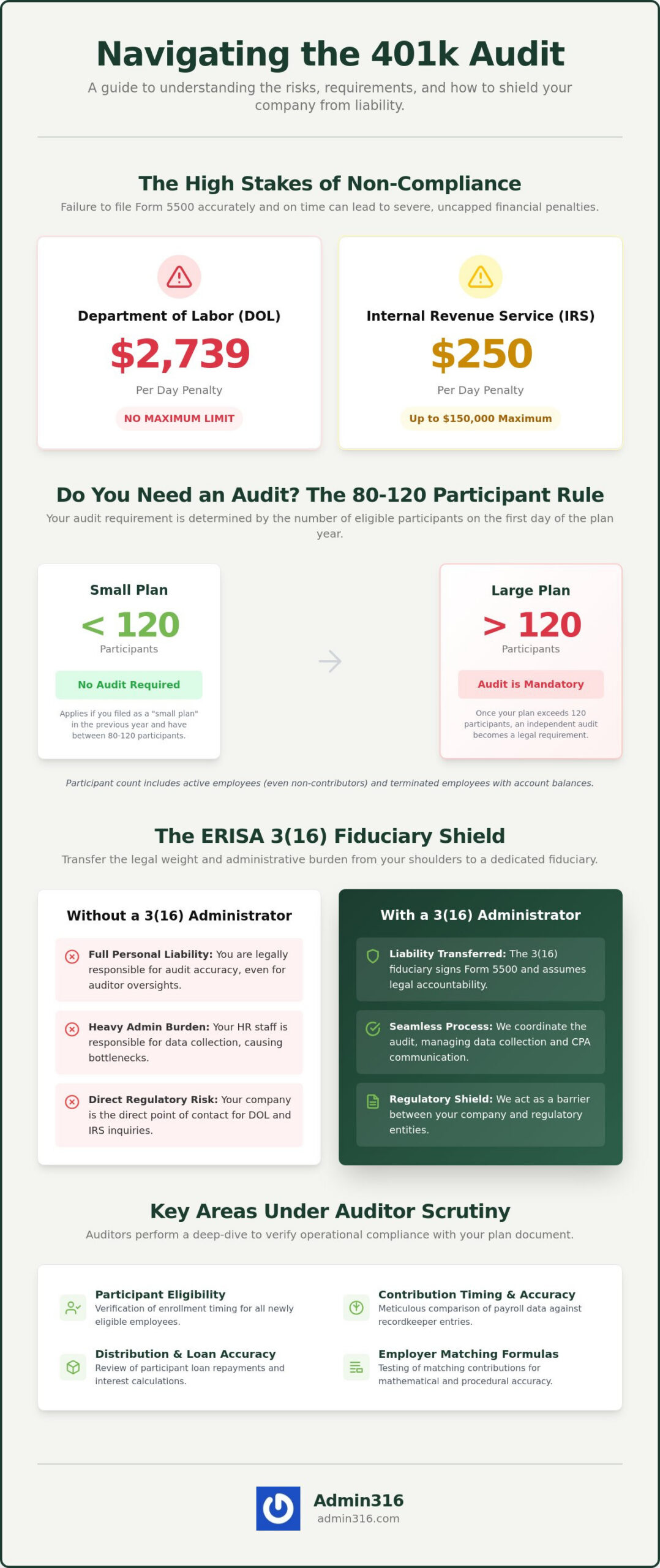
The consequences of failing to secure professional 401k audit services are severe. The DOL can assess a penalty of up to $2,739 per day for a late or incomplete Form 5500 filing, and there is no maximum cap on these fines. Simultaneously, the IRS can impose a penalty of $250 per day, up to a maximum of $150,000. These financial risks exist to ensure that plan sponsors maintain absolute transparency and protection for participant assets.
The 80-120 Participant Rule: Do You Need an Audit?
Determining whether your company requires an audit depends on your participant count at the beginning of the plan year. Generally, once a plan reaches 100 participants, it’s classified as a “large plan” and must be audited. However, the 80-120 rule provides a layer of flexibility for businesses on the cusp of growth. If your plan had between 80 and 120 participants and filed as a “small plan” in the previous year, you can continue to file as a small plan and forgo the audit. Once your count exceeds 120 participants on the first day of the plan year, an audit becomes mandatory.
- Eligible Participants: This count includes active employees, even those not currently contributing, and terminated employees who still have account balances.
- Status Determination: Your filing status is locked in based on the participant count as of January 1 for calendar-year plans.
- Growth Nuances: If you expect to cross the 120-participant threshold in 2026, you should begin coordinating with 401k audit services early to avoid a last-minute scramble before the July 31 filing deadline.
Fiduciary Liability and the Audit Process
As a Plan Sponsor, you hold a fiduciary duty to oversee the audit process. Many owners mistakenly view the audit as a task for their CPA alone. In reality, you are legally responsible for the accuracy of the data provided. Blindly signing financial statements without expert oversight creates individual fiduciary exposure. If an auditor misses a deficiency that the DOL later discovers, the legal responsibility rests on your desk, not the auditor’s.
We provide a shield against this exposure by assuming the role of the Section 3(16) Plan Administrator. We don’t just coordinate the audit; we assume the legal weight of the findings. By having a professional fiduciary oversee the data collection and sign the Form 5500, you mitigate the risk of personal liability and ensure your company remains in good standing with regulatory entities.
Not sure where your plan’s fiduciary liability actually sits?
Admin316 serves as your named 3(16) plan administrator and takes the filing, notice and compliance work off your desk — along with the liability that comes with it. A 15-minute call is usually enough to tell you where you stand.
Key Areas Covered by Comprehensive 401k Audit Services
A thorough examination of your retirement plan is more than a simple financial checkup; it is a forensic deep-dive into your operational compliance. When you engage 401k audit services, the objective is to verify that the plan operates exactly as the written document dictates. Auditors don’t just look for balanced ledgers. They look for consistency between your payroll records, your recordkeeper’s data, and the legal requirements set forth by the Department of Labor (DOL) ERISA guidelines.
A comprehensive review typically focuses on four critical pillars: participant eligibility, contribution timing, distribution accuracy, and internal controls. If any of these pillars are weak, the weight of the resulting penalties falls directly on the plan sponsor. By understanding these focus areas, you can better prepare your team for the scrutiny of an independent CPA firm. Most audits follow a methodical path through your data, including:
- Verification of enrollment timing for newly eligible employees.
- Testing of employer matching formulas for mathematical accuracy.
- Review of participant loan repayments and interest calculations.
- Cross-referencing plan assets against third-party custodian statements.
Testing Contributions and Distributions
The most common point of failure in any audit is the handling of employee deferrals. Auditors meticulously compare your payroll data against the recordkeeper’s entries to ensure every dollar was accounted for correctly. Specifically, they watch for “late deposits.” According to recent DOL audit quality studies, approximately 30% of audits reveal at least one deficiency, with late remittance of employee contributions being a primary culprit. The DOL requires that contributions be deposited as soon as they can be reasonably segregated from general assets, which is often much sooner than the maximum 15-day rule suggests.
Distributions and benefit payments undergo similar scrutiny. The auditor verifies that every participant who received a payout was actually eligible to do so under the plan’s specific terms. Whether it’s a hardship withdrawal or a standard retirement distribution, a clear “paper trail” must exist to prove the transaction followed the rules. If your team is struggling to manage these complex data points, you might consider how a Section 3(16) Plan Administrator can take over these coordination tasks to ensure accuracy.
Evaluating Internal Controls
Auditors are deeply interested in your administrative procedures, not just the final numbers. They evaluate how your company handles data, from the moment an employee becomes eligible to the day they receive their final payout. They look for documented proof of participant elections, changes in deferral rates, and the methodology used to calculate employer matches. Internal controls are the procedural shield of plan governance. Without these documented checks and balances, even a perfectly balanced plan can be flagged for “material weaknesses.” Professional 401k audit services help identify these gaps before they become liabilities, providing a layer of protection between your business and regulatory oversight.
Evaluating the Administrative Burden of an Independent Audit
Many business owners view the annual audit fee as the primary expense. However, the true cost is often the “hidden tax” on your internal HR and payroll teams. An independent audit requires dozens of hours of manual labor to gather, organize, and verify data. This administrative weight pulls your staff away from strategic initiatives. Without professional 401k audit services to coordinate the flow of information, your team becomes an unpaid project manager for the auditor. You’re left to navigate the friction between your recordkeeper, your TPA, and the independent CPA firm.
This friction often stems from a lack of communication. Recordkeepers provide the raw data, but they don’t always format it for an auditor’s specific needs. Your HR team is caught in the middle, translating technical reports and chasing down missing files. It’s a role most aren’t trained for, and the stress of a looming July 31 deadline only intensifies the pressure. We believe you should be shielded from this coordination grind.
The Data Collection Grind
The “Provided by Client” (PBC) list is the catalyst for this administrative burden. Auditors request a mountain of documentation: payroll reports, employee census data, and signed plan amendments. If your records are fragmented across multiple payroll cycles or platforms, the collection process becomes a grueling task. Missing a single signature or a date-stamped election form can lead to a “qualified” audit opinion. This is a significant red flag for the DOL that suggests your internal controls are failing. You shouldn’t have to carry the load of acting as the exhausted middleman between a recordkeeper and a CPA firm.
The Risks of Administrative Errors
Simple clerical mistakes are more than just nuisances; they’re potential legal liabilities. Under the law, you have specific fiduciary responsibilities to ensure plan accuracy and compliance. A mistyped birth date or a delayed enrollment entry can be classified as a fiduciary breach by the IRS or DOL. While your Third-Party Administrator (TPA) handles basic recordkeeping, they often lack the legal authority or the “Specialist Guardian” mindset to defend your plan during a rigorous audit. This is where the gap in plan governance creates the most anxiety for business owners.
We fill that gap by assuming the administrative load. We oversee the flow of information and ensure every document meets the auditor’s standards before it’s submitted. For a deeper look at protecting your plan, review our 2026 401k Plan Compliance Checklist: Reducing Your Fiduciary Liability. We do the heavy lifting so you can focus on your core business operations.
Best Practices for Streamlining Your Annual 401k Audit
Success in a retirement plan audit is rarely the result of a last-minute scramble. Instead, it comes from maintaining a compliance-first mindset every month of the year. When you treat regulatory oversight as a continuous process, the annual audit transforms from a looming threat into a routine validation of your excellence. This proactive approach ensures that when you engage 401k audit services, the process is swift, quiet, and free from the friction that typically plagues unorganized plans.
One of the most effective strategies is conducting a mid-year internal review. By July or August, your team should verify that Highly Compensated Employees (HCEs), defined as those earning $160,000 or more in 2026, are on track with their contributions. Simultaneously, cross-check total employee deferrals against the 2026 limit of $24,500. Identifying a minor calculation error in the fall allows for a simple correction. Discovering that same error during a formal audit in the spring could lead to a flagged deficiency and potential DOL penalties.
Preparing Your Documentation Year-Round
The burden of an audit is often tied to the “hunt” for paper. To eliminate this, centralize all plan amendments, board resolutions, and participant notices in a single digital repository. Preparation is the antidote to audit anxiety. When an auditor requests a specific document, your team should be able to produce it in seconds, not days. Automating your participant notices also ensures a clear, date-stamped audit trail that proves you’ve met your disclosure obligations. This level of organization signals to regulatory bodies that your plan is managed with meticulous care. Pairing this documentation discipline with a structured approach to 401k plan benchmarking fiduciary responsibilities creates a comprehensive defense against DOL scrutiny throughout the year.
Leveraging Professional Fiduciary Oversight
There is a fundamental difference between a CPA firm performing the audit and a fiduciary managing the plan’s administration. While the CPA firm provides the 401k audit services required by law, they are an independent third party; they cannot fix your data or assume your liability. In contrast, a Section 3(16) Plan Administrator acts as the project manager for the entire audit lifecycle. We coordinate with your recordkeeper and payroll provider to ensure the auditor receives clean, reconciled data from the very first day. This eliminates the back-and-forth emails that drain your HR staff’s time and energy.
By delegating these complex tasks, you shift the administrative weight of the audit from your desk to ours. We assume the legal responsibility for the accuracy of the filing, acting as a shield for your company. To see how we can lift this burden for your organization, contact Admin316 today to discuss our comprehensive fiduciary support.
The Admin316 Advantage: Transferring the Audit Burden
Selecting professional 401k audit services is a critical step, but the audit itself is only half the battle. The true vulnerability for most business owners lies in the legal accountability that remains on their desk even after the CPA finishes their work. Admin316 changes this dynamic by stepping into the role of your ERISA Section 3(16) Plan Administrator. We don’t just help you prepare for an audit; we assume the legal responsibility for it. This isn’t a surface-level consulting arrangement. It is a total transfer of the administrative weight that has traditionally rested on your internal team.
The most significant advantage we provide is our signature on the Form 5500. When we sign this document, the legal weight of the plan’s accuracy and compliance transfers from your shoulders to ours. We act as a shield between your company and the Department of Labor. If an issue arises, we are the ones standing in the gap to defend the plan’s administration. This is a level of protection that a traditional CPA or recordkeeper simply cannot offer. We oversee the entire audit lifecycle, coordinating directly with your CPA and recordkeeper so you don’t have to act as the middleman.
A Specialized Guardian for Your Plan
Our partnership model is built on the principle of non-displacement. We don’t seek to replace your financial advisor or your current recordkeeper. Instead, we fortify your existing team by adding a layer of 402(a) Named Fiduciary protection. We collaborate alongside your trusted partners to preserve those relationships while providing the meticulous oversight required by ERISA. You gain the peace of mind that comes from having a seasoned expert managing the technical complexities behind the scenes. We handle the heavy lifting while your team continues to benefit from the investment expertise they already trust. Learn more about how we handle these duties in our guide on the ERISA 3(16) Plan Administrator: Lifting the Burden of Fiduciary Liability.
Your Next Steps for 2026 Compliance
Transitioning to a 3(16) model is a methodical process designed to be seamless for your organization. If you are approaching the audit threshold or are simply tired of the administrative grind, now is the time to fortify your plan governance. Our team ensures that your transition is handled with the same discipline we apply to our compliance audits. We coordinate the data transfer and establish the necessary links with your payroll provider to ensure 2026 is your most compliant year yet. For a detailed roadmap, see our Switching 3(16) Plan Administrator: A 2026 Guide to Seamless Fiduciary Transition.
The regulatory environment of 2026 demands a higher standard of care and absolute transparency. Don’t carry the weight of fiduciary liability alone. Schedule a consultation with Admin316 to lift your audit burden and secure your company’s future with a specialized guardian at your side.
Securing Your Fiduciary Future for 2026 and Beyond
Navigating the 2026 regulatory landscape requires more than just meeting the 120-participant threshold or hiring a CPA. It demands a proactive strategy that addresses the internal controls and data integrity auditors scrutinize most. By centralizing your documentation and conducting mid-year reviews, you transform a potentially chaotic process into a routine validation of your plan’s health. Professional 401k audit services are essential for compliance; however, they are most effective when supported by a dedicated fiduciary who handles the administrative heavy lifting throughout the year. Complementing your audit preparation with a formal 401k plan benchmarking process to satisfy ERISA fiduciary responsibilities further strengthens your plan governance and demonstrates the prudence regulators expect.
Since 1997, we’ve provided institutional stability and national reach to companies seeking to mitigate their fiduciary exposure. We don’t just coordinate the audit process. We assume the legal weight by signing your Form 5500 as an independent ERISA 3(16) Plan Administrator. This shield allows you to preserve your existing advisor relationships while fortifying your company against significant DOL penalties. Let Admin316 assume the burden of your 401k audit compliance. You deserve the peace of mind that comes from having a specialized guardian overseeing your plan’s most critical responsibilities.
Frequently Asked Questions
Who is responsible for signing the Form 5500 after a 401k audit?
The Plan Administrator is the party legally responsible for signing the Form 5500. While many business owners carry this weight themselves, a Section 3(16) Plan Administrator like Admin316 assumes this legal duty for you. By signing on your behalf, we take full accountability for the accuracy of the filing and the attached audit report, acting as a shield for your company.
What is the “80-120 Rule” for 401k audits in 2026?
The 80-120 Rule allows plans with between 80 and 120 participants at the beginning of the year to maintain their previous filing status. If you filed as a “small plan” last year and have fewer than 120 participants on January 1, 2026, you can forgo the audit requirement. However, once your participant count exceeds 120, the Department of Labor mandates an independent audit to ensure plan integrity.
How much do 401k audit services typically cost for a mid-sized plan?
Industry averages for 401k audit services generally range from $10,000 to $25,000 depending on the complexity of your plan and the number of participants. These fees are paid directly to an independent CPA firm. While we don’t set these prices, we help manage the process to prevent cost overruns caused by disorganized data or extended auditor hours spent on follow-up requests.
Can a 3(16) fiduciary help reduce the cost of my annual 401k audit?
Yes, a 3(16) fiduciary reduces the overall burden by delivering reconciled, audit-ready data to the CPA firm from the start. When auditors receive clean files, they spend fewer billable hours on testing and data correction. This efficiency helps keep your audit fees stable and prevents the drain on your internal HR staff’s time and productivity during the collection process.
What happens if my 401k audit reveals compliance errors?
If an audit reveals errors like late deferral deposits or eligibility mistakes, you must correct them through official IRS or DOL programs. These corrections often involve making participants whole and paying specific excise taxes. We mitigate the stress of these findings by overseeing the correction process and ensuring your internal controls are fortified to prevent these fiduciary breaches from recurring.
Does my company need a new audit if we switch recordkeepers mid-year?
Switching recordkeepers doesn’t require a second audit, but it does make the data collection process more complex. Your auditor will need to examine reports from both the old and new platforms to verify the entire year’s activity. We coordinate this transition to ensure that the hand-off between providers doesn’t leave gaps in your records that could trigger a qualified audit opinion.
How long does the 401k audit process take from start to finish?
A typical audit for 401k audit services takes between six and twelve weeks to complete, though the preparation phase should begin months in advance. The timeline depends heavily on how quickly your team can provide the requested documentation. By assuming the coordination role, we keep the process moving steadily toward the July 31 filing deadline without disrupting your core business operations.
What is the difference between a TPA and a 3(16) Plan Administrator during an audit?
A Third-Party Administrator (TPA) handles ministerial tasks like bookkeeping and basic testing, but they don’t assume legal liability for the plan. In contrast, a 3(16) Plan Administrator acts as a fiduciary guardian who takes legal responsibility for the plan’s operations. While a TPA provides the reports, the 3(16) fiduciary oversees the audit’s accuracy and signs the legal documents on your behalf.
Transfer this responsibility to a professional fiduciary.
Every item in this article is work Admin316 does for plan sponsors every day as an ERISA 3(16) administrator. Bring us your plan documents and we’ll show you exactly which risks move off your shoulders.