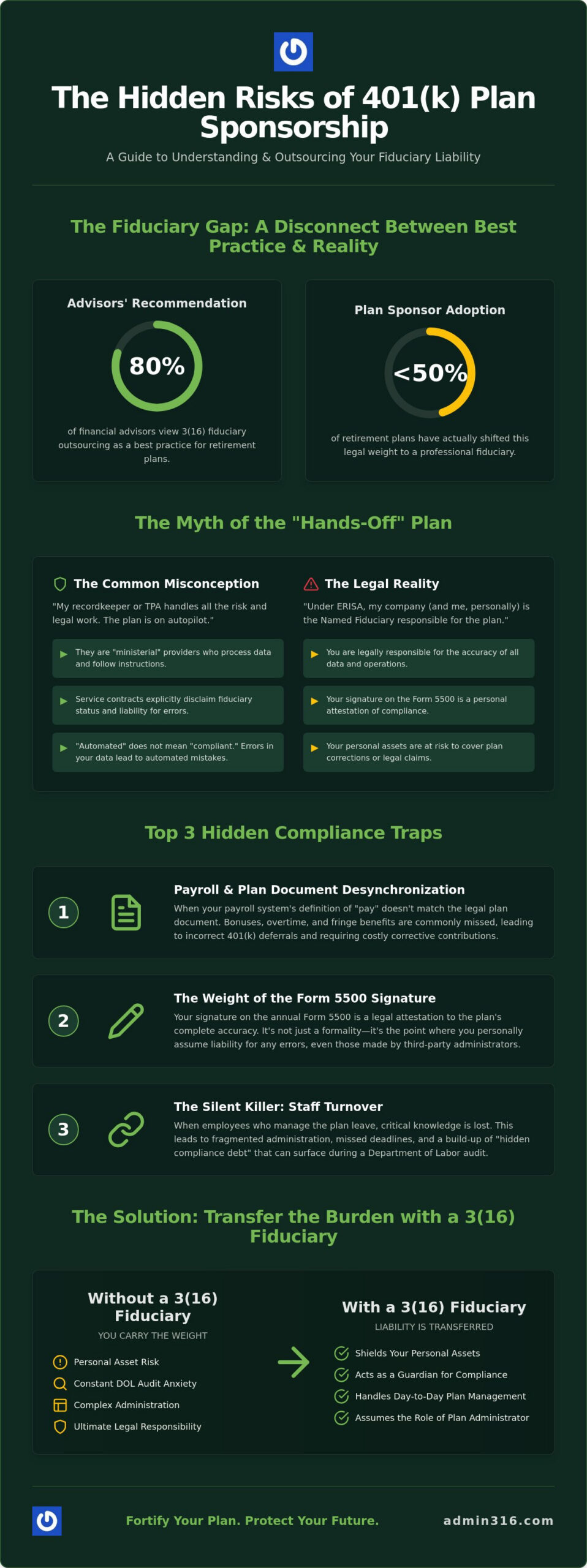
More than 80% of financial advisors now view 3(16) fiduciary outsourcing as a best practice, yet fewer than half of retirement plans have actually shifted this legal weight to a professional. You likely established your company’s 401(k) to support your team’s future, not to spend your weekends deciphering ERISA Section 3(16) or the complex nuances of the SECURE 2.0 Act. It’s natural to feel a persistent sense of anxiety regarding your personal liability as a plan sponsor, especially when a single oversight in participant notice distribution or a missed filing deadline can trigger a rigorous Department of Labor audit. These common retirement plan compliance mistakes employers make often stem from administrative overload rather than a lack of intent.
In this 2026 fiduciary guide, you’ll discover the hidden compliance traps that expose your company to regulatory scrutiny and learn how to effectively shift the legal burden of plan administration. We’ll examine critical upcoming requirements, such as the mandatory Roth catch-up contributions for high earners and the December 31 amendment deadline, while providing a clear path to shield your personal assets. By the end of this article, you’ll understand how to fortify your existing team with a specialized guardian who handles the heavy lifting of compliance for you.
Key Takeaways
- Learn why most service providers are considered ministerial and don’t assume the legal liability for your plan’s administration.
- Identify the common retirement plan compliance mistakes employers make when payroll definitions for bonuses and fringe benefits don’t align with plan documents.
- Understand the gravity of signing the Form 5500 and the importance of professional oversight for participant notice distribution.
- Uncover how internal staff turnover leads to fragmented administration and a build up of hidden compliance debt.
- Explore how an ERISA Section 3(16) fiduciary can shield your company by assuming the legal responsibility for daily plan management.
The Myth of the ‘Set It and Forget It’ Retirement Plan
Many business owners believe that hiring a recordkeeper or a Third Party Administrator (TPA) effectively removes the risk from their shoulders. They view the retirement plan as a “set it and forget it” benefit that runs on autopilot. This is one of the most dangerous retirement plan compliance mistakes employers make. While these partners handle the data and the mechanics, they rarely assume the legal consequences of errors. They are typically classified as “ministerial” service providers. This means they follow instructions and process data, but they don’t carry the fiduciary weight of the plan’s administration. The legal responsibility remains firmly with you.
There is a critical distinction between “doing the work” and “being legally responsible” for the work. Your current providers might perform the calculations, but you are the one who signs the documents and attests to their accuracy. We believe that compliance shouldn’t be a weight you carry in isolation. By acting as a specialized guardian, a professional fiduciary assumes the legal burden so that you can focus on the growth of your business without the constant shadow of regulatory anxiety.
Why Your Recordkeeper Isn’t Your Shield
Recordkeepers manage the digital plumbing of your 401(k). They provide the platform where employees log in and the automated systems that track contributions. However, standard service contracts almost always contain clauses that explicitly disclaim fiduciary status. If a payroll error occurs or an eligibility date is missed, the recordkeeper will point to the data you provided. They manage the information; you remain responsible for its accuracy. It is a common misconception that “automated” means “compliant.” If the inputs from your internal team are wrong, the software will simply process those errors, leaving you vulnerable to a Department of Labor audit.
The Reality of ERISA Fiduciary Liability in 2026
Under the Employee Retirement Income Security Act of 1974 (ERISA), specifically Section 402(a), every plan must have a “Named Fiduciary.” In most cases, this is the company owner or a high-level executive. This isn’t just a corporate title; it is a position of personal liability. When plan sponsors act as their own administrators, they are putting their personal assets at risk to satisfy potential legal claims or plan corrections.
The regulatory environment in 2026 is more complex than ever, but you don’t have to navigate it alone. We offer a burden-lifting solution where we assume the role of the 3(16) Plan Administrator. We take on the legal signature and the oversight duties, acting as a shield between your company and complex regulatory entities. This approach doesn’t replace your existing advisors; instead, it fortifies your plan with a layer of professional protection that preserves your peace of mind.
Not sure where your plan’s fiduciary liability actually sits?
Admin316 serves as your named 3(16) plan administrator and takes the filing, notice and compliance work off your desk — along with the liability that comes with it. A 15-minute call is usually enough to tell you where you stand.
Operational Errors: When Payroll and Plan Documents Desynchronize
The most frequent source of friction in retirement plan management isn’t the volatility of the stock market; it’s the hidden gap between your payroll system and your plan document. Most retirement plan compliance mistakes employers make occur because these two critical components fall out of sync over time. While your payroll software processes checks every two weeks, your plan document acts as the legal constitution for your benefit program. When the software isn’t configured to match the document’s specific definitions, a compliance breach is inevitable. These errors often remain invisible until a regulatory auditor begins a review of your books.
The Compensation Definition Disaster
Imagine your company awards a performance bonus to your sales team at the end of the year. If your payroll administrator assumes this bonus is “extra” pay and fails to withhold 401(k) deferrals, you have likely violated your plan’s legal definition of compensation. Most plan documents define compensation as “total gross pay,” which includes bonuses, overtime, and even certain fringe benefits. Excluding these amounts without a specific plan amendment is a primary cause of plan failure.
Fixing this error isn’t as simple as adjusting the next paycheck. You must often make “corrective contributions” to the affected employees’ accounts, paying out of company funds to make up for the missed deferral opportunity. Additionally, you must calculate and pay the “lost earnings” that the money would have gained if it had been invested on time. We act as a specialized guardian to audit the alignment between your payroll codes and plan definitions, ensuring that these costly discrepancies never reach the point of a regulatory filing.
Late Deposits: The DOL’s Favorite Red Flag
The Department of Labor (DOL) maintains a strict stance on the timing of employee deferrals. Their rule is simple yet demanding: you must deposit employee contributions into the plan as soon as they can be reasonably segregated from the company’s general assets. For many employers, this is interpreted as the earliest date possible, often within a few business days of the pay date.
A single late deposit, even if it’s only by 48 hours, is technically a prohibited transaction. It creates an unintentional “loan” from the plan to the employer, which is a significant red flag during a DOL audit retirement plan preparation process. By utilizing 3(16) fiduciary oversight, you gain a shield that monitors these timelines. We coordinate with your team to ensure deposits move swiftly and accurately, removing the risk of a simple timing error turning into a full-scale investigation.
Beyond deposit timing, eligibility tracking for retirement plans remains a moving target, especially with the shifting requirements of the SECURE 2.0 Act regarding long-term, part-time employees. If you feel the weight of these operational demands, you can partner with a professional fiduciary to assume these daily administrative burdens on your behalf.
Missing the Fine Print: Deadlines, Notices, and the Form 5500 Signature
While operational gaps in payroll are common, the administrative burden of regulatory filing and disclosure is where many companies stumble. These retirement plan compliance mistakes employers make often stem from a misunderstanding of the legal gravity behind a simple signature or a missed mailing date. Regulators typically target three specific areas: the Form 5500 filing, the Summary Annual Report (SAR), and the timely distribution of participant notices. In 2026, the complexity of these tasks has intensified due to the implementation of SECURE 2.0 Act provisions, making manual oversight a high-risk strategy for any business owner.
The Weight of the Form 5500 Signature
The individual whose pen touches the Form 5500 is the one the Department of Labor (DOL) holds personally accountable for every line item. For most calendar-year plans, the deadline for this filing is July 31, 2026. Signing this document isn’t just a routine administrative task; it’s a legal attestation that the plan has been managed in full accordance with ERISA standards. If the data is inaccurate or the filing is late, the signer carries the personal liability for any resulting penalties. Understanding what happens if your 401(k) is out of compliance — including steep IRS excise taxes and DOL audits — makes the gravity of this signature impossible to ignore.
You don’t have to carry this liability alone. By utilizing a form 5500 filing service, you can effectively transfer the legal burden to a professional. This signature acts as a formal hand-off of responsibility to a 3(16) partner who assumes the oversight of the data. We act as a shield, ensuring that your filings are meticulous and submitted on time, which preserves your personal assets from the weight of regulatory scrutiny.
Participant Notices: The Invisible Compliance Trap
The DOL requires that employees receive specific information at regular intervals, yet retirement plan participant notices are often overlooked until an audit begins. Mandatory disclosures include Safe Harbor notices, fee disclosures, and the Summary Annual Report, which must be distributed by September 30, 2026, for calendar-year plans. Relying on internal staff to track these dates and maintain proof of delivery is a dangerous gamble. Missing a single eligible employee can be interpreted as a breach of fiduciary duty.
We believe that your internal team should be supported, not replaced. As a Specialized Guardian, we coordinate the entire notice process alongside your existing recordkeeper and HR department. We assume the duty of distribution and guarantee that every participant receives the required information within the legal window. This layer of protection ensures that you remain compliant with the evolving 2026 standards without adding to your team’s daily workload.
The Silent Compliance Killer: Staff Turnover and Fragmented Administration
A common refrain among business owners is, “My HR manager handles all of that.” While your internal team is undoubtedly capable, relying on a single individual to manage the intricate web of ERISA regulations is a high-stakes gamble. When that knowledgeable staff member leaves, they often take “tribal knowledge” with them, leaving behind a vacuum of documentation and process. This transition period is when “Compliance Debt” begins to accumulate. These hidden retirement plan compliance mistakes employers make often go unnoticed for years, only surfacing when a successor discovers a backlog of missed notices or unfiled documents during a transition audit.
Fragmented administration is the second half of this silent threat. When your payroll provider, HR department, and Third Party Administrator (TPA) operate in silos, blind spots inevitably emerge. Data is passed from one entity to another without a central authority to verify its accuracy or legal compliance. Retirement plan compliance outsourcing provides a layer of protection that bridges these gaps, offering institutional continuity that remains steady even when your internal personnel change. We don’t replace your team; we fortify it by acting as the permanent repository for plan governance and fiduciary accountability.
Why Your HR Department Shouldn’t Be Your Fiduciary
HR professionals are experts in talent acquisition, culture, and employee relations, but they are rarely trained in the high-formality technical register of retirement law. Placing the legal weight of fiduciary responsibility on their shoulders creates an unnecessary burden and a potential conflict of interest. If an error occurs, the company owner remains the one legally accountable to the Department of Labor. By appointing an independent fiduciary, you remove the professional anxiety from your staff and ensure that the plan is overseen by a specialized guardian whose only priority is regulatory stability. This partnership allows your HR team to focus on people while we assume the responsibility for the legal mechanics.
Bridging the Gap Between Payroll and Providers
Establishing a permanent compliance shield requires a methodical approach to data flow. To mitigate the risks of fragmented administration, we recommend a structured transition to fiduciary oversight. This process ensures that no detail is lost between your payroll system and your plan providers.
- Step 1: Identify all ‘moving parts’ in the plan administration. This involves mapping out exactly how data moves from your payroll software to your recordkeeper and who is responsible for each touchpoint.
- Step 2: Assign a ERISA 3(16) plan administrator to oversee the data flow. By transferring this duty to a professional, you ensure that an expert eye is constantly monitoring the “blind spots” between your various service providers.
If you are concerned about the “Compliance Debt” that may be building up in your current system, you can request a fiduciary review from Admin316 to identify and resolve these risks before they result in a regulatory audit.
Transferring the Burden: How 3(16) Fiduciary Services Shield Your Business
The cumulative weight of managing a retirement plan often feels like a second full-time job for business owners. As we have explored, the most common retirement plan compliance mistakes employers make are rarely the result of negligence. They are the natural outcome of a complex regulatory environment meeting a busy internal team. You don’t have to carry this legal weight in isolation. By transferring the administrative burden to a professional, you achieve a level of professional peace that allows you to focus on your core business objectives while knowing your personal assets are shielded.
Keeping Your Advisor, Losing the Liability
Many employers hesitate to seek fiduciary support because they fear it will disrupt their existing professional relationships. Our “Specialized Guardian” model is built on the principle of non-displacement. We don’t replace your investment advisor or your recordkeeper; we fortify them. We work alongside your current team to handle the legal back-office tasks that fall outside their scope. We assume the role of the ERISA 3(16) Plan Administrator so that your advisor can focus on investment strategy and your HR team can focus on employee culture. This collaborative shield ensures that administrative gaps are closed without severing the bonds you’ve built with your trusted partners.
When you transfer the legal burden to a 3(16) partner, you delegate the specific tasks that often lead to compliance failures:
- Signing the Form 5500 as the Plan Administrator to assume legal accountability.
- Coordinating and distributing all mandatory participant notices within strict deadlines.
- Monitoring eligibility tracking to ensure long-term, part-time employees are correctly included.
- Auditing payroll data to ensure compensation definitions align with plan documents.
- Managing the QDRO process and participant loan approvals with professional precision.
The Admin316 Difference: Decades of Fiduciary Expertise
Institutional permanence is the foundation of trust. Admin316 has specialized in 3(16) fiduciary services since 1997, providing a stable anchor for plans across the country. We understand the gravity of the legal signature, and we embrace the responsibility that comes with it. The relief of knowing a professional is overseeing every filing and notice distribution is the ultimate antidote to regulatory anxiety. We handle the heavy lifting so that your company remains protected and your team remains focused.
When evaluating a 3(16) partner to protect your business, use this checklist to ensure they provide a comprehensive shield:
- Does the firm assume full legal liability as a Named Fiduciary?
- Do they have a proven track record of longevity (e.g., 25+ years)?
- Will they sign the Form 5500 on your behalf as the Plan Administrator?
- Do they offer a non-displacement guarantee for your current advisor?
- Is their service model proactive rather than merely reactive?
You have built your company through years of hard work and dedication. Don’t let administrative oversights put your legacy at risk. Transfer your administrative burden to the experts at Admin316 and reclaim the peace of mind that comes with professional fiduciary protection.
Securing Your Legacy with Professional Fiduciary Oversight
The regulatory landscape of 2026 demands a shift from passive administration to proactive governance. As we have examined, the most significant retirement plan compliance mistakes employers make often occur in the quiet gaps between payroll systems, internal staff transitions, and complex filing deadlines. These aren’t just administrative hurdles; they are personal liability risks that can weigh heavily on your professional peace of mind. By recognizing that your recordkeeper provides the tools while you provide the legal signature, you can begin to see the necessity of a specialized guardian to carry that weight for you.
We provide a permanent layer of protection that preserves your existing professional bonds while assuming the legal accountability you currently hold in isolation. Serving plan sponsors as an independent 3(16) fiduciary specialist since 1997, we work alongside your current advisor and recordkeeper to ensure every notice is sent and every filing is meticulous. You deserve the stability of a plan that runs with precision. Secure your plan and lift the compliance burden with Admin316. Your focus belongs on your business; let us handle the heavy lifting of your fiduciary duties.
Frequently Asked Questions
What is the most common retirement plan compliance mistake for small businesses?
The most frequent error involves failing to correctly apply the plan’s definition of compensation, especially regarding bonuses and overtime pay. Small businesses often assume their payroll software handles these nuances automatically, but software only processes the codes you provide. This is one of the most common retirement plan compliance mistakes employers make. Correcting these errors usually requires making retroactive company contributions and paying lost earnings to affected employees.
Can I be held personally liable for 401(k) compliance errors?
Yes, ERISA Section 409 establishes that plan fiduciaries are personally liable for any losses resulting from a breach of their duties. This means your personal assets could be at risk to satisfy plan corrections or legal claims. While corporate structures protect you from many business debts, they do not shield you from fiduciary liability. Shifting this responsibility to a professional 3(16) partner is the most effective way to protect your personal estate.
Does my TPA already act as a 3(16) fiduciary?
Most Third Party Administrators do not act as 3(16) fiduciaries; they generally perform ministerial tasks under your direction. Their service contracts typically state they are not fiduciaries and that the employer remains the legal Plan Administrator. While they prepare the Form 5500, you are usually the one who signs it and carries the legal weight. You must specifically hire an ERISA Section 3(16) Plan Administrator to transfer that legal accountability.
What happens if I miss a participant notice deadline?
Missing a participant notice deadline, such as the Summary Annual Report or Safe Harbor notice, can trigger significant Department of Labor penalties. Beyond the fines, it creates a compliance gap that regulators view as a failure in plan governance. These oversights are often the catalyst for a broader audit of your entire retirement plan. We coordinate notice distribution to ensure every eligible employee receives required disclosures within the legal window.
How does a 3(16) administrator differ from a 3(38) investment manager?
A 3(16) administrator handles the daily operations and legal compliance of the plan, while a 3(38) investment manager assumes responsibility for selecting and monitoring the plan’s investments. Think of the 3(16) as the back-office legal guardian and the 3(38) as the investment expert. Both roles are designed to lift different types of fiduciary weight from your shoulders. We focus on the 3(16) administrative duties to shield you from operational risks.
Is it possible to outsource 401(k) administration without changing my investment advisor?
You can absolutely outsource your plan administration without disrupting your relationship with your current investment advisor. Our model is designed for non-displacement, meaning we act as an independent layer of protection alongside your existing team. We handle the legal mechanics and Form 5500 signing so your advisor can focus on wealth management. This partnership ensures you keep your trusted advisors while removing the administrative liability from your desk.
What are the penalties for late Form 5500 filings in 2026?
Late Form 5500 filings carry heavy penalties that accumulate daily from both the Department of Labor and the IRS. For the 2025 plan year, the DOL can assess penalties that exceed $2,600 per day for late filings. These fines can quickly grow into six-figure liabilities if they aren’t addressed through the Delinquent Filer Voluntary Compliance Program. We assume the responsibility for timely filing to prevent these avoidable financial burdens from impacting your company.
How do I know if my company needs a 3(16) plan administrator?
Your company likely needs a 3(16) administrator if you lack a dedicated internal team to monitor complex ERISA regulations and payroll alignment. If you feel the weight of personal liability or find yourself overwhelmed by participant notice deadlines, it’s time to consider retirement plan compliance outsourcing as a strategic solution. Many retirement plan compliance mistakes employers make occur because of staff turnover or fragmented systems. Partnering with a specialized guardian provides the institutional continuity required for long-term stability.
Transfer this responsibility to a professional fiduciary.
Every item in this article is work Admin316 does for plan sponsors every day as an ERISA 3(16) administrator. Bring us your plan documents and we’ll show you exactly which risks move off your shoulders.