Most business owners view retirement plan participant notices as a routine mailing task, but they’re actually a significant legal liability that can jeopardize your company’s compliance standing. When your internal team handles these disclosures, they’re carrying a heavy weight of tracking shifting deadlines and the constant fear of missing a SECURE 2.0 update. It’s a technical burden that often leads to professional anxiety, especially when dealing with undeliverable mail or “missing participants.”
We agree that managing these complex ERISA requirements is an overwhelming distraction from your primary business goals. This guide will help you master the intricate world of disclosures and show you how to transfer the legal burden of communication to a specialized fiduciary. You’ll get a clear list of required notices for 2026 and learn how to shield your team from distribution liability. By the end, you’ll have a roadmap to ensure your plan is audit-ready while your internal staff focuses on what they do best.
Key Takeaways
- Recognize how recent SECURE 2.0 implementations have increased the regulatory weight and frequency of mandatory plan disclosures.
- Utilize a structured 2026 checklist to organize your retirement plan participant notices into annual, quarterly, and event-driven categories.
- Learn why your TPA likely doesn’t assume distribution liability, leaving the legal risk on your shoulders.
- Adopt modern best practices for electronic delivery and “missing participant” searches to protect your plan during audits.
- Discover how appointing an ERISA Section 3(16) Plan Administrator serves as a shield, letting you hand off the heavy lifting of compliance to a specialized guardian.
The Regulatory Weight of Retirement Plan Participant Notices in 2026
Retirement plan participant notices are far more than administrative paperwork; they are the “voice” of your plan’s compliance under federal law. When these communications are handled internally, the weight of accuracy falls squarely on your team’s shoulders. Each notice serves as a vital bridge between the plan sponsor and the participant, ensuring that rights are protected and obligations are met. Without this transparency, even a well funded plan can face significant legal exposure. We understand that tracking these deadlines is a taxing process, but it’s a fundamental requirement for maintaining a qualified status.
Why ERISA Mandates Transparent Communication
The Employee Retirement Income Security Act of 1974 (ERISA) was established to protect the interests of employee benefit plan participants. Transparent communication isn’t just a courtesy; it’s a legal safeguard designed to facilitate informed decision making. When a notice is missed or contains errors, it often triggers a Department of Labor (DOL) inquiry. These inquiries can lead to costly penalties or even claims of fiduciary breach. By maintaining a steady flow of accurate information, you preserve the trust of your employees and satisfy the rigorous standards of federal oversight. This transparency acts as a primary defense against litigation and regulatory scrutiny.
The Evolving Landscape of SECURE 2.0 Disclosures
As we move through 2026, the requirements for retirement plan participant notices have become increasingly stringent. The implementation of the SECURE 2.0 Act has introduced several new layers of complexity that internal teams often struggle to track. For instance, there are now specific requirements for “unvested” participant statements to ensure those who have left the company understand their remaining account status. Additionally, changes to the timing and clarity of auto-enrollment notices require meticulous coordination to remain compliant. The Summary Plan Description (SPD) serves as the foundational ERISA document that outlines the rules and benefits of the plan for all participants.
Managing these updates manually creates a constant state of professional anxiety. We position ourselves as a specialized guardian to lift this burden. By appointing an ERISA Section 3(16) Plan Administrator, you shift the legal liability of these communications away from your office. We assume the responsibility for the distribution and accuracy of every retirement plan participant notice, acting as a shield between your company and regulatory entities. This transition from internal management to fiduciary oversight replaces a difficult, high risk task with a seamless resolution. We oversee the technical details so that you can preserve your focus on your business.
Not sure where your plan’s fiduciary liability actually sits?
Admin316 serves as your named 3(16) plan administrator and takes the filing, notice and compliance work off your desk — along with the liability that comes with it. A 15-minute call is usually enough to tell you where you stand.
Mandatory ERISA Disclosures: A 2026 Compliance Checklist
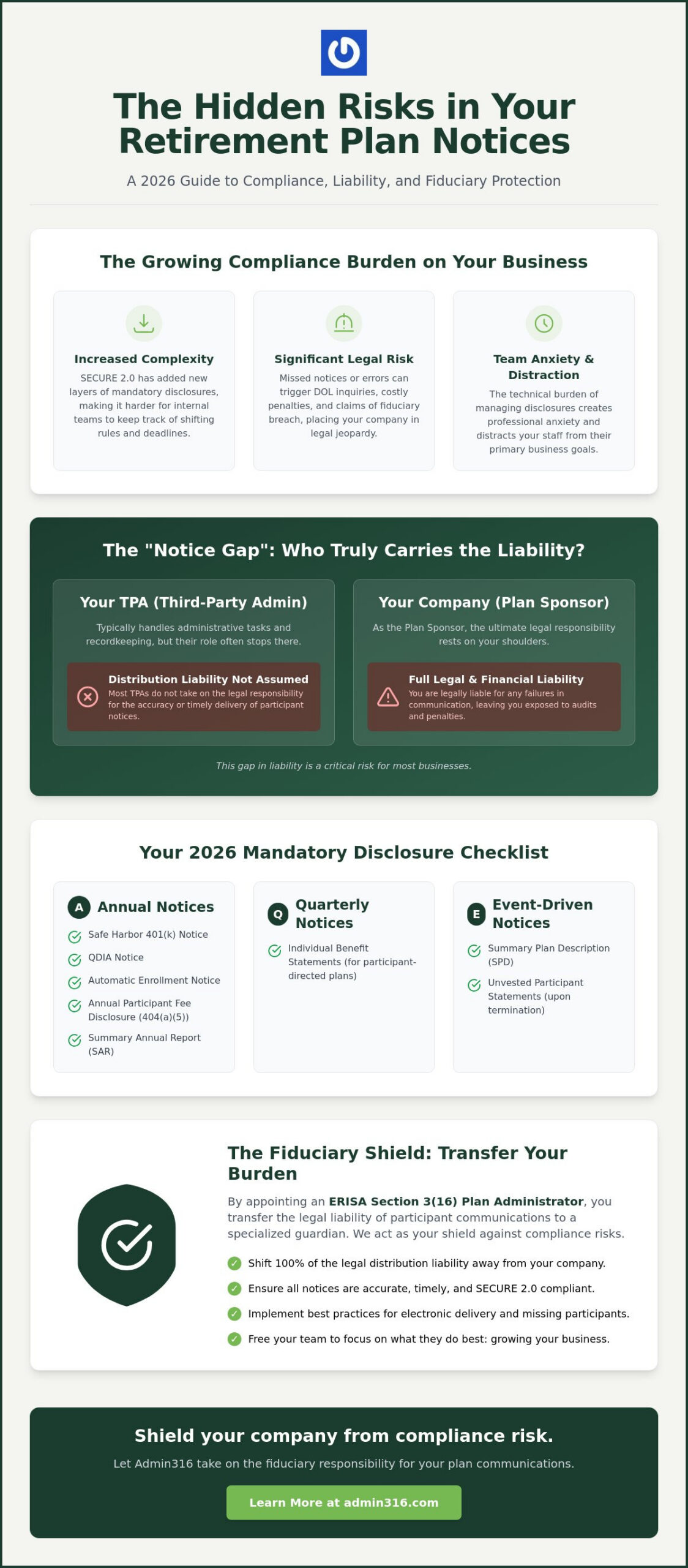
Maintaining compliance requires a methodical approach to tracking various retirement plan participant notices. We categorize these requirements by their frequency to help you visualize the timeline and mitigate the risk of missed deadlines. By organizing these duties into annual, quarterly, and event-driven buckets, you can replace a chaotic manual process with a disciplined compliance rhythm. This structure provides the stability your internal team needs to ensure no participant is left uninformed.
Annual and Quarterly Periodic Notices
The Summary Annual Report (SAR) is a critical financial disclosure that translates complex Form 5500 data into a readable format for your employees. For calendar year plans, the deadline to file Form 5500 for the 2025 plan year is July 31, 2026, which typically sets the SAR distribution deadline for two months later. In addition to the SAR, participant directed plans must distribute individual benefit statements at least quarterly. These statements provide transparency and allow participants to track their progress toward retirement goals.
Several annual reminders also require your attention before each new plan year begins. For the 2026 plan year, calendar year plans must distribute the following by December 2, 2025:
- Safe Harbor 401(k) Notice: Explains the employer contribution and vesting rules.
- Qualified Default Investment Alternative (QDIA) Notice: Informs participants where their funds will be invested if they don’t make an election.
- Automatic Enrollment Notice: Details the default deferral rates and the right to opt out.
- Annual Participant Fee Disclosure (404(a)(5)): Provides a clear breakdown of investment and administrative costs.
Event-Driven Disclosures You Cannot Ignore
Beyond the predictable calendar, certain plan changes trigger immediate communication requirements. A Summary of Material Modifications (SMM) must be provided following any significant change to plan terms, such as a new vesting schedule or a change in matching formulas. If you’re transitioning recordkeepers, a blackout period notice is mandatory to inform participants when their ability to direct investments or take loans will be temporarily suspended. This notice must typically be provided 30 to 60 days before the blackout begins.
Managing “missing participants” is another area where the weight of responsibility is heavy. When mail is returned or a participant cannot be located, you must follow the DOL guidance on missing participants to demonstrate a good faith effort in your search. This includes using certified mail, checking related plan records, and utilizing public search records. Handling these specific retirement plan participant notices correctly is essential for shielding your company during a DOL audit. If the complexity of these tasks feels overwhelming, you can outsource the administrative burden to a fiduciary who assumes full legal accountability for every distribution.
The “Notice Gap”: Why Your TPA May Not Be Protecting You
A common misconception among business owners is that hiring a Third Party Administrator (TPA) or recordkeeper automatically shifts the legal burden of compliance communications. In reality, most service agreements are structured to leave the plan sponsor holding the weight of responsibility. While a TPA might provide the software or templates to generate documents, the duty to ensure they reach the right hands at the right time remains yours. This creates a “Notice Gap” where you assume you’re protected, yet you’re still legally exposed to Department of Labor (DOL) penalties. We understand the confusion this causes, and we’re here to act as a shield for your company.
Production vs. Distribution vs. Liability
It’s vital to understand the difference between notice production and notice distribution. A recordkeeper’s system may print retirement plan participant notices, but if those documents sit in a portal or a mailroom without being delivered, the compliance chain is broken. Under a standard TPA model, the answer to who is responsible for a missed mailing is always the plan sponsor. We contrast this “template-only” model with our role as an ERISA Section 3(16) Plan Administrator. We don’t just provide the documents; we assume the legal risk of mailing errors. We take the duty from your desk and place it on ours.
The Hidden Risks of Internal Distribution
Internal HR teams often become the weakest link in the compliance chain because they’re juggling competing priorities. Tracking eligibility for new hires across multiple locations is a complex, manual task that invites human error. When mail is returned to sender, the administrative nightmare begins. Does your team have a documented process for locating “missing participants” that meets DOL standards? Most don’t have one. These small gaps in execution can lead to significant liabilities during an audit. We oversee the technical details of distribution so that your internal team is no longer burdened by the anxiety of missed deadlines or undeliverable mail.
Admin316 closes this gap by stepping into the role of Plan Administrator. We assume the fiduciary weight that your TPA leaves behind. This isn’t just a software solution; it’s a transfer of legal accountability. We coordinate with your existing team to ensure that every retirement plan participant notice is distributed accurately and on time. You preserve your existing professional relationships while adding a layer of protection that shields you from the consequences of administrative oversight. This rhythmic sense of delegation allows your business to move forward with confidence, knowing the legal burden has been successfully transferred.
Modern Distribution Best Practices: Electronic Delivery and Missing Participants
While identifying which notices are required is a technical hurdle, the actual delivery of those documents presents a logistical challenge that carries its own set of legal risks. Modernizing your approach to retirement plan participant notices requires more than a digital transition. It demands a rigorous coordination of data between your payroll provider, recordkeeper, and plan administrator to ensure no employee is overlooked. We act as your specialized guardian in this process, overseeing the flow of information to maintain a clean compliance record and protect your plan’s qualified status.
Navigating Electronic Disclosure Rules
The Department of Labor (DOL) provides Safe Harbor frameworks that allow for electronic disclosure, yet these rules are often misunderstood by internal teams. The 2020 “Notice and Access” rule allows for a “delivery by posting” model. However, you must still provide an initial paper notice of the right to opt out before implementing this framework. For participants who don’t have regular access to a computer as part of their daily work duties, you must still provide paper copies unless they affirmatively consent to digital delivery. An auditable delivery log is the only defense during a DOL audit. Without a timestamped record of every digital transmission, your plan remains vulnerable to claims of non-compliance if a participant alleges they never received a disclosure.
The Missing Participant Challenge
We mitigate this risk by integrating comprehensive participant searches directly into our notice process. As your 3(16) Plan Administrator, we don’t just mail documents. We manage the entire lifecycle of the communication. If a notice fails to reach its destination, we initiate the necessary search protocols to fulfill your fiduciary duty and document the effort. This “burden-lifting” service ensures that you’re not just sending mail. You’re maintaining a compliant, audit-ready plan. You can appoint an ERISA Section 3(16) Plan Administrator to assume these duties and shield your company from the weight of distribution liability.
Transferring the Burden: How Admin316 Acts as Your Specialized Guardian
The complexity of retirement plan participant notices isn’t just a matter of logistics; it’s a matter of legal survival. Managing these requirements internally creates a constant state of professional anxiety that distracts you from growing your business. We offer a “Problem-Solution-Peace” approach that allows you to hand off this entire duty. By appointing an ERISA Section 3(16) Plan Administrator, you’re not just buying a service; you’re transferring a legal object, the liability itself, away from your corporate entity. We assume the legal responsibility so that you can focus on your core business.
A Shield Between You and Regulatory Entities
When we assume the role of Plan Administrator, we step into the gap between your company and regulatory bodies like the DOL and IRS. We don’t just advise you on what to do; we perform the work and sign the documents. This means we carry the weight of every mailing deadline and every eligibility calculation. Our methodical process ensures that every retirement plan participant notice is tracked with precision. With over 25 years of fiduciary expertise, we’ve developed the institutional permanence required to shield our clients from the consequences of administrative oversight. You gain the stability of a seasoned expert who handles the heavy lifting behind the scenes.
Preserving Your Professional Relationships
We believe in a “non-displacement” philosophy that fortifies your current team rather than replacing it. We work alongside your existing investment advisor and recordkeeper to create a seamless layer of protection. You keep the professional bonds you’ve built, but you lose the stress of managing the administrative minutiae. We coordinate directly with your payroll provider to ensure a consistent data flow, which is the foundation of accurate notice distribution. This collaborative approach preserves the integrity of your plan while removing the technical burden from your HR staff. A sound eligibility tracking retirement plan process is equally essential to this foundation, ensuring that the right participants receive the right notices at the right time.
The transition to our oversight is methodical and deliberate. We identify your specific liability points, offer our comprehensive fiduciary oversight as the antidote, and provide long-term stability through meticulous execution. This rhythmic sense of delegation ensures that your plan remains audit-ready without taxing your internal resources. Lifting the compliance burden starts with a conversation. Contact Admin316 today.
Securing Your Plan’s Future Through Fiduciary Accountability
Managing retirement plan participant notices shouldn’t be a source of professional anxiety for your internal team. We’ve explored how the regulatory landscape has shifted in 2026, making it clear that a standard TPA model often leaves a “Notice Gap” in your protection. By recognizing that distribution is a legal liability rather than a simple administrative task, you can move toward a more secure operational model that prioritizes accuracy and accountability.
Admin316 acts as a shield between your company and complex regulatory entities. Founded in 1997, we are an independent 3(16) fiduciary with a national service scope, dedicated to handling the heavy lifting of compliance. We don’t replace your existing advisor or recordkeeper; we fortify your current team by assuming the legal responsibility for every disclosure. This methodical approach ensures your plan is audit-ready while you preserve your focus on business growth and long term stability.
Transfer your fiduciary liability to the experts at Admin316 and reclaim your peace of mind. We’re here to oversee the technical details so you can move forward with confidence.
Frequently Asked Questions
Who is legally responsible for sending 401(k) participant notices?
The Plan Administrator is the entity legally accountable for the distribution of all retirement plan participant notices. Under ERISA, this role defaults to the employer unless you formally appoint an ERISA Section 3(16) Plan Administrator. We assume this technical burden so that your team doesn’t have to track every deadline internally. This transfer of duty ensures that the legal weight of compliance rests with a specialized expert.
Does my TPA automatically handle all retirement plan disclosures?
Most TPAs provide the tools for notice production but rarely assume the legal liability for distribution. This creates a gap where the employer is still responsible if a notice is never received or if a deadline is missed. We close this gap by taking full fiduciary accountability for the entire communication lifecycle. We don’t just provide templates; we oversee the actual delivery to your participants.
What are the penalties for missing a required participant notice?
Fines for non-compliance can be severe and compound quickly. For instance, failing to provide a Summary Plan Description within 30 days of a request can result in penalties of up to $195 per day per participant (2026 indexed rate, capped at $1,956 per request). These costs often surface during a Department of Labor audit, leading to significant financial exposure and potential fiduciary breach claims. Proactive DOL audit retirement plan preparation is the most effective way to mitigate these risks through methodical tracking before an inquiry ever begins.
Can all retirement plan notices be sent electronically in 2026?
Most notices can be sent electronically if you follow the DOL’s “Notice and Access” safe harbor rules. You must ensure that participants have a reasonable expectation of receiving the digital notice and provide a paper version if they opt out or lack regular computer access at work. We coordinate these frameworks for you to ensure your electronic delivery is legally defensible and an auditable trail is maintained.
What is a Summary of Material Modifications (SMM) and when is it required?
A Summary of Material Modifications is a mandatory update issued when significant changes are made to your plan’s terms. You must distribute an SMM whenever you modify vesting schedules, matching contributions, or eligibility requirements. It serves as a vital amendment to your Summary Plan Description. This ensures participants stay informed of changes that affect their benefits and satisfies your transparent communication requirements.
How does a 3(16) fiduciary reduce my liability for participant notices?
A 3(16) fiduciary acts as a shield by formally assuming the legal duties of the Plan Administrator. We sign the required documents and oversee the technical execution of the mailing process. This rhythmic sense of delegation removes professional anxiety by transferring the risk of administrative errors to our specialized team. You preserve your focus on business growth while we carry the weight of regulatory compliance.
What should I do if a participant notice is returned as undeliverable?
You must initiate a documented search process that aligns with the 2021 DOL best practices for missing participants. This involves using commercial locator services, certified mail, and related plan records to find the individual. We integrate these search protocols into our service to preserve your compliance standing. Handling undeliverable mail correctly is essential for protecting the plan’s qualified status and demonstrating a good faith effort.
How often must Individual Benefit Statements be provided to employees?
Participant-directed plans must provide these statements at least quarterly to ensure transparency and informed decision making. If your plan is not participant-directed, the requirement is generally once per year. Keeping a consistent schedule for retirement plan participant notices helps participants track their retirement goals and satisfies your ERISA obligations. We coordinate with your recordkeeper to ensure these statements are distributed accurately and on time. Maintaining an accurate eligibility tracking retirement plan checklist ensures that every eligible participant is included in this distribution cycle without exception.
Transfer this responsibility to a professional fiduciary.
Every item in this article is work Admin316 does for plan sponsors every day as an ERISA 3(16) administrator. Bring us your plan documents and we’ll show you exactly which risks move off your shoulders.