Key Takeaways
- Establish a structured cadence for fiduciary duties by utilizing a comprehensive 401k plan compliance checklist that organizes quarterly and annual tasks.
- Protect your business from Department of Labor scrutiny by maintaining a meticulous fiduciary trail where every plan amendment and participant notice is documented.
- Prepare for 2026 regulatory shifts, including the expansion of eligibility for part-time workers and mandatory automatic enrollment features for newer plans.
- Transition from a high-risk DIY administration model to a protected framework where an ERISA 3(16) Plan Administrator assumes the legal weight of your plan’s governance.
The Gravity of 401k Compliance in 2026
Compliance is the invisible foundation of a healthy retirement benefit. It represents the continuous alignment of your 401(k) plan with the rigorous standards set by ERISA and the IRS. For many business owners, this feels like an abstract legal requirement. However, the Department of Labor views it as a concrete, daily obligation. When you maintain a rigorous 401k plan compliance checklist, you aren’t just organizing paperwork. You are actively mitigating the risk of plan disqualification and protecting your company from severe financial penalties.The legal weight of a plan rests heavily on the shoulders of the Plan Sponsor. While you likely focus on the role of the Sponsor, which involves the high level decision to offer the plan, the law also identifies a “Plan Administrator.” This is the entity responsible for the granular, technical execution of the plan’s rules. If these roles aren’t clearly defined and professionally managed, the stakes are high. Non-compliance doesn’t just result in a letter from the IRS; it can lead to the loss of tax-advantaged status for all participants, creating a catastrophic financial event for your entire workforce.Why 2026 is a Pivotal Year for Plan Sponsors
2026 marks a critical juncture because the grace periods for several SECURE Act 2.0 provisions are coming to an end. By December 31, 2026, most plans must be formally amended to reflect mandatory changes, including updated rules for long-term, part-time employees. The Department of Labor has also intensified its focus on fee transparency, demanding that sponsors provide clear evidence that they are acting in the best interest of participants. This shift toward automated compliance requirements means that manual errors are more visible than ever. Using a 401k plan compliance checklist helps ensure that these new, complex requirements don’t slip through the cracks during this high-pressure transition period.The Personal Liability of the “Named Fiduciary”
Under ERISA Section 402(a), every plan must have a “Named Fiduciary.” This individual or entity has the ultimate authority to manage and control the plan. Many company officers don’t realize they hold this title by default. This translates into significant personal financial risk. If an administrative error occurs, your personal assets could be on the line to make the plan whole. A common misconception is that a Third Party Administrator (TPA) handles this risk. In reality, most TPAs are service providers, not fiduciaries. They process the data you provide, but they don’t shield you from the legal consequences of errors. We assume these responsibilities alongside your existing team, providing a layer of protection that a standard TPA simply cannot offer.Not sure where your plan’s fiduciary liability actually sits?
Admin316 serves as your named 3(16) plan administrator and takes the filing, notice and compliance work off your desk — along with the liability that comes with it. A 15-minute call is usually enough to tell you where you stand.
The Essential 2026 401k Compliance Checklist
Managing a retirement plan effectively requires a shift from reactive troubleshooting to a disciplined, proactive cadence. A well-structured 401k plan compliance checklist serves as your operational blueprint, ensuring that no regulatory requirement is overlooked. It’s vital to differentiate between plan design, which focuses on the high-level goals of your benefits, and operational execution, which involves the daily technical tasks that carry the most risk. While your investment advisor helps design the plan, the operational burden often falls on your internal team. Coordinating these efforts between advisors and recordkeepers is essential to maintain plan integrity and protect your professional standing.Quarterly and Periodic Maintenance Tasks
Operational hygiene is maintained through small, repetitive actions that prevent large-scale audits. One of the most frequent points of failure is eligibility tracking. With the 2026 regulations for long-term, part-time employees now fully active, you must identify newly eligible staff every month or quarter. Failing to do so can result in expensive “missed opportunity” corrections that drain company resources. As part of your periodic review, you should also ensure payroll systems are updated to reflect the 2026 employee contribution limit of $24,500 and the “super” catch-up limit of $11,250 for those aged 60 to 63.- Timely Deposits: The Department of Labor enforces strict timelines for depositing employee deferrals. For small plans, the “7-day rule” is the standard. You must ensure funds are moved as soon as they can be reasonably segregated from general assets.
- Benefit Statements: You’re required to distribute quarterly benefit statements to all participants. These documents provide transparency and ensure participants are aware of their account status and investment performance.
Annual Reporting and Disclosure Milestones
The annual cycle of a plan involves significant fiduciary responsibilities that carry heavy legal weight. The most visible of these is the Form 5500. For calendar-year plans, the filing deadline for the 2025 plan year is July 31, 2026. A critical question for every business owner is: who is actually signing as the Plan Administrator? If your name appears on that line, you’re personally vouching for the accuracy of the filing and assuming the legal liability for any errors found during an audit. Engaging professional 401k audit services can help ensure your Form 5500 is filed accurately and on time, transferring the legal weight of this high-stakes obligation to a dedicated fiduciary.Beyond filings, you must oversee the distribution of essential participant notices. These include Safe Harbor notices, Qualified Default Investment Alternative (QDIA) notices, and Fee Disclosures. Following the 5500 filing, you must also distribute the Summary Annual Report (SAR) to all participants to maintain transparency. If these tasks feel like an administrative burden that distracts from your core mission, you might consider how a professional plan administrator can assume these duties on your behalf, providing a shield between your company and regulatory scrutiny.Documentation and Recordkeeping: Audit-Proofing Your Plan
The “fiduciary trail” is the only thing standing between your business and a Department of Labor (DOL) penalty. In the eyes of a regulatory auditor, if a decision or action isn’t documented, it effectively didn’t happen. Maintaining the integrity of your Plan Document and its subsequent amendments is a non-negotiable duty. As we move toward the critical December 31, 2026, amendment deadline for SECURE Act 2.0, your 401k plan compliance checklist must prioritize the preservation of these legal records. We oversee this process for our partners, ensuring that every legislative update is captured and archived with precision.Organizing a digital compliance folder is your best defense for an immediate audit response. This shouldn’t be a disorganized pile of emails; it must be a structured repository that demonstrates a consistent pattern of governance. Historical longevity matters here. Because ERISA records often need to be kept for at least six years, and sometimes much longer, you need a partner with established tenure. We have been specialized in assuming these administrative responsibilities since 1997. We preserve your data so that you can focus on your company’s growth, knowing your “fiduciary shield” is intact.The Auditor’s Toolkit: What the DOL Wants to See
When a DOL auditor arrives, they don’t just look at totals; they look for the process behind the numbers. Your documentation must provide a clear narrative of your plan governance. Specifically, an auditor will expect to see detailed investment committee meeting minutes that outline the rationale behind fiduciary decisions. They’ll also require concrete evidence of timely participant notice delivery and payroll records that match 401(k) contribution files exactly. By maintaining these records in real-time, you remove the professional anxiety associated with a surprise investigation.Managing Participant Data and Eligibility
Tracking “lost” participants and uncashed checks is a growing administrative burden that many sponsors overlook. These abandoned accounts represent a significant liability if they aren’t managed according to IRS guidelines. Additionally, the process of handling distributions and loans requires a high degree of accuracy to avoid tax errors. By automating the eligibility notification process, you can prevent “missed deferral” errors before they occur. We coordinate these complex data points alongside your internal team, acting as a meticulous guardian for your participant records. This level of oversight ensures that your 401k plan compliance checklist isn’t just a list of tasks, but a robust framework for long-term stability.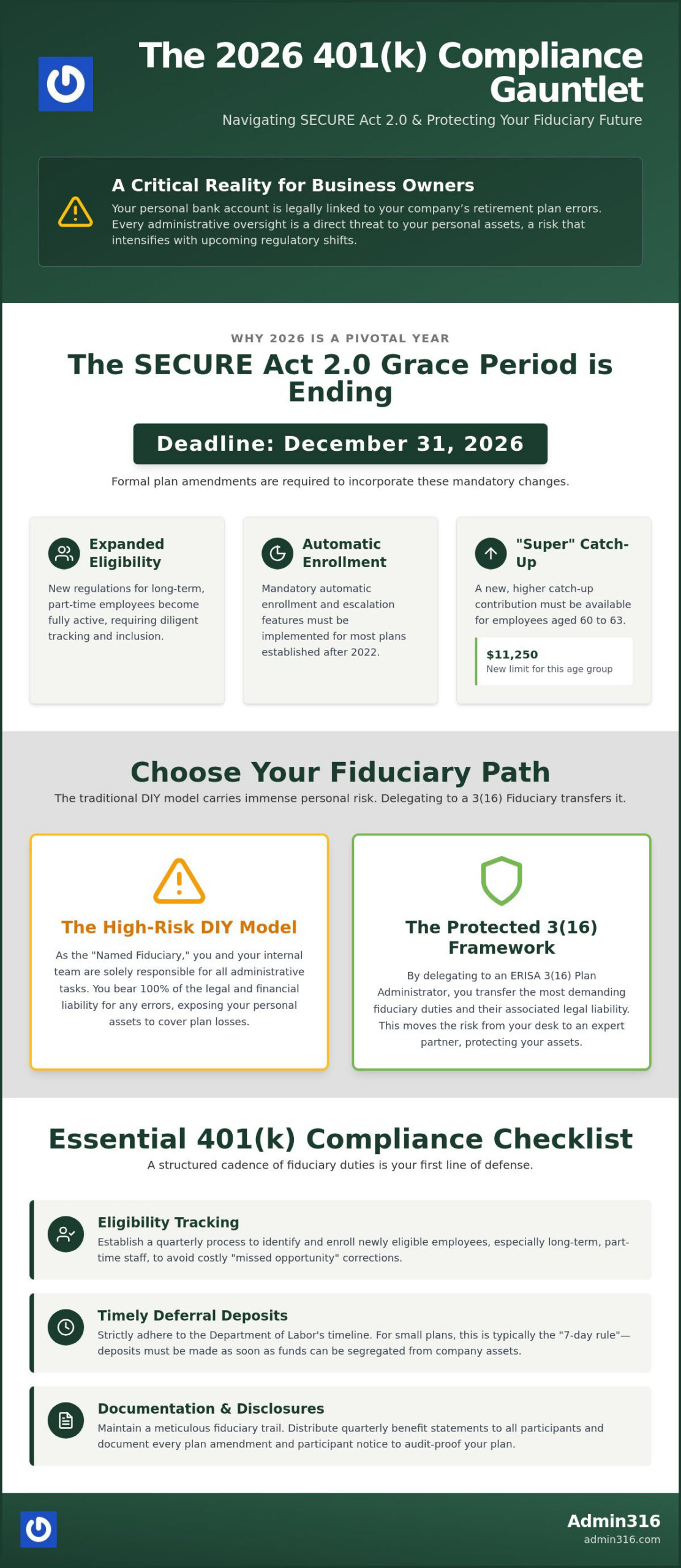
Navigating SECURE Act 2.0 and New Regulatory Shifts
The regulatory environment is shifting from optional improvements to mandatory structural changes. Your 401k plan compliance checklist for 2026 must account for the full implementation of SECURE Act 2.0, which targets participation and savings rates with unprecedented specificity. For instance, most plans established after December 29, 2022, are now required to include automatic enrollment and automatic escalation features. This isn’t just a design choice; it’s a legal mandate that must be formally documented in your plan records by the end of the year.Another significant shift involves the expansion of eligibility for “Long-Term, Part-Time” employees. Beginning in 2026, the service requirement for these workers drops to two consecutive years of at least 500 hours of service. Tracking these hours across multiple departments is a heavy administrative lift that can lead to significant liability if mismanaged. We coordinate this tracking alongside your payroll team to ensure that no eligible employee is overlooked, effectively shielding you from the high cost of “missed deferral” corrections. We assume the weight of this oversight so you don’t have to monitor individual timesheets personally.2026 Implementation Deadlines for Small Businesses
The most pressing date on your calendar is December 31, 2026. This is the final deadline for adopting formal plan amendments related to the original SECURE Act, the CARES Act, and SECURE Act 2.0. Additionally, January 1, 2026, marks the start of the “Rothification” mandate. Participants who earned more than $150,000 in FICA wages during the prior year must now make their catch-up contributions on a Roth basis. Managing this transition requires precise coordination between your payroll provider and recordkeeper to ensure tax compliance for your high earners. Failure to adjust these systems in time can lead to complex tax reporting errors that are difficult to unwind.The Complexity of Enhanced Compliance Credits
While the new rules bring complexity, they also offer financial relief through enhanced tax credits. Small businesses can leverage credits for plan startup costs and even for employer contributions in some cases. However, these benefits are contingent on strict adherence to compliance standards. If your documentation is incomplete or your eligibility tracking is flawed, you risk losing these valuable offsets. We assume the legal responsibility for your plan’s administration, ensuring every requirement is met so these credits remain secure. To move this technical weight off your desk and fortify your plan governance, you can partner with an ERISA 3(16) plan administrator who takes full accountability for the “heavy lifting” of compliance.Transferring the Burden: The Role of a 3(16) Fiduciary
Most business owners are familiar with the “what” of retirement plan management. They understand that a 401k plan compliance checklist is necessary to track deadlines and filings. However, the critical question isn’t what needs to be done, but who is legally responsible for doing it. In a traditional “DIY Compliance” model, the business owner remains the primary target for Department of Labor (DOL) scrutiny. By shifting to a “Fiduciary Shield” model, you transfer the legal weight of these duties to a professional partner. This isn’t just an administrative convenience; it’s a structural change that protects your personal assets from the consequences of technical errors.An ERISA 3(16) plan administrator assumes the day-to-day operational responsibility for your plan. While a Third Party Administrator (TPA) might prepare your paperwork, the 3(16) fiduciary is the one who actually signs it. The person who signs the Form 5500 is the one holding the legal liability. When we step into this role, we take the administrative burden off your desk and place it on ours. We oversee participant notices, eligibility tracking, and government filings with a level of precision that only a specialized guardian can provide.One of the most significant advantages of this partnership is the “non-displacement” factor. We don’t seek to replace your current investment advisor or recordkeeper. Instead, we fortify your existing team by adding a layer of legal protection. We work alongside your professionals, handling the “heavy lifting” behind the scenes while they focus on investment strategy and employee education. This collaborative approach ensures that your professional bonds remain intact while your fiduciary risk is significantly mitigated. Complementing this protection with a structured approach to 401k plan benchmarking fiduciary responsibilities further validates the prudence of your plan governance and strengthens your legal defense against DOL scrutiny.The Peace of Mind of Professional Delegation
Delegating these duties removes the professional anxiety that often accompanies a complex regulatory landscape. We follow a rhythmic “Problem-Solution-Peace” flow. We identify the specific pain points in your current administration, implement a comprehensive compliance framework, and provide the long-term stability you need to grow your business. By redirecting your internal HR resources away from eligibility timesheets and toward core business growth, you preserve the energy of your leadership team. You can rest easy knowing that the technical weight of your plan is being carried by experts who have specialized in this field since 1997.How to Evaluate a 3(16) Fiduciary Partner
When selecting a fiduciary partner, independence is paramount. You want a specialized guardian who is humble enough to work in the background but authoritative enough to take full legal accountability. Historical tenure and national scope are also vital anchors for trust. A partner with a long track record and broad geographic reach offers a sense of institutional permanence that smaller, newer firms cannot match. If you’re considering a change, our Switching 3(16) Plan Administrator: A 2026 Guide provides a clear roadmap for a seamless fiduciary transition. Choosing the right partner ensures that your 401k plan compliance checklist remains a tool for security rather than a source of stress.Securing Your Professional Legacy in 2026
The landscape of retirement plan management is more complex than ever, but it doesn’t have to be a source of personal risk. By maintaining a rigorous 401k plan compliance checklist, you’ve identified the technical hurdles that lie ahead. From managing the new Roth mandates for high earners to tracking expanded eligibility for part-time staff, the administrative weight is significant. However, you don’t have to carry this burden alone.We provide specialized 3(16) fiduciary services as an independent partner that works alongside your existing team. Since 1997, we’ve focused on the full legal assumption of Plan Administrator duties, acting as a shield between you and regulatory entities. We assume the legal responsibility so that you can focus on your company’s future growth with total confidence. Discover how Admin316 can lift the burden of your 401(k) compliance checklist today.Your plan deserves the protection of a seasoned guardian. We’re here to help you navigate these changes and preserve the stability of your business for years to come.Frequently Asked Questions
What is a 401k compliance checklist and why do I need one for 2026?
A 401k plan compliance checklist is a structured schedule of regulatory tasks required to keep a retirement plan in good standing with the IRS and Department of Labor. You need one for 2026 because of the critical December 31 deadline for SECURE Act 2.0 amendments. This document helps you track the introduction of new Roth catch-up requirements and eligibility shifts, ensuring no technical deadline is missed.Who is legally responsible for signing Form 5500 for my 401k plan?
The designated Plan Administrator is legally responsible for signing Form 5500. In many companies, this role defaults to the business owner or a high-level officer unless a professional fiduciary is appointed. If you sign this document, you’re personally assuming the legal liability for the accuracy of the filing and the plan’s operational compliance, making it a high-stakes duty for any executive.What are the consequences of failing a 401k compliance test?
Failing compliance tests like the ADP or ACP usually requires corrective distributions to highly compensated employees or additional employer contributions. If these errors are left uncorrected, the plan risks losing its tax-qualified status. This means all contributions could become immediately taxable to participants, creating a significant financial and reputational crisis for your organization. We mitigate this risk by overseeing these tests with meticulous precision.How does SECURE Act 2.0 change my compliance duties in 2026?
SECURE Act 2.0 mandates several structural shifts, including the “Rothification” of catch-up contributions for employees earning over $150,000. You must also include long-term, part-time employees after they complete two years of service. You’re required to update your plan documents by the end of 2026 to reflect these changes. Utilizing a 401k plan compliance checklist is essential for tracking these overlapping and complex legislative deadlines.Can I outsource the fiduciary liability of my retirement plan?
Yes, you can transfer specific legal liabilities by appointing an ERISA Section 3(16) Plan Administrator and a Section 402(a) Named Fiduciary. While you retain the duty to monitor the service provider, the 3(16) administrator assumes the legal responsibility for the plan’s day-to-day operation and government filings. This creates a “fiduciary shield” that protects your company’s officers from personal financial risk related to administrative errors.What is the difference between a TPA and a 3(16) Plan Administrator?
A Third Party Administrator (TPA) typically performs ministerial tasks like data processing and document preparation without assuming legal liability. In contrast, a 3(16) Plan Administrator assumes full fiduciary responsibility for the plan’s governance. While a TPA does the technical work, the 3(16) administrator owns the results and signs the filings. We assume these duties alongside your TPA to move the legal weight off your desk.How often should I review my 401k plan documents for compliance?
You should conduct a high-level review of your plan documents at least annually, though certain legislative shifts require more frequent attention. In 2026, a year-end review is mandatory to ensure all SECURE Act 2.0 amendments are formally adopted. Integrating this review into your 401k plan compliance checklist helps identify operational errors before they become permanent audit triggers, providing a layer of protection for your business.Does fiduciary liability insurance cover administrative errors?
Fiduciary liability insurance generally covers legal defense costs and certain settlements related to breaches of duty, but it doesn’t absolve you of the underlying responsibility. It’s a financial safety net rather than a compliance solution. Transferring duties to a professional 3(16) fiduciary provides a more robust layer of protection. This specialized oversight prevents errors from occurring in the first place, removing the professional anxiety of a potential audit.Transfer this responsibility to a professional fiduciary.
Every item in this article is work Admin316 does for plan sponsors every day as an ERISA 3(16) administrator. Bring us your plan documents and we’ll show you exactly which risks move off your shoulders.
How much of this risk are you personally carrying?
Answer 5 questions about how your plan is actually administered and get your fiduciary risk score in about two minutes. No email required to see the result.
Take the 3(16) risk checkKeep reading: browse the full 401(k) & Retirement Plan Resource Library — every Admin316 guide on ERISA fiduciary duties, plan administration, defined benefit plans and retirement income.