If you are still the one signing your plan’s Form 5500, you haven’t actually offloaded your risk; you’ve only outsourced the paperwork. It is a common source of professional anxiety to realize that, despite paying for “plan help,” you remain personally liable for every administrative oversight. You shouldn’t have to spend your valuable time tracking employee eligibility or worrying about Department of Labor audits that can carry penalties as high as $2,739 per day. With industry reports showing that over 75% of plans contain preventable errors, the weight of that responsibility is a heavy burden to carry alone.
We understand the pressure of maintaining a compliant retirement plan while trying to grow a business. This guide breaks down the critical differences in 3(16) vs TPA services so you can effectively transfer your plan’s legal liability and administrative burden to an expert. We act as a specialized guardian so that you can focus on your core mission. You will discover how a 3(16) fiduciary provides a layer of protection that a traditional TPA cannot, moving beyond simple support to assume full accountability for your plan’s success. We will compare the scope of these roles and show you how to achieve total relief from the weight of ERISA compliance.
Key Takeaways
- Learn why a TPA acts as the plan’s architect while a 3(16) fiduciary serves as the process owner who carries the actual legal weight.
- Understand the nuances of 3(16) vs TPA services to identify where technical calculations end and true fiduciary execution begins.
- Discover the “Signature Gap” and why signing the Form 5500 yourself leaves you personally liable for plan errors and Department of Labor penalties.
- Find out how to add a robust layer of protection to your retirement plan without replacing your existing recordkeeper or trusted financial advisor.
- Explore how transferring administrative duties to a specialized guardian can remove the “heavy lifting” from your daily business operations.
Understanding the Distinction: Performance vs. Responsibility
Most business owners view their retirement plan as a collection of tasks to be completed. They hire experts to design documents, calculate contributions, and run compliance tests. While these tasks are essential, there is a fundamental difference between performing a technical calculation and carrying the legal responsibility for its outcome. This is the core of the 3(16) vs TPA services debate. One role provides the labor; the other assumes the weight of the legal consequences.
Under the Employee Retirement Income Security Act of 1974 (ERISA), every plan must have a designated “Plan Administrator.” Unless you specifically appoint an outside professional to this role, that title, and all the personal liability that comes with it, defaults to the employer. You become the fiduciary responsible for ensuring every notice is mailed on time and every eligibility rule is followed, even if you don’t have the technical expertise to catch errors. Transitioning from a TPA-only model to a 3(16) partnership moves you from overseeing the work to delegating the accountability.
What is a Third-Party Administrator (TPA)?
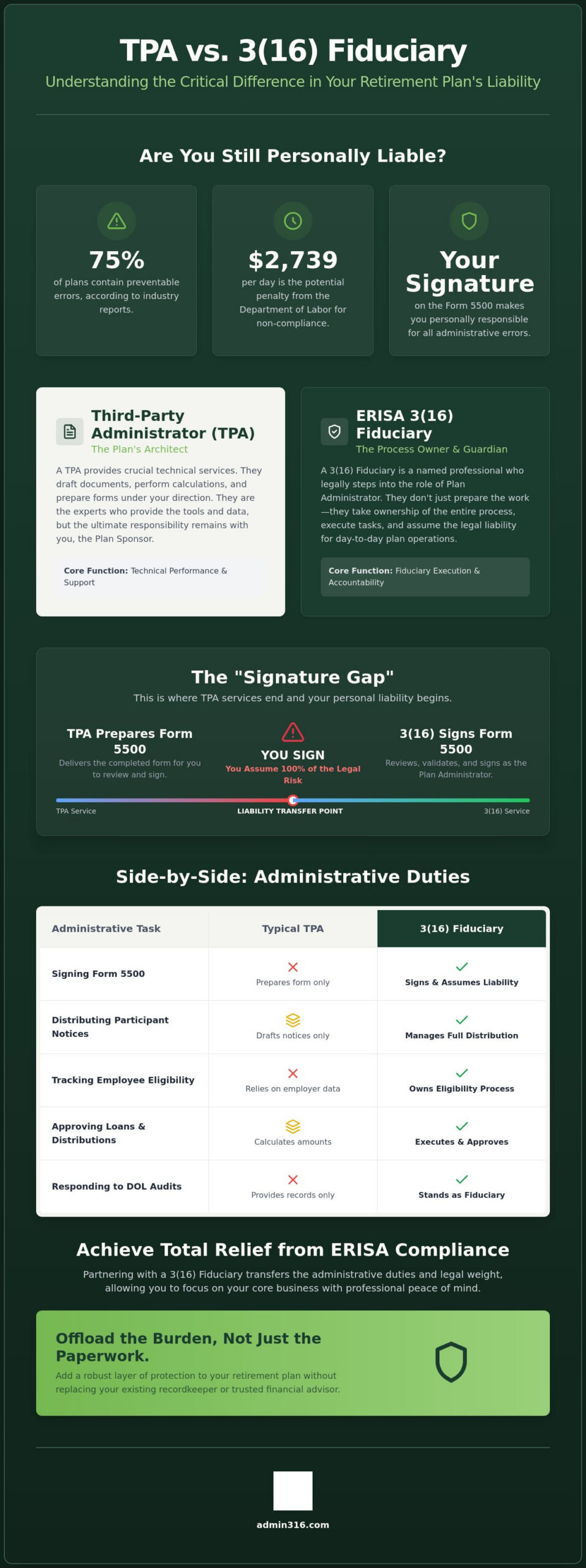
A TPA acts as the technical architect of your plan. They focus on back-office functions like drafting plan documents, performing annual non-discrimination testing, and preparing the Form 5500. However, their work is performed under your direction. They provide the data and the forms, but they don’t usually take legal responsibility for the accuracy of the information provided by your payroll department. If a mistake occurs, the TPA provides the instructions for the fix, but you remain the one standing before regulatory agencies. They provide the tools, but you still carry the weight.
What is an ERISA 3(16) Plan Administrator?
An ERISA 3(16) Plan Administrator is a named fiduciary that steps into the legal role of the employer for administrative matters. While a TPA performs the calculations, the 3(16) fiduciary takes ownership of the entire process. This role involves the day-to-day operations that often drain an employer’s time, such as tracking employee eligibility, distributing required notices, and signing the Form 5500 as the Plan Administrator. When you evaluate 3(16) vs TPA services, the 3(16) is the partner that acts as a shield, assuming the legal weight so you can focus on your business.
We specialize in this “burden-lifting” transition, allowing your current team to remain in place while we fortify your plan with a layer of professional protection. It’s the difference between checking someone else’s math and having a partner who takes full legal accountability for the answer. By delegating the heavy lifting, you preserve your time and protect your professional peace of mind.
Not sure where your plan’s fiduciary liability actually sits?
Admin316 serves as your named 3(16) plan administrator and takes the filing, notice and compliance work off your desk — along with the liability that comes with it. A 15-minute call is usually enough to tell you where you stand.
A Side-by-Side Comparison of Administrative Duties
Many business owners mistakenly believe their TPA handles the entirety of their plan’s compliance. In reality, the difference in 3(16) vs TPA services often comes down to who actually executes the tasks. A TPA provides technical calculations and document drafting, while a 3(16) fiduciary exercises discretionary authority to ensure those tasks are completed correctly and on time. This distinction is vital because the Department of Labor holds the Plan Administrator accountable for Fiduciary Responsibilities, not the technical service provider.
The “red zone” is where most administrative errors occur. These are the tasks where a TPA stops providing support and the employer is left to manage the details. For example, a TPA might calculate a required contribution, but the 3(16) fiduciary ensures the funds are actually moved. This shift in duties significantly reduces the internal HR workload. Instead of your team spending hours on data entry and tracking, you delegate the accountability to a partner who assumes the legal weight of the process.
Execution of Plan Notices and Disclosures
While a TPA may draft a required notice, they rarely handle the distribution. The 3(16) fiduciary ensures that every participant receives the right document at the right time. This includes tracking “lost participants” who have left the company and managing required minimum distributions (RMDs). Admin316 manages these participant notices with automated accuracy to preserve plan compliance. We take over the mailing and tracking so you don’t have to worry about missing a federal deadline. If you want to see how we can shield your business from these administrative risks, we are here to help.
Eligibility Tracking and Enrollment
Tracking hire dates and hours worked is a constant burden for HR departments. A TPA processes the data you give them, but a 3(16) fiduciary proactively monitors eligibility to ensure no one is missed. This proactive management mitigates the risk of “omitted eligible participants,” which is one of the most frequent triggers for a Department of Labor audit. We assume the burden of monitoring these details. We do the heavy lifting of eligibility tracking so that your staff can focus on high-value projects. This partnership fortifies your existing team by adding a layer of professional oversight that preserves your plan’s integrity.
The Form 5500 and the Signature Gap: Where TPAs Stop
The moment of truth for many plan sponsors arrives once a year when a thick stack of papers, the Form 5500, lands on their desk. Your TPA has done the technical work of preparing the filing, but they won’t put their name on the dotted line. This “Signature Gap” is the most visible dividing line in 3(16) vs TPA services. By asking you to sign, the TPA is effectively handing the legal weight of the plan’s data back to you. They provide the report; you assume the risk for its accuracy. This distinction matters because the Department of Labor can assess penalties of up to $2,739 per day for late or inaccurate filings.
Signing a federal document under penalty of perjury is a high-stakes responsibility. It isn’t just a formality. It is a legal attestation that every participant count, contribution total, and compliance test is perfect. Many employers don’t realize they are personally liable for these figures until an audit occurs. A 3(16) fiduciary closes this gap by assuming the role of the “Designated Plan Administrator.” We sign the form so you don’t have to. This professional oversight helps mitigate the risk of IRS penalties, which can reach $250 per day, capped at $150,000 per filing.
Who Signs Form 5500 for a 401(k)?
In a traditional TPA model, the business owner or a designated “employee fiduciary” must sign as the Plan Administrator. Your signature represents the final transfer of legal liability from the service provider to your personal desk. It’s the moment you become the primary target for regulatory scrutiny. Admin316 acts as the signatory, lifting that physical and legal weight off the owner’s desk. Adding 3(16) fiduciary protection ensures that a professional is the one accountable for the filing’s integrity. We work alongside your existing team to ensure every data point is verified before the signature is applied.
Handling Audits and Regulatory Inquiries
A 3(16) fiduciary doesn’t just sign the forms; they become the primary point of contact for the DOL or IRS. If a regulatory agency has questions about your plan’s administration, they call us. This is a critical component of DOL audit retirement plan preparation, as it shields the business owner from the stress and time drain of a federal investigation. We ensure all records are “audit-ready” at all times through continuous oversight. This proactive stance allows you to maintain your focus on business growth while we manage the complexities of regulatory defense behind the scenes.
The ‘Power of Three’: Why You Need Both a TPA and a 3(16) Fiduciary
Many plan sponsors believe choosing between 3(16) vs TPA services is an either/or decision. This is a misconception that often leads to gaps in protection. In reality, the most secure retirement plans utilize a “Power of Three” structure: the Recordkeeper, the TPA, and the 3(16) fiduciary. Think of the Recordkeeper as the vault where assets are held and the TPA as the architect who designs the plan’s blueprint. The 3(16) fiduciary is the owner who assumes the legal weight of the daily operations, ensuring the architect’s plans are executed perfectly and the vault remains compliant.
This partnership creates a comprehensive safety net. While the TPA focuses on technical plan design and compliance testing, we provide the fiduciary execution that brings those designs to life. We don’t replace your current team; we fortify it. This “non-displacement” approach allows you to keep the professionals you already trust while adding a dedicated layer of legal protection. The synergy between technical design and fiduciary execution ensures that no administrative detail falls through the cracks.
Collaborating with Your Current Advisor
Admin316 works alongside your existing financial advisor to strengthen plan governance. We handle the un-glamorous administrative details, such as participant notices and eligibility tracking, so your advisor can focus on investment strategy and participant outcomes. It’s important to clarify that our role is strictly administrative. We don’t provide investment advisory services or recordkeeping software. Instead, we act as a specialized guardian, coordinating with your existing partners to shield you from regulatory scrutiny. This collaboration preserves your professional bonds while removing the anxiety of administrative oversight.
Cost vs. Value: Is the Extra Layer Worth It?
When evaluating the cost of an additional service, consider the internal opportunity cost of your HR team’s time. Every hour spent mailing notices or tracking hire dates is an hour lost to growing your business. Beyond time, there is the “insurance” value of transferring fiduciary liability. The weight of potential ERISA penalties is a heavy burden for any business owner to carry alone. By delegating these duties, you reduce long-term risk and the potential for expensive compliance corrections. We assume the administrative heavy lifting so that you can operate with total professional peace of mind. If you are ready to transfer your plan’s legal liability to a specialized partner, our team is ready to assist.
Offloading the Burden: Partnering with Admin316 for Total Plan Security
Admin316 has specialized in assuming full administrative responsibilities for retirement plans since 1997. We recognize that the choice between 3(16) vs TPA services isn’t just about selecting a technical service provider; it’s about deciding who carries the legal accountability for your plan’s success. Our transition process is designed to be seamless and methodical. We first identify your specific pain points, such as the time lost to mailing notices or the anxiety of signing federal forms. Then, we implement our comprehensive service as the antidote. We do the administrative heavy lifting so that you can lead your company with total confidence. Unlike generic providers, we assume the role of a Named Fiduciary, providing a layer of institutional permanence that preserves your professional peace of mind.
Our approach is rooted in the belief that business owners should be shielded from the complexities of regulatory scrutiny. We act as a specialized guardian, handling the intricate details behind the scenes while you maintain your core business focus. By assuming the legal weight of your plan, we provide a source of relief for overwhelmed HR departments. This isn’t just about outsourcing tasks. It’s about transferring the professional anxiety that comes with ERISA compliance to an expert partner who has operated nationally for decades.
Our Specialized Guardian Approach
We provide meticulous oversight of every administrative detail, from eligibility tracking to participant communication. By acting as the ERISA Section 402(a) Named Fiduciary, we provide the maximum level of legal protection available to plan sponsors. We act as a shield between your company and regulatory entities like the DOL and IRS. In an increasingly complex regulatory environment, we provide a steady, authoritative voice that ensures your plan remains audit-ready. We handle the “un-glamorous” details so you don’t have to. Our “non-displacement” narrative ensures that your existing recordkeeper and advisor relationships remain intact while we fortify your plan’s governance.
Next Steps: Transferring the Weight
Initiating a change doesn’t have to be complicated. We begin with a thorough fiduciary assessment of your current plan to identify where the “signature gap” may be exposing you to personal risk. Understanding the nuances of 3(16) vs TPA services allows you to make an informed decision about your company’s future. The integration process is straightforward and organized. We work alongside your existing retirement plan team to coordinate data and assume responsibility without disrupting your daily operations. This partnership allows you to preserve your current professional bonds while adding the safety of a seasoned guardian. You don’t have to carry the weight of ERISA liability alone. Secure your plan and offload the administrative burden with Admin316.
Securing Your Plan’s Future and Your Professional Peace of Mind
Managing a retirement plan shouldn’t feel like a constant legal tightrope walk. We’ve explored how the choice between 3(16) vs TPA services defines who actually stands behind the plan’s data. While a TPA provides the essential technical blueprint, only a 3(16) fiduciary assumes the physical and legal weight of the administration. By closing the signature gap on your Form 5500, you move from a position of personal liability to one of professional security. You don’t have to sacrifice your existing advisor relationships to gain this protection.
Since 1997, we’ve served as an independent partner to plan sponsors nationwide. We act as a specialized ERISA Section 402(a) Named Fiduciary, providing a shield between your business and regulatory scrutiny. Our team works alongside your current advisor to handle the heavy lifting behind the scenes. It’s time to preserve your focus on growth while we oversee the compliance details. Offload your fiduciary burden and protect your business with Admin316. We are ready to help you achieve a seamless partnership where experts handle the details and your professional peace of mind is restored.
Frequently Asked Questions
What is the main difference between a 3(16) and a TPA?
The main difference in 3(16) vs TPA services lies in the level of legal responsibility assumed by the provider. A TPA functions as a service provider that handles technical tasks under your direction, whereas a 3(16) fiduciary is a named plan administrator who takes on the legal accountability for those operations. While the TPA provides the data, the 3(16) carries the weight of the decision-making and execution.
Does a 3(16) fiduciary replace my current TPA?
No, a 3(16) fiduciary does not replace your current TPA. We operate as an independent partner that fortifies your existing team by adding a layer of protection. This non-displacement approach ensures that your current recordkeeper and TPA relationships remain intact while we assume the administrative heavy lifting that those providers typically leave on your desk.
Who is legally responsible for signing the Form 5500 if I hire a 3(16)?
When you hire a 3(16) fiduciary, they become the “Designated Plan Administrator” and sign the Form 5500 on your behalf. This transfer of responsibility removes the legal weight of signing a federal document under penalty of perjury from your desk. We assume the risk for the filing’s accuracy, shielding you from the personal liability associated with Department of Labor and IRS reporting.
Can a 3(16) fiduciary help me if my plan is currently out of compliance?
Yes, a 3(16) fiduciary can assist you in bringing an out-of-compliance plan back into good standing. We conduct a thorough assessment to identify errors and coordinate the necessary corrections with regulatory agencies. Our goal is to mitigate existing risks and implement a stable, methodical process that prevents future oversights, restoring professional peace of mind to your organization.
Will my 401(k) advisor still be able to manage the plan’s investments?
Yes, your 401(k) advisor will continue to manage the plan’s investments and provide participant education. We handle the administrative details that advisors generally don’t oversee, such as eligibility tracking and notice distribution. By assuming these un-glamorous tasks, we support your advisor in focusing on investment outcomes while we maintain the plan’s legal integrity behind the scenes.
How much does it cost to add 3(16) fiduciary services to my plan?
The cost to add 3(16) services varies based on the size and complexity of your retirement plan. Unlike standardized 3(16) vs TPA services fees, fiduciary pricing reflects the level of legal risk and administrative weight the provider assumes. We provide a customized assessment to determine the most effective structure for your plan, ensuring the value of the fiduciary protection outweighs the internal opportunity cost of your HR team’s time.
Does Admin316 provide payroll processing or recordkeeping?
Admin316 does not provide payroll processing or recordkeeping software. We are a specialized guardian that focuses exclusively on assuming 3(16) and 402(a) fiduciary responsibilities. We coordinate alongside your chosen payroll and recordkeeping providers to ensure that the data they generate is managed and executed according to ERISA standards, providing a seamless layer of oversight.
What happens if our plan is audited by the Department of Labor?
If your plan is audited by the Department of Labor, the 3(16) fiduciary acts as the primary point of contact for the agency. We represent the plan, provide the requested documentation, and manage the stress of the inquiry on your behalf. Our continuous oversight ensures that your records are audit-ready at all times, shielding your business from the burden of regulatory defense.
Transfer this responsibility to a professional fiduciary.
Every item in this article is work Admin316 does for plan sponsors every day as an ERISA 3(16) administrator. Bring us your plan documents and we’ll show you exactly which risks move off your shoulders.