If you sponsor a retirement plan, you have almost certainly been handed a proposal with a fiduciary section in it. One provider calls itself a 3(16). Another sells 3(21) advice. A third offers 3(38) investment management. And somewhere in your plan document, mostly unread, sits a line naming the 402(a) named fiduciary — usually your company. Comparing 3(16), 3(21), 3(38) and 402(a) is not academic. Each number describes a different job, a different slice of liability, and a different answer to the question a Department of Labor investigator will eventually ask: who was responsible for this?
The four numbers, in one pass
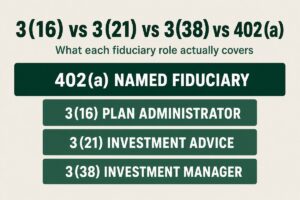
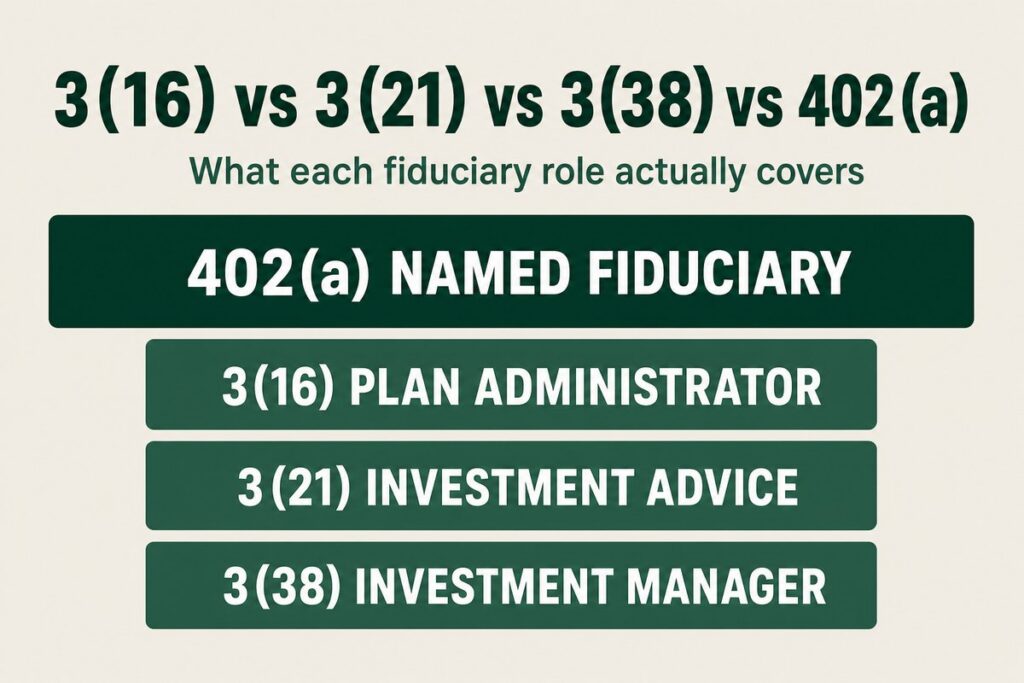
All four come from ERISA, and they stack rather than compete. Two are about running the plan. Two are about the money.
- ERISA 402(a) — named fiduciary. The top of the org chart. Your plan document must name someone with authority to control and manage the operation and administration of the plan. By default that is the employer.
- ERISA 3(16) — plan administrator. The operational job: notices, filings, disclosures, eligibility, distribution approvals, keeping the plan running the way the document says.
- ERISA 3(21) — investment advice fiduciary. Advises on investments for a fee. Recommends. You still decide.
- ERISA 3(38) — investment manager. Takes discretion over plan assets in writing. Decides, and owns those decisions.
3(16): who actually runs the plan
The 3(16) plan administrator is the party your plan document identifies as responsible for administration. That covers the unglamorous work that generates most compliance problems: tracking eligibility, delivering participant notices on time, approving distributions and loans, handling the annual return, and retaining records long enough to prove all of it.
Here is where sponsors get surprised. Many providers use “3(16) services” to mean they will prepare the work and hand it back to you for signature. That is support, not appointment. A true 3(16) appointment names the provider in the plan document and moves the administrative fiduciary duty with it. If your provider prepares the Form 5500 but you sign it, the signature — and the exposure — is still yours. Our breakdown of 3(16) versus TPA services walks through how to tell the two apart in a proposal, and 3(16) pricing shows what real appointment tends to cost.
3(21): advice you can accept or decline
A 3(21) investment advice fiduciary reviews your lineup, benchmarks funds, documents recommendations, and sits with your committee. It is a co-fiduciary role. The provider is accountable for the quality of the advice; the sponsor remains accountable for the decision to follow it.
That works well for committees that want to stay involved and have the discipline to meet, read the materials, and document why they acted. It works badly for sponsors who intend to delegate and then never look again — because in a 3(21) arrangement, the last decision is always yours. If you want help evaluating that relationship, see how to choose a 401(k) financial advisor.
3(38): discretion over the money
A 3(38) investment manager must be a registered investment adviser, bank, or qualified insurance company, and must acknowledge fiduciary status in writing. Once appointed, it selects, monitors, and replaces investments without asking you first. Of the four roles, this is the cleanest transfer of investment liability available under ERISA.
What does not transfer is the duty to pick and watch the manager. Prudent selection and ongoing monitoring stay with the sponsor permanently — a point we cover in 3(16) administrator vs. 3(38) fiduciary and in the wider 2026 fiduciary liability guide.
402(a): the appointment almost nobody signs
The named fiduciary is the role sponsors overlook, because it is already filled — by them. Open your plan document and look. If it names your company, your board, or “the Employer” as named fiduciary, then every administrative and delegation decision ultimately routes back to you, no matter how many service agreements you have signed underneath.
Most providers will not accept the 402(a) appointment. They will sign a 3(16) service agreement, they will sign a 3(38) investment management agreement, and they will decline the seat at the top of the chart. Admin316 accepts the 402(a) named-fiduciary appointment. That is a different commitment than administrative support, and it is the difference between outsourcing tasks and actually relocating responsibility. Our standalone explainer on who the 402(a) named fiduciary is covers the mechanics.
Three misreadings that cost sponsors money
“We hired a TPA, so administration is covered.” A third-party administrator can do excellent work and still hold no fiduciary status at all. TPA is a business description; 3(16) is a legal appointment. If the plan document does not name the TPA as plan administrator, the fiduciary duty never moved. Our comparison of the independent plan administrator role lays out the distinction.
“Our advisor is a fiduciary, so the investments are handled.” Ask which section. A 3(21) advisor recommends and documents; if your committee never formally accepts and records those recommendations, the file that would defend you does not exist. A 3(38) manager acts, and the paper trail is created by the manager rather than by you.
“We signed a service agreement, so we are protected.” Service agreements allocate work between companies. Fiduciary status under ERISA follows the plan document and actual functional control. An agreement that never touches the document is a promise about effort, not a transfer of responsibility — which is why we always start a review by reading the document rather than the contract. Late deposits and missed notices are the classic places this gap shows up; see timely deposit rules and participant notice requirements.
Side by side
- Scope: 3(16) = plan operations. 3(21) = investment advice. 3(38) = investment discretion. 402(a) = overall control of operation and administration.
- Who decides: 3(16) provider decides administrative matters within the document; 3(21) recommends and you decide; 3(38) decides investments; 402(a) sits above all of it.
- How it is created: 3(16) and 402(a) come from the plan document plus a written appointment. 3(21) and 3(38) come from a written service or management agreement.
- What stays with you: in every case, the duty to select and monitor the parties you appoint.
Which combination fits your plan
- Pull your plan document and read the named fiduciary and plan administrator sections. Whatever is written there governs, not what a sales deck says.
- Ask each provider, in writing, exactly which sections it accepts. “We handle 3(16) work” is not an answer. “We are named in the plan document as 3(16) plan administrator” is.
- Ask who signs. Signature on the annual return is the plainest test of who holds administrative responsibility. See who signs the Form 5500.
- Decide how involved your committee will really be. Committees that meet quarterly can run 3(21). Committees that exist on paper should be looking at 3(38).
- Ask about 402(a) last, and listen for the decline. The answer tells you how much liability the provider is genuinely willing to hold.
- Document the appointments and your monitoring. Minutes, benchmarking files, and signed appointments are what a DOL audit actually examines.
The practical takeaway
3(16), 3(21) and 3(38) each carve off a defined piece of the work. 402(a) is the piece that decides where everything else lands. Sponsors who stack the first three and leave themselves as named fiduciary have outsourced effort while keeping ultimate responsibility — often without realizing it. If you would rather move that seat, that is the conversation to have.
Reviewing your current arrangement is a reasonable place to start. Book a plan review with Admin316 and we will read your document with you, show you which sections name whom today, and tell you plainly which appointments we will sign.