The weight of personal fiduciary liability is a heavy burden for any business owner to carry alone. You understand that even a minor oversight in plan eligibility or contribution limits can trigger a cascade of regulatory scrutiny. Navigating the landscape of 401k administrative error correction shouldn’t consume your schedule or threaten your peace of mind. We agree that your primary focus belongs on growing your business, not on deciphering the intricate web of IRS and DOL compliance requirements.
This guide provides the clarity you need to resolve mistakes and preserve the integrity of your plan. You’ll learn how to navigate the IRS Voluntary Correction Program (VCP) and the expanded self-correction rules introduced by SECURE 2.0 to shield your company from liability. We’ll preview the updated 2026 user fees and the December 31, 2026, plan amendment deadline, offering a methodical approach to mitigate financial risk. By the end, you’ll have a roadmap to ensure these errors never happen again, allowing you to hand off the heavy lifting of administration to a seasoned partner.
Key Takeaways
- Learn how to identify common operational failures, such as incorrect compensation definitions and eligibility oversights, before they escalate into significant liabilities.
- Master the 401k administrative error correction process by utilizing the updated EPCRS framework and the expanded self-correction provisions introduced by SECURE 2.0.
- Gain a methodical, step-by-step approach to calculating lost earnings and restoring participant accounts to ensure full regulatory compliance and financial accuracy.
- Discover how to establish robust internal controls and compliance calendars that act as a protective shield against future administrative oversights.
- Understand how appointing an ERISA 3(16) plan administrator can lift the weight of legal accountability from your shoulders while preserving your existing professional relationships.
Identifying 401k Administrative Errors: Why Compliance Fails
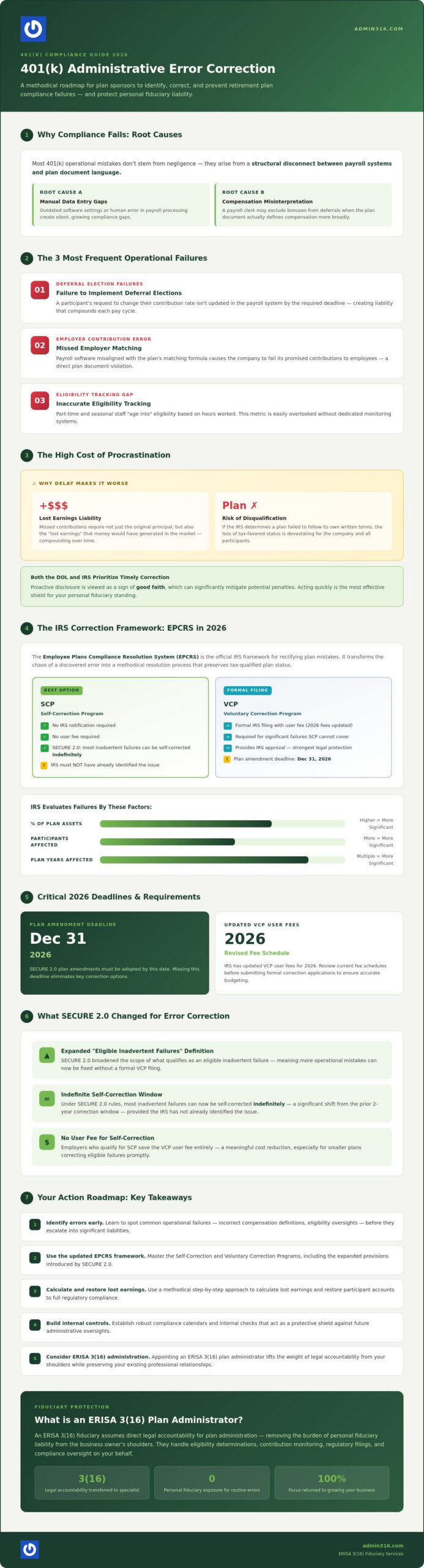
Managing a 401(k) plan requires a level of precision that often exceeds the capacity of standard business operations. Most operational mistakes don’t happen because of negligence. Instead, they usually stem from a structural disconnect between payroll systems and the specific language of the plan document. Even the most meticulous plan sponsors find that manual data entry or outdated software settings can lead to significant compliance gaps. These “unforced errors” carry a heavy emotional and financial weight. They create a layer of professional anxiety that distracts from core business goals.
When these gaps occur, initiating a 401k administrative error correction begins with a clear-eyed assessment of how the failure happened. It’s often a matter of interpretation. For instance, a payroll clerk might exclude bonuses from deferrals because they aren’t “regular pay,” while the plan document defines compensation more broadly. This mismatch creates a liability that grows with every pay cycle. We see these issues as burdens that can be identified, quantified, and eventually lifted through methodical oversight and supportive partnership.
The Most Frequent Operational Failures
Operational failures typically cluster around three specific areas where human error and system limitations intersect. These mistakes are common, yet they require immediate attention to prevent regulatory friction.
- Failure to implement deferral elections: This occurs when a participant’s request to change their contribution rate isn’t updated in the payroll system by the required deadline.
- Missed employer matching: If the payroll software doesn’t align with the plan’s matching formula, the company fails to fulfill its promise to employees.
- Inaccurate eligibility tracking: Part-time or seasonal staff often “age into” eligibility based on hours worked. This metric is easily overlooked without dedicated monitoring.
The High Cost of Procrastination
Ignoring a known error is a strategy that carries immense risk. Small mistakes compound over time. Missed contributions require not just the original principal, but also the “lost earnings” that money would have generated in the market. Beyond the financial cost, there is the existential threat of plan disqualification. If the IRS determines a plan has failed to follow its own written terms, the loss of tax-favored status can be devastating for both the company and its employees.
Both the DOL and IRS prioritize timely correction. They view proactive disclosure as a sign of good faith, which can significantly mitigate potential penalties. Taking action now serves as a shield, preserving the stability of your retirement offering and protecting your personal fiduciary standing. A methodical approach to 401k administrative error correction ensures that your plan remains a source of value rather than a source of liability.
Not sure where your plan’s fiduciary liability actually sits?
Admin316 serves as your named 3(16) plan administrator and takes the filing, notice and compliance work off your desk — along with the liability that comes with it. A 15-minute call is usually enough to tell you where you stand.
The IRS Correction Framework: Navigating EPCRS in 2026
The Employee Plans Compliance Resolution System (EPCRS) serves as the official IRS framework for rectifying plan mistakes. It transforms the chaotic anxiety of a discovered error into a methodical, step-by-step resolution process. For plan sponsors, this system provides the legal mechanism to preserve the tax-qualified status of their plans while shielding themselves from disproportionate penalties. Understanding this framework is the first step toward lifting the weight of regulatory uncertainty from your shoulders.
SECURE 2.0 has fundamentally shifted the landscape of 401k administrative error correction by expanding the availability of self-correction. As of 2026, the IRS has broadened the definition of “eligible inadvertent failures,” allowing most operational mistakes to be fixed without a formal filing. This shift acts as a significant burden-lifting measure for diligent employers. However, the success of any correction depends on whether the error is classified as “significant” or “insignificant.” The IRS evaluates this based on the percentage of plan assets involved, the number of participants affected, and whether the error occurred across multiple plan years.
Self-Correction Program (SCP) and SECURE 2.0
The Self-Correction Program (SCP) allows you to fix errors without notifying the IRS or paying a user fee. Under the new SECURE 2.0 rules, most inadvertent failures can be self-corrected indefinitely, provided the IRS has not already identified the issue. To qualify for SCP, your plan must have established internal practices and procedures designed to promote compliance. Using the IRS 401(k) Plan Fix-It Guide can help you align your internal processes with these expectations before an error occurs.
Voluntary Correction Program (VCP) vs. Audit CAP
When a failure is too complex for SCP, the Voluntary Correction Program (VCP) allows you to submit the error to the IRS for a formal compliance statement. VCP is the proactive path to legal certainty. As of January 1, 2026, VCP user fees are based on plan assets: $2,000 for plans with $500,000 or less, $3,500 for those up to $10 million, and $4,000 for larger plans. In contrast, Audit CAP occurs when the IRS discovers the error during an examination. The sanctions in Audit CAP are negotiated and typically much higher than VCP fees. Partnering with a specialized fiduciary ensures these filings are handled with precision, protecting your company from the high stakes of an involuntary audit.
Step-by-Step Guide: Correcting Common 401(k) Plan Failures
Resolving a compliance failure requires a methodical shift from identifying the problem to executing a technical resolution. While the IRS programs provide the regulatory framework, the actual 401k administrative error correction happens through a series of precise operational steps. We oversee these details so that you can remain focused on your company’s growth without the distraction of regulatory friction. Following a logical progression ensures that the fix is both thorough and defensible during a potential audit.
Step 1: Identify the scope of the error. You must determine exactly which participants were affected and the specific payroll periods involved. This often requires a deep dive into payroll records to see where the data diverged from the plan document. Step 2: Determine lost earnings. You must restore the amount the participant would have earned had the error not occurred. The IRS 401(k) Plan Fix-It Guide provides standard methodologies for these calculations. Step 3: Implement the prescribed correction. This involves making the necessary deposits into the affected employees’ accounts. Step 4: Issue required notices. Transparency is essential; you must explain the error and the resolution to affected participants. Step 5: Document and update. Finalize the process by recording the correction and adjusting internal controls to shield the plan from future failures.
Fixing Missed Deferrals and Eligibility Errors
When an eligible employee is excluded from the plan, you must provide a “Qualified Non-Elective Contribution” (QNEC) to compensate for the missed deferral opportunity. Under the 2026 safe harbor rules, certain automatic enrollment failures can be corrected with reduced or zero QNECs if caught and fixed within specific timeframes. However, you must always restore lost earnings based on the plan’s actual rate of return during the period of the error. This ensures the participant is made whole, as if the mistake never happened.
Resolving Delinquent Participant Contributions
The Department of Labor (DOL) maintains a strict 7-business-day rule for small plans to deposit participant deferrals. If you miss this window, the contributions are considered “prohibited transactions.” You can use the Voluntary Fiduciary Correction Program (VFCP) to resolve these late deposits and avoid some of the more aggressive enforcement actions. Keep in mind that late contributions usually require the filing of Form 5330 to pay excise taxes on the prohibited transaction. We coordinate these moving parts to mitigate your financial risk and preserve your fiduciary standing.
Documenting the Fix: Establishing Internal Controls
Fixing the financial deficit of a plan failure is only half the battle. The IRS considers the “correction of the process” just as vital as the “correction of the money.” If you resolve a mistake but leave the underlying system broken, you remain exposed to recurring liability and increased regulatory scrutiny. Establishing robust internal controls transforms your compliance efforts from a reactive scramble into a steady, methodical operation. This transition provides the stability needed to protect both the plan and your personal fiduciary standing.
A functional compliance calendar serves as the foundation of this oversight. It should coordinate eligibility tracking, the distribution of annual notices, and the timely filing of Form 5500. As a Plan Sponsor, your primary duty involves overseeing the data feeds between your payroll provider and your recordkeeper. When these systems don’t communicate perfectly, errors in compensation definitions or deferral rates often follow. By maintaining a rhythmic schedule of reviews, you can identify these discrepancies before they compound into significant financial burdens.
The Paper Trail: Why Documentation is Your Best Defense
Documentation serves as your primary shield during a Department of Labor (DOL) audit. You should maintain a detailed “Correction Memo” for every 401k administrative error correction performed. This memo should detail the nature of the failure, the specific calculations used for lost earnings, and the exact date the fix was finalized. Under the Employee Retirement Income Security Act (ERISA), plan sponsors are required to preserve these records, along with participant notices and proof of QNEC deposits, for a period of at least 6 years. Keeping these files organized ensures that if a regulator asks for evidence, you can produce it with confidence and poise.
Modernizing Compliance with Tech-Driven Oversight
Modern payroll integration can significantly reduce manual entry errors; however, software is not a replacement for active fiduciary oversight. A “set it and forget it” mentality creates a dangerous gap where system glitches can go unnoticed for years. Transitioning from reactive fixing to proactive fiduciary management means having a partner who oversees these technical details alongside your existing team. We assume the weight of these administrative duties so that you can preserve your energy for growing your business. To lift the burden of manual compliance from your schedule, you can outsource your administrative duties to a specialized 3(16) fiduciary.
Ending the Cycle of Errors with 3(16) Fiduciary Services
The recurring cycle of 401k administrative error correction often drains the resources and morale of internal HR teams. While understanding the IRS correction framework is necessary for immediate fixes, it doesn’t solve the long-term problem of administrative fatigue. Appointing an ERISA 3(16) plan administrator allows you to transfer the weight of these responsibilities to a specialized partner. We operate as a shield between your company and regulatory entities, ensuring that the burden of compliance never rests solely on your shoulders again.
It’s vital to distinguish between the roles of your existing service providers. A Third Party Administrator (TPA) performs the essential “heavy lifting” of data processing and reporting, yet they rarely take legal accountability for the results. In contrast, a 3(16) fiduciary doesn’t just do the work; we take the responsibility. We oversee the TPA’s output, verify its accuracy, and assume the legal liability for the plan’s administration. This distinction provides a layer of protection that a standard TPA relationship cannot offer, effectively lifting the threat of personal fiduciary liability from your desk.
Shifting the Weight: How Admin316 Assumes Legal Responsibility
When we step into the role of a Specialized Guardian, we assume the specific duties that typically cause the most professional anxiety. Our team coordinates the complex moving parts of plan management to ensure absolute precision. We do the administrative work so that you can do the work of leading your company.
- Signing Form 5500: We review and sign the annual return, taking full legal accountability for its accuracy and timely submission to the DOL.
- Eligibility and Notices: We oversee the tracking of employee eligibility and coordinate the distribution of all required participant notices.
- Audit Advocacy: If the IRS or DOL initiates an examination, we act as the primary point of contact and manage the entire response process.
Preserving Your Advisor Relationships While Mitigating Risk
Our service is designed to fortify your current team, not replace it. We operate under a “non-displacement” philosophy, meaning you don’t need to change your investment advisor, recordkeeper, or payroll provider. We simply add a fiduciary layer that preserves your existing professional bonds while removing the administrative risk. By assuming the duty of 401k administrative error correction and ongoing oversight, we create a stable environment where your retirement plan can thrive without constant intervention. Schedule a consultation with Admin316 to offload your fiduciary burden.
Securing Your Plan’s Future Through Proactive Oversight
Navigating the complexities of IRS compliance doesn’t have to be a source of professional anxiety. By leveraging the expanded self-correction rules of SECURE 2.0 and maintaining rigorous documentation for at least six years, you create a formidable shield for your company. Effective 401k administrative error correction is not just about fixing the past; it’s about establishing the internal controls that preserve your plan’s integrity for the long term. You’ve learned that while self-correction is a vital tool, transferring the legal weight of these duties provides the ultimate peace of mind.
Since 1997, Admin316 has served as a specialized 3(16) Plan Administrator and a Named Fiduciary under ERISA 402(a). We provide national coverage and institutional-grade compliance to fortify your existing team without displacing your trusted advisors. We oversee the technical details so that you can focus on your business’s core mission. Let Admin316 assume your 401(k) administrative liability today. You have the tools to build a defensible compliance record; now, let us provide the stability to keep you there.
Frequently Asked Questions
What is the most common 401k administrative error?
The most frequent mistake is failing to follow the plan document’s specific definition of compensation. This often happens when payroll systems aren’t updated to include bonuses, commissions, or overtime in deferral calculations. These errors create a liability that compounds over every pay period. We act as a shield by overseeing these definitions to ensure your payroll data aligns perfectly with your plan’s legal requirements.
Can I fix a 401k error without notifying the IRS?
You can fix many mistakes without notifying the IRS by using the Self-Correction Program (SCP). This is available for “eligible inadvertent failures” that occur despite having established internal 401k administrative error correction procedures. This program removes the professional anxiety of a formal filing. It allows you to resolve the issue internally while preserving the plan’s tax-favored status and avoiding unnecessary user fees.
How does SECURE 2.0 change 401k error correction?
SECURE 2.0 significantly expands the ability of plan sponsors to self-correct most operational errors indefinitely. Before this legislation, significant errors had to be corrected within a specific two-year window. Now, as long as you identify and fix the mistake before the IRS catches it during an audit, you can often use SCP to avoid formal penalties. This shift provides a much-needed layer of protection for diligent employers.
What happens if I miss the deadline for a Form 5500 filing?
Missing a Form 5500 deadline triggers substantial daily penalties from both the DOL and the IRS. To mitigate this risk, you should utilize the Delinquent Filer Voluntary Compliance Program (DFVCP), which significantly reduces the potential fines compared to an involuntary audit. We assume the burden of these filings to ensure deadlines are met and your company remains shielded from such avoidable and expensive financial exposure.
Is a 3(16) fiduciary responsible for fixing past errors?
A 3(16) fiduciary typically assumes legal responsibility for the plan’s administration starting from their date of appointment. While they aren’t legally liable for errors that occurred before they were hired, they will coordinate the 401k administrative error correction for any legacy issues discovered. This partnership ensures that past mistakes are resolved properly and a protective, methodical layer is established to prevent those errors from ever happening again.
How much does it cost to use the IRS Voluntary Correction Program (VCP)?
As of January 1, 2026, the IRS user fees for VCP submissions are based on the total dollar value of the plan’s assets. Plans with $500,000 or less pay $2,000; plans with over $500,000 to $10 million pay $3,500; and plans exceeding $10 million pay $4,000. These flat fees provide a predictable path to legal certainty. This is far preferable to the high-stakes, negotiated sanctions of an Audit CAP settlement.
Do I need a lawyer to correct a 401k administrative error?
You don’t technically need a lawyer to correct a plan failure, but specialized fiduciary expertise is highly recommended for technical accuracy. While attorneys are helpful for complex legal disputes, a 3(16) administrator handles the granular operational details of the correction process more efficiently. We provide the methodical oversight needed to resolve the error while preserving your existing professional relationships with investment advisors and recordkeepers.
What is the “lost earnings” calculation for missed 401k contributions?
The “lost earnings” calculation is designed to restore the participant’s account to the position it would have been in if the error never occurred. You typically use the plan’s actual rate of return for the period of the failure. If the actual rate is difficult to determine, the DOL offers an online calculator to determine the appropriate restoration amount. This ensures the employee is made whole while mitigating your fiduciary risk.
Transfer this responsibility to a professional fiduciary.
Every item in this article is work Admin316 does for plan sponsors every day as an ERISA 3(16) administrator. Bring us your plan documents and we’ll show you exactly which risks move off your shoulders.