Texas 401(k) administration works differently than many employers expect. The rules that govern your plan come almost entirely from federal law — ERISA and the Internal Revenue Code — not from Austin. But the practical side of running a plan in Texas does have local texture: multi-site workforces, high-growth headcount, heavy use of PEOs and staffing firms, and no state-run retirement mandate pushing employers into a program. That combination means Texas employers have more freedom in how they structure a plan, and more room to get the administration wrong.
This guide is written for employer plan sponsors — the business owner, CFO, controller, or HR leader whose name is attached to the plan — not for individual savers. It covers what actually applies in Texas, which duties stay with you no matter who you hire, and which duties can be transferred to a professional fiduciary.
Is there a Texas state 401(k) mandate?
No. Texas has not enacted a state-run auto-IRA or private-sector retirement savings mandate of the kind adopted in some other states. Texas employers are not required by state law to offer a retirement plan, and there is no state program you must either join or certify an exemption from.
Two things follow from that. First, offering a 401(k) in Texas is a competitive decision, not a compliance one — which is why plan design and cost matter more here than mandate paperwork. Second, once you do sponsor a plan, you are fully inside the federal ERISA framework, and there is no state agency softening the landing. Your regulators are the Department of Labor and the IRS.
What federal law requires of every Texas plan sponsor
ERISA imposes duties on the people who control a plan. The core ones do not change by state:
- A written plan document that is kept current with legislative and regulatory changes, and administered exactly as written.
- Fiduciary conduct — acting solely in the interest of participants, with the care and skill of a prudent expert, and following plan terms.
- Timely deposit of employee deferrals as soon as they can reasonably be segregated from company assets. Late deposits are the single most common ERISA error, and they are self-reported.
- Annual reporting on Form 5500, plus an independent audit once the plan is above the participant-count threshold.
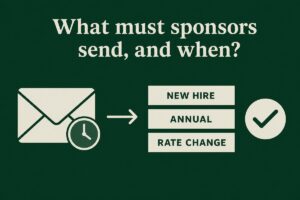
- Participant disclosures — summary plan description, fee disclosures, safe harbor and automatic enrollment notices, blackout notices, and the annual summary annual report.
- Nondiscrimination and limit testing each year, with corrective action inside the correction windows.
None of this is optional, and none of it disappears because you hired a recordkeeper. See our overview of what happens when a 401(k) is out of compliance for how these failures usually surface.
Where Texas specifics actually show up
1. Payroll timing across multiple locations
Texas employers frequently run several worksites — DFW, Houston, Austin, San Antonio, plus field or jobsite crews. When payroll is processed regionally or by different administrators, deferral remittance dates drift. Standardize a single remittance calendar and reconcile every payroll to the recordkeeper file.
2. Contractor and staffing-heavy workforces
Construction, energy services, and logistics employers in Texas lean on temporary labor. Worker classification and the treatment of leased employees drive eligibility, and misclassification is an eligibility failure waiting to be found. Our pages for construction companies and manufacturing employers cover how these plans are usually structured.
3. Fast headcount growth
Growth is the Texas story, and growth changes plan obligations. Crossing the audit threshold, triggering coverage-testing problems after an acquisition, or adding a second plan through a purchase all require action in the same plan year.
4. Professional practices and closely held businesses
Physician groups, law firms, and owner-heavy companies often want owner-favorable design — cross-testing, cash balance pairings, or profit sharing. That design freedom is real, but it raises testing complexity. See medical practices, law firms, and cash balance plans.
5. No state mandate means no forced review
In mandate states, employers get pushed into a periodic decision point. Texas sponsors don’t, so plans quietly sit unreviewed for years while fees drift and documents go stale. Build your own cadence — an annual plan review and periodic fee benchmarking.
The mistakes Texas sponsors make most
- Assuming the recordkeeper is the plan administrator. Most are not. They provide a platform and reporting; the legal administrator is usually the employer.
- Treating the signature on Form 5500 as clerical. It isn’t — see who signs the Form 5500.
- Letting eligibility run on habit instead of the document. Entry dates, hours requirements, and rehire rules must match the plan document, not the HR handbook.
- Skipping notices. Automatic enrollment and safe harbor notices have deadlines; missing them is a correctable but reportable failure.
- No document retention system. When an audit or DOL inquiry arrives, the ask is documents, fast. Use our audit readiness checklist.
- Believing insurance is fiduciary protection. Fidelity bonds and fiduciary liability insurance pay claims; they do not remove the duty.
What you can delegate — and what you can’t
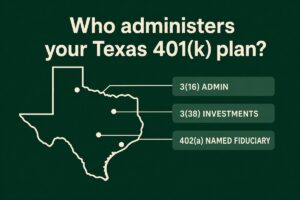
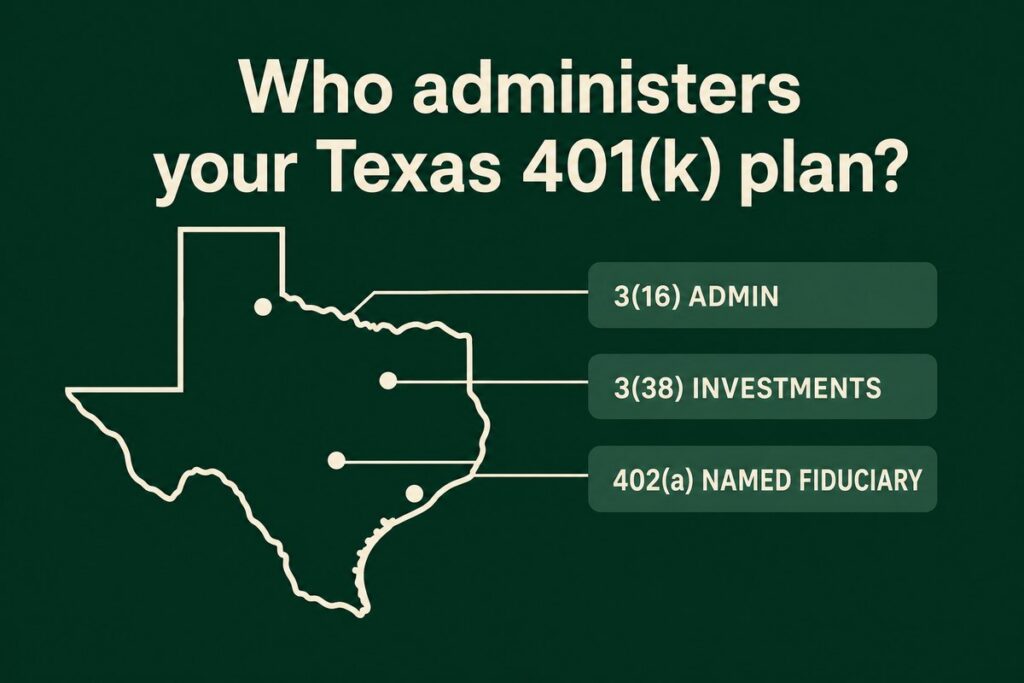
ERISA lets a sponsor appoint professional fiduciaries and shift specific responsibilities off the company. The roles are defined by statute section:
- 3(16) plan administrator — day-to-day administration: eligibility determinations, notices, distributions and loan approvals, testing oversight, and Form 5500 filing. See 3(16) plan administration.
- 3(21) or 3(38) investment fiduciary — advice on, or discretionary control of, the investment lineup. See 3(38) investment fiduciary.
- 402(a) named fiduciary — the top-level fiduciary identified in the plan document with overall authority.
What never leaves you: the duty to select and monitor whoever you appoint, the duty to fund the plan and remit deferrals on time, and the duty to provide accurate payroll and census data. Delegation narrows your exposure; it does not erase it. Our breakdown of what each fiduciary role covers shows where the lines fall.
A practical starting sequence for a Texas sponsor
- Pull the current plan document, adoption agreement, and all amendments, and confirm who is named as plan administrator and named fiduciary.
- Reconcile the last twelve months of payroll deferrals against recordkeeper deposits and note every date gap.
- Confirm the last three Form 5500 filings were filed and signed, and that any required audit was attached.
- Inventory participant notices actually sent, with dates.
- Benchmark total plan cost — recordkeeping, advisory, administration, and investment expense — against comparable plans.
- Decide which duties you want to keep and which you want a professional fiduciary to accept in writing.
Why the 402(a) appointment matters most
Here is the part most Texas employers only discover late: many providers will happily perform administrative tasks while declining to be named as a fiduciary in the plan document. The work moves; the liability stays with the employer.
Admin316 accepts the ERISA 402(a) named-fiduciary appointment — the role most providers decline — alongside 3(16) administration and 3(38) investment fiduciary services. For a Texas plan sponsor, that is the difference between outsourcing tasks and genuinely transferring responsibility.
If you sponsor a plan in Texas and are not certain who is legally on the hook for administration today, that question is worth an hour. Schedule a plan review with Admin316 and we will walk your document, your filings, and your delegation structure with you.
City-specific guides: Corpus Christi · San Antonio · Houston · Dallas · McAllen · Austin.