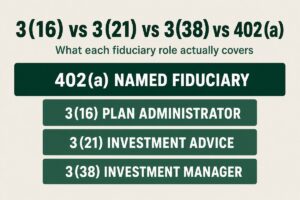

Every time you sign a Form 5500, you aren’t just filing paperwork; you’re personally assuming the legal weight of your company’s retirement plan. It’s a specialized burden that often brings anxiety over potential audits or missed participant notices. Understanding 3(16) fiduciary services pricing is about more than just comparing line items. It’s about determining the cost of transferring that liability to a professional guardian who can carry the load for you.
You likely feel that managing plan compliance shouldn’t be your primary focus. With the IRS finalizing SECURE 2.0 guidance in July 2026 and the recent vacating of the DOL’s Retirement Security Rule, the regulatory environment is shifting again. This guide will show you how fees are structured so you can secure a predictable pricing model and total peace of mind. We’ll break down the variables that drive costs and help you evaluate the ROI of a partnership that shields your business from administrative risk.
Key Takeaways
- Understand that 3(16) pricing reflects a legal transfer of risk, shifting the weight of plan administration from your shoulders to a professional fiduciary.
- Analyze standard 3(16) fiduciary services pricing models, typically structured as a predictable base fee plus a per-participant charge rather than asset-based percentages.
- Identify how plan complexity, such as the inclusion of Cash Balance or Profit Sharing features, and payroll integration methods influence your total cost of oversight.
- Evaluate the ROI of outsourcing by comparing service fees against the internal cost of HR hours and the potential price of Department of Labor penalties.
- Discover how a specialized guardian assumes the role of Named Fiduciary to shield your business from the personal liability associated with signing Form 5500.
What Components Define 3(16) Fiduciary Services Pricing?
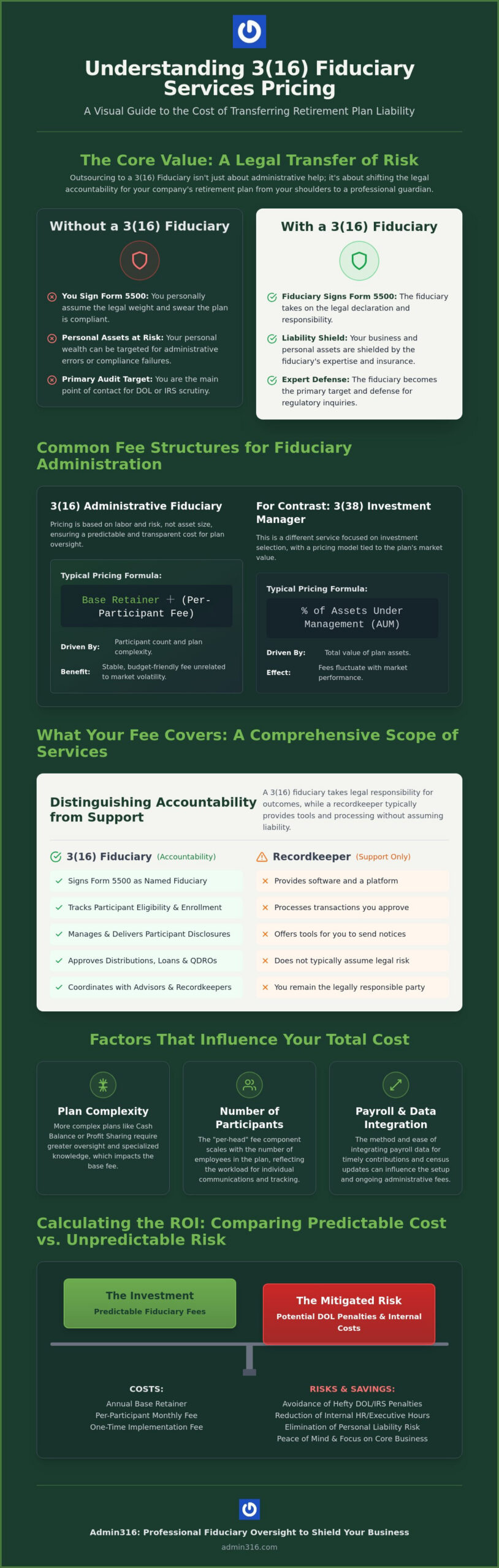
When you evaluate 3(16) fiduciary services pricing, you aren’t just buying an administrative checklist. You’re paying for a specialized guardian to step into the line of fire. Most providers offer “support,” but a true 3(16) partner assumes the legal accountability that otherwise rests on your shoulders. It’s the difference between having a consultant and having a legal shield. Pricing reflects this total transfer of risk. Every decision made within the plan carries a price tag in terms of potential liability. By outsourcing these duties, you move the weight of compliance from your company’s balance sheet to the fiduciary’s professional insurance and expertise.
The Cost of Legal Liability Assumption
Signing Form 5500 is one of the most significant risks a business owner takes. It’s a legal declaration that the plan is compliant with the Employee Retirement Income Security Act of 1974 (ERISA). When a 3(16) fiduciary signs this document, they become the primary target for Department of Labor (DOL) or IRS regulatory scrutiny. The fee you pay compensates the fiduciary for this exposure. They take on the discretionary decision-making, which means they are responsible for the outcomes of plan operations. They act as a shield, ensuring that your personal assets aren’t at risk for administrative errors or missed deadlines.
Administrative Tasks Included in the Price
While the liability transfer is the core value, the price also covers the heavy lifting of daily operations. A comprehensive fee quote should include recurring oversight of participant enrollment and eligibility tracking. This ensures that employees are brought into the plan at the correct time, preventing costly correction fees later. It also covers the management of mandatory participant disclosures, which must be delivered according to strict federal timelines. A professional fiduciary coordinates these tasks alongside your existing recordkeepers and advisors, ensuring nothing falls through the cracks. This collaborative approach preserves your professional relationships while removing your personal anxiety.
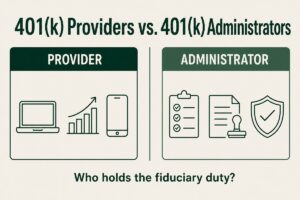
It’s vital to distinguish between a recordkeeper’s “administrative support” and a 3(16) fiduciary’s “accountability.” A recordkeeper might provide the software to send a notice, but they don’t usually assume the legal responsibility if that notice isn’t sent or contains errors. When comparing 3(16) fiduciary services pricing, look for a partner that takes full legal responsibility rather than just offering data entry. This ensures that the professional fee you pay results in a genuine removal of administrative burden and a total mitigation of regulatory risk.
Not sure where your plan’s fiduciary liability actually sits?
Admin316 serves as your named 3(16) plan administrator and takes the filing, notice and compliance work off your desk — along with the liability that comes with it. A 15-minute call is usually enough to tell you where you stand.
Common Fee Structures for Fiduciary Administration
Clarity in 3(16) fiduciary services pricing starts with understanding that administration is a labor-intensive discipline, not an investment one. Unlike 3(38) investment managers who typically charge a percentage of assets under management (AUM), 3(16) fiduciaries usually employ a flat-fee or “per-head” model. This is because the legal risk and administrative work don’t necessarily increase just because your plan assets grow. Instead, the workload is driven by the number of participants and the complexity of the plan’s design. Most professional quotes will include a one-time implementation fee for new or takeover plans to cover the meticulous process of auditing your current records and establishing a clean slate for compliance.
Transparency is a hallmark of a seasoned fiduciary partner. A predictable fee structure allows you to budget effectively without worrying about hidden costs for every distribution or loan approval. While some providers might bundle these costs into a generic platform fee, independent fiduciaries prioritize a clear breakdown. This ensures you know exactly what you’re paying for the assumption of your Fiduciary Responsibilities. This separation of fees protects the plan sponsor from overpaying for services that should be fixed in scope.
The Base Annual Retainer
The base annual retainer is the core cost for the fiduciary to “stand in the gap” for your plan. It represents the baseline expense of maintaining the legal shield around your company. This fee is governed primarily by the type of plan you offer. A standard 401(k) plan has different oversight requirements than a complex Cash Balance or Defined Benefit plan. Independent fiduciaries like Admin316 focus on these fixed retainers because they provide long-term stability. You aren’t just paying for a service; you’re paying for the institutional permanence and the specialized expertise required to oversee your specific plan document.
Per-Participant Monthly or Annual Fees
Headcount is the primary driver of administrative labor. Each participant represents a unique data point that requires eligibility tracking, enrollment coordination, and mandatory notice delivery. Per-participant fees reflect this volume of work. It’s also important to note that “terminated participants with a balance” still require oversight and disclosures, which is why they’re often included in the pricing. Industries with high employee turnover often see higher per-participant costs because the fiduciary must constantly coordinate new entries and exits. If you’re looking for a partner to handle these intricate details, you can explore how a dedicated fiduciary manages these burdens.
By shifting to a model that combines a base retainer with a per-participant fee, you gain a scalable solution. As your business grows, your costs remain predictable and directly tied to the value of the protection you receive. This structure ensures that the fiduciary is incentivized to maintain data integrity and compliance for every individual in the plan, regardless of market fluctuations or asset size.
Factors That Influence Your Total Fiduciary Cost
Your plan’s unique blueprint dictates the final 3(16) fiduciary services pricing. It isn’t a one-size-fits-all calculation because no two businesses carry the same administrative weight. While the base fee and per-participant rates discussed earlier provide a foundation, the specific architecture of your retirement offering can shift the price. A plan with complex vesting schedules or diverse eligibility requirements requires more meticulous oversight than a basic safe harbor setup. The fiduciary must account for every nuance in your plan document to ensure that your legal shield remains intact.
Complexity and Plan Design
Simple 401(k) plans are often the baseline for pricing models. However, if you’ve implemented a Profit Sharing component or a hybrid Cash Balance plan, the complexity spikes. Cash Balance plans, in particular, require precise coordination between the fiduciary and the actuary to ensure compliance with contribution limits and interest credits. The pricing for these sophisticated structures reflects the specialized expertise needed to manage them. Regular benchmarking is a useful tool here. It helps ensure you aren’t overpaying for basic administration while acknowledging that complex plan designs require a more robust level of professional guardianship.
The Integration Factor
How your data moves from payroll to the plan is a significant cost driver. Manual data submission is a liability trap, often leading to errors in eligibility or contribution timing. Automated feeds reduce this friction and lower the risk of a regulatory breach. A professional ERISA 3(16) Plan Administrator prioritizes payroll integrity because clean data is the foundation of a compliant plan. We oversee these technical handshakes so that you can focus on your core business. This doesn’t mean replacing your current team. A specialized guardian works alongside your existing TPA and recordkeeper, adding a layer of protection without disrupting established professional bonds.
Existing infrastructure also plays a role. If you have a long-standing relationship with a Third Party Administrator (TPA), you don’t need a total replacement. You need a partner who can fortify that relationship by assuming the legal accountability the TPA usually avoids. Finally, consider the impact of audit requirements. Once a plan reaches “large” status, usually at 100 participants, it requires an annual independent audit. The fiduciary’s role in preparing the plan for this scrutiny and coordinating with auditors is a vital part of the service. This ensures the audit process is seamless and removes the professional anxiety often associated with Department of Labor oversight.
Cost vs. Risk: Calculating the ROI of Fiduciary Outsourcing
Many plan sponsors view 3(16) fiduciary services pricing as an elective administrative expense. It’s more accurate to view it as a strategic investment that eliminates the “DIY Tax.” The most expensive way to manage a retirement plan is often to do it yourself. When your HR manager spends hours every month chasing census data or manually tracking eligibility, those are resources diverted from recruiting and employee retention. This internal labor cost is often invisible until you quantify the time lost to technical compliance. If an error occurs, the cost of “free” administration evaporates instantly, replaced by expensive legal corrections and potential fines.
A specialized guardian provides a source of relief by assuming these burdens. By shifting the accountability to a professional partner, you aren’t just buying a service; you’re securing a shield. This partnership preserves your company’s resources and allows your internal team to focus on growth rather than regulatory minutiae. The ROI of fiduciary outsourcing is found in the removal of professional anxiety and the long-term stability of your plan operations.
The Price of Administrative Errors
Missed participant notices or eligibility tracking failures are not just paperwork glitches. They are regulatory violations that carry heavy price tags. The Department of Labor (DOL) maintains strict penalty schedules for late filings, and the cost of correcting a single missed enrollment can reach thousands of dollars in back-contributions and lost earnings. A 3(16) fiduciary mitigates the risk of a DOL audit through proactive oversight and meticulous data integrity checks. On average, outsourcing 3(16) duties returns approximately 40 to 60 hours of annual productivity to a mid-sized HR department. This proactive stance ensures that your plan remains a tool for employee wealth rather than a source of corporate liability.
Preserving the Integrity of Your Team
Hiring a fiduciary protects your internal staff from personal fiduciary liability. When an employee is named as the plan administrator, they are personally responsible for errors under ERISA. This creates an environment of professional anxiety that can stifle your team’s effectiveness. We step in to carry that regulatory weight. Our non-displacement approach is a deliberate cost-saving strategy. We don’t seek to replace your current financial advisor or recordkeeper. Instead, we fortify your existing team by adding a layer of protection. This collaborative model ensures that your advisor can focus on investment performance while we oversee the technical compliance. Request a proposal to see how we shield your business from compliance costs.
The Admin316 Approach: Professional Fiduciary Oversight
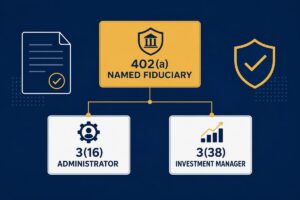
Admin316 operates with a singular focus: we assume the legal and administrative weight that typically burdens a plan sponsor. Our role as both the ERISA Section 3(16) Plan Administrator and the Section 402(a) Named Fiduciary allows us to act as a definitive shield for your business. When you evaluate 3(16) fiduciary services pricing, you’re looking for more than just a vendor. You’re looking for a partner with the institutional permanence to stand by every decision made within your plan. We’ve refined this “burden-lifting” philosophy for national employers who need a steady, methodical hand to oversee their regulatory requirements.
We don’t believe in displacing the professionals you already trust. Our approach is built on collaboration, not replacement. We work alongside your existing recordkeeper and investment advisor to fortify your plan’s compliance structure. While they focus on growth and data, we focus on the integrity of your plan’s legal standing. This “non-displacement” model ensures that your established professional bonds remain intact while we carry the regulatory load in the background.
A Specialized Guardian for Your Plan
Specializing in fiduciary administration since 1997 has taught us that stability is the most valuable asset we offer. We utilize a methodical process for assuming legal responsibility, ensuring that every participant notice and eligibility check is handled with precision. Our independent status is a core strength. Because we don’t sell investment products or payroll software, we provide an objective layer of protection. We’re dedicated solely to the oversight and coordination of your plan’s compliance. This independence ensures that our interests are always aligned with the security of your plan and the peace of mind of your leadership team.
Institutional longevity matters in the world of ERISA. We’ve navigated decades of regulatory shifts, providing a consistent shield against the complexities of federal law. We don’t just offer technology; we offer the seasoned judgment of experts who have managed fiduciary duties through every market cycle. This experience allows us to identify potential risks before they become liabilities, preserving your company’s resources and reputation.
Securing Your Fiduciary Future
Transitioning the weight of Form 5500 filings to our team is a seamless process designed to remove professional anxiety. We coordinate the collection of census data and the preparation of all required filings, ensuring that you never have to worry about a missed deadline or an inaccurate signature. By assuming the role of Named Fiduciary, we take the legal accountability for these documents off your desk. This allows you to refocus your energy on scaling your business while we manage the granular details of compliance.
Every plan has unique needs, and our pricing reflects that reality. We provide tailored analyses that account for your specific plan design and participant count. This ensures that you receive a predictable, transparent fee structure that matches the value of the protection provided. If you’re ready to transfer the administrative burden to a seasoned expert, you can contact Admin316 for a personalized fiduciary pricing analysis. Let us carry the load so you can focus on your professional legacy.
Securing Your Compliance Shield for 2026 and Beyond
Your retirement plan should be a tool for growth, not a source of legal anxiety. As we have explored, 3(16) fiduciary services pricing represents a strategic investment in liability transfer. By moving the weight of Form 5500 filings and eligibility tracking to a professional guardian, you preserve your company’s resources and protect your staff from personal risk. Whether you manage a standard 401(k), a complex Cash Balance plan, or a Defined Benefit structure, the right pricing model provides predictable costs and total administrative relief.
Admin316 has been specializing in fiduciary administration since 1997. We act as an independent 3(16) and 402(a) Named Fiduciary with a national service scope, ensuring your plan remains compliant regardless of shifting regulations. We handle the heavy lifting so that you can focus on your professional legacy. It’s time to fortify your team with a partner that assumes full legal accountability. To see how our burden-lifting approach can support your business, Request a Fiduciary Services Quote from Admin316 today. You don’t have to carry the regulatory weight alone.
Frequently Asked Questions
What is the difference between TPA fees and 3(16) fiduciary fees?
TPA fees cover the technical preparation of plan documents and compliance testing, but they don’t usually include legal accountability. In contrast, 3(16) fees cover the legal assumption of plan administrator duties. While a TPA prepares the data, the 3(16) fiduciary signs the Form 5500 and carries the legal weight of the plan’s operations. This distinction is vital because a TPA acts as a service provider, while a fiduciary acts as a legal shield.
Does hiring a 3(16) fiduciary eliminate all of my liability as an employer?
Hiring a 3(16) fiduciary mitigates the vast majority of your administrative liability, but it doesn’t eliminate your duty to monitor the provider. You remain responsible for ensuring the fiduciary is performing their duties according to the service agreement. We assume the role of the specialized guardian for the plan’s daily operations, but the employer retains the high level responsibility of selecting and overseeing the fiduciary partner.
How often are 3(16) fiduciary service fees typically billed?
Most providers bill their service fees on a monthly or quarterly basis to align with the plan’s administrative cycle. This predictable schedule helps businesses manage cash flow while ensuring continuous fiduciary protection. By billing regularly, the fiduciary can maintain constant oversight of participant eligibility and data integrity, ensuring that no compliance deadlines are missed throughout the fiscal year.
Can I keep my current 401(k) advisor if I hire a 3(16) fiduciary?
You can absolutely keep your current 401(k) advisor. Our independent model is built on the principle of non-displacement, meaning we fortify your existing team rather than replacing it. We coordinate alongside your advisor to ensure that while they focus on investment performance, we are handling the regulatory weight of plan administration. This partnership approach preserves your trusted professional bonds while adding a layer of legal protection.
Are 3(16) fiduciary fees tax-deductible for the business?
Yes, 3(16) fiduciary services pricing is generally considered a necessary business expense and is tax-deductible for the company. Since these fees are directly related to the legal operation and compliance of a retirement plan, they are viewed as standard administrative costs. You should consult with your tax professional to confirm how these deductions apply to your specific business structure and filing requirements.
What happens to the pricing if my company headcount grows significantly?
If your headcount grows, the per-participant portion of the pricing will scale accordingly to cover the increased administrative labor. This ensures that every new employee receives the proper enrollment notices and eligibility tracking required by law. While the base retainer remains stable, the variable per-head fee allows the fiduciary to maintain meticulous data integrity for every individual in the plan as your business expands.
Does the fiduciary price include the cost of the annual 401(k) audit?
The fiduciary price usually covers the heavy lifting of audit preparation and coordination, but it does not include the separate fee charged by an independent CPA firm. We act as the primary contact for the auditor, gathering the necessary data and answering technical questions. This removes the professional anxiety of the audit process from your internal team while ensuring the CPA has everything they need to finish the review.
How do 3(16) services differ from fiduciary liability insurance?
3(16) services are proactive, meaning the fiduciary manages the plan to prevent errors and assumes the legal role of administrator. Fiduciary liability insurance is reactive; it is a financial safety net that pays for legal defense or settlements after a claim is filed. While insurance provides a source of funds for mistakes, a 3(16) fiduciary provides the methodical oversight to ensure those mistakes don’t happen in the first place.
Transfer this responsibility to a professional fiduciary.
Every item in this article is work Admin316 does for plan sponsors every day as an ERISA 3(16) administrator. Bring us your plan documents and we’ll show you exactly which risks move off your shoulders.