
Original research · National study
What American 401(k) Plans Actually Pay
An analysis of 48,944 plan year 2024 Form 5500 filings. Nearly one in three 401(k) plans with fewer than 500 active participants paid more than double the national median administrative cost per participant.
Most plan sponsors have never seen what comparable plans pay. Vendor benchmarking surveys are voluntary, self-reported and rarely public. This study uses a different source: the Form 5500 and Schedule H filings that every covered plan submits to the U.S. Department of Labor, signed under penalty of perjury.
Key findings
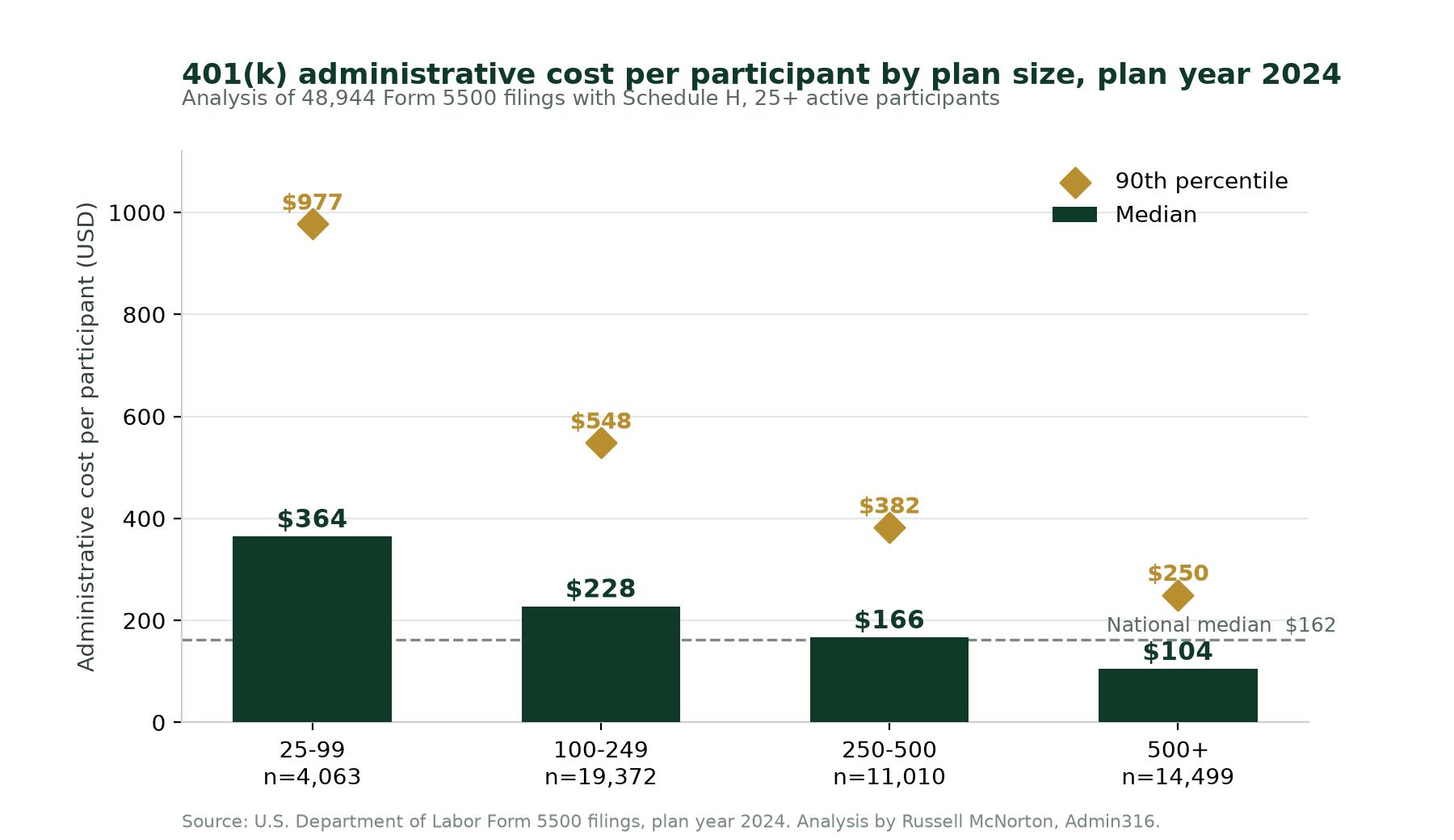
- Small plans pay roughly three and a half times more per person. Plans with 25–99 active participants paid a median $364 per participant per year. Plans with 500 or more paid a median $104.
- The gap survives the fixed-cost explanation. Measured in basis points of plan assets, the smallest band paid a median 32.5 bps versus 18.6 bps for the largest — more per participant and more relative to assets at the same time.
- Roughly 10,500 plans pay above $324 per participant. Among the 34,423 plans with fewer than 500 active participants, 30.6% paid more than twice the national median.
- The tail is expensive. At the 90th percentile of the 25–99 participant band, administrative cost reached $977 per participant. For a 70-person plan, that is about $68,000 a year.
- Most plan compensation is not invoiced to the employer. Only 44.6% of plans reported a contract administrator fee and 56.0% reported recordkeeping fees, indicating a substantial share of provider compensation is paid indirectly — through investment expenses and revenue sharing — rather than billed to the company.
- Texas cut. The 3,682 Texas-sponsored plans in the dataset paid a median $136 per participant and 27.1 bps, close to the national basis-point median.
Median administrative cost by plan size
| Plan size (active participants) | Plans | Median $/participant | Median bps of assets | 90th percentile $/participant |
|---|---|---|---|---|
| 25–99 participants | 4,063 | $364 | 32.5 bps | $977 |
| 100–249 participants | 19,372 | $228 | 31.8 bps | $548 |
| 250–500 participants | 11,010 | $166 | 28.7 bps | $382 |
| 500+ participants | 14,499 | $104 | 18.6 bps | $250 |
What this does and does not mean
A higher number is not proof that a plan is overpriced, and ERISA does not require a plan sponsor to hire the cheapest provider. What ERISA requires is that the responsible fiduciary determine whether the compensation paid is reasonable for the services received, and document that determination.
“Paying $977 per participant is not a breach. Paying it without ever having compared it to anything is a much harder position to defend.”
— Russell McNorton, Founder & CEO, Admin316
The indirect-compensation finding is the one sponsors most often miss. If nothing is billed to the company, the arrangement feels free. It is not — it is being paid out of employees’ retirement savings, in a form that never reaches the employer’s accounts payable. The question is not whether an invoice arrived. The question is what the plan pays in total, and who receives it.
Methodology
Source data: U.S. Department of Labor EFAST2 Form 5500 datasets for plan year 2024, joined at the filing (ACK_ID) level to Schedule H financial detail. The universe is 401(k) filings (pension benefit code 2K) reporting 25 or more active participants with both total administrative expenses and end-of-year total assets greater than zero — 48,944 plans. Cost per participant is total administrative expenses divided by active participant count. Basis points are total administrative expenses divided by end-of-year assets. All statistics are medians unless labeled otherwise; percentiles are computed within plan-size bands.
Stated limitations
Schedule H, which carries the expense detail, is generally filed by larger Form 5500 filers, while the smallest plans may file Form 5500-SF, which does not require the same breakdown. The 25–99 participant band therefore represents small plans filing a full Schedule H, not every small 401(k) plan in the United States. Reporting practices also vary between filers, and administrative expense lines are not defined identically by every preparer. Figures are as filed and are not adjusted for service scope.
For journalists and researchers
Admin316 will provide the methodology, the underlying figures by plan-size band, and state-level cuts on request, and Russell McNorton is available on deadline for comment on employer fiduciary duty, Form 5500 reporting, fee benchmarking and §3(16) administration. See the Admin316 newsroom or email rmcnorton@admin316.com. This is the first in a monthly series of data releases running through 2027, drawn from research for McNorton’s forthcoming book on employer fiduciary responsibility, Who Is Your Named Fiduciary?
Find out what your own plan pays
Admin316 will read your Form 5500, Schedule H or C and your 408(b)(2) disclosures and tell you where your plan lands against the 48,944 plans in this study — direct and indirect compensation, in dollars and in basis points. No cost, no obligation.
Request a fee reviewAdmin316 is an independent retirement plan fiduciary based in Corpus Christi, Texas, serving employer-sponsored plans nationwide. Admin316 accepts written appointment as ERISA §402(a) Named Fiduciary and §3(16) Plan Administrator, assuming administrative fiduciary responsibility that otherwise remains with the employer, and works alongside a plan’s existing advisor, recordkeeper and TPA rather than replacing them.
This study is provided for general information. It is not legal, tax, investment or fiduciary advice, and reviewing it does not create a fiduciary or advisory relationship. Cost comparisons do not establish that any particular plan’s fees are reasonable or unreasonable; that determination depends on the services received and must be made by the plan’s responsible fiduciary.
