Choosing among 401k administrators is one of the most consequential vendor decisions an employer makes — and one of the least understood. The company you pick does not just push paperwork. It touches your plan document, your payroll data, your participant notices, your Form 5500, and in some cases your personal fiduciary exposure as a plan sponsor. This checklist is written for employers and plan committees, not for individual savers, and it walks through what to verify before you sign.
First, get clear on what a 401(k) administrator actually does
“Administrator” is used loosely in the retirement industry, which is exactly where employers get into trouble. There are three different things people mean:
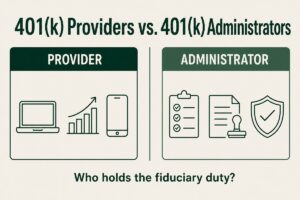
- The recordkeeper — holds participant accounts, processes contributions and distributions, runs the participant website.
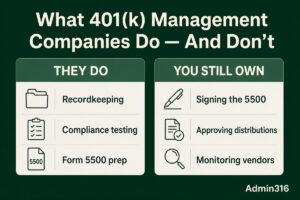
- The TPA (third-party administrator) — performs compliance testing, drafts plan documents and amendments, prepares the Form 5500 for your signature.
- The “plan administrator” under ERISA — a legal role, named in your plan document. Unless someone else is formally appointed, this is your company. It carries fiduciary duties and personal liability for the people who exercise them.
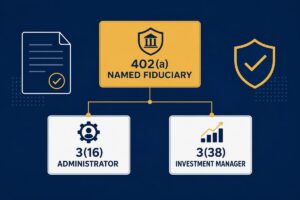
That last distinction is the one that surprises employers. A recordkeeper or TPA can do the work while your company still holds the legal responsibility and the liability. Only a contractually appointed 3(16) plan administrator takes on the named administrative fiduciary role itself. If you want to understand how the roles split, our guide to 401(k) fiduciary liability lays out the hierarchy.
The employer’s 2026 checklist for evaluating 401(k) administrators
1. Ask exactly which fiduciary role they accept — in writing
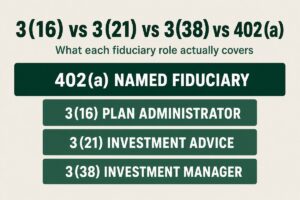
Do not accept “we handle compliance for you” as an answer. Ask the provider to point to the paragraph in the service agreement where they are appointed as an ERISA fiduciary, and to which section: 3(16) for administration, 3(21) or 3(38) for investments. Many bundled providers explicitly disclaim fiduciary status and act only at your direction. That is a legitimate business model — it just means the buck still stops with you.
2. Find out who signs the Form 5500
The annual return is signed by the plan administrator. If your HR director or CFO is signing under penalty of perjury, your company owns the accuracy of that filing and the late-filing exposure. A true 3(16) provider signs and files it — see who signs the Form 5500 for the mechanics. This is the single fastest question for separating marketing language from a real delegation of duty.
3. Test their handling of payroll and deferral timing
Late deposit of employee deferrals is one of the most common ERISA problems the Department of Labor finds, and it is almost always a process failure between payroll and the recordkeeper. Ask: who monitors the deposit timeline, what happens when a payroll file fails validation, and who calculates and funds the correction if a deposit is late? Get names and a service-level commitment, not a philosophy.
4. Look at compliance testing calendar, not just capability
Every provider can run ADP/ACP and top-heavy testing. What differentiates them is when. Mid-year projected testing gives you time to change course before a failure forces corrective distributions to your highly compensated employees — including, often, your owners. Ask whether interim testing is included or billed as a project.
5. Match the provider to your plan design
A provider that is excellent with a straightforward safe-harbor 401(k) may be out of its depth with a cross-tested profit sharing allocation, a cash balance plan paired with a 401(k), or an ESOP. If your plan is or will be more complex, confirm hands-on experience with your structure. Our pages on 401(k) plans, profit sharing plans, and cash balance plans outline where these designs create extra administrative load.
6. Read the fee disclosure like a fiduciary
You have a duty to ensure fees are reasonable for the services received — which requires knowing what the services and the fees actually are. Separate the layers: recordkeeping, administration, advisory, and investment expense ratios including any revenue sharing. Then ask what is not included: plan document restatements, amendments, distribution processing, loan setup, audit support, corrections. “All-in” quotes frequently are not. Periodic 401(k) benchmarking is how you document that the comparison was actually done.
7. Confirm the audit story before you need it
Plans above the participant-count threshold require an independent audit each year. Ask how the provider supports it: do they deliver a standard audit package, do they respond directly to auditor requests, and is that support included? Ask the same question about a DOL or IRS inquiry. Employers routinely discover the answer is “that’s billed hourly” in the middle of an exam. See our overview of 401(k) audit support for the documents auditors typically request.
8. Interrogate the service model, not the sales team
Ask who your day-to-day contact will be, how many plans that person supports, their tenure, and the escalation path. Ask for the average time to resolve a participant distribution question. Then ask for two references with plans of similar size and complexity — and actually call them.
9. Check the technology where it hurts
The participant app is the easiest thing to demo and the least likely to cause you a compliance problem. Ask instead about payroll integration with your specific provider, eligibility tracking for part-time and rehired employees, automatic enrollment and escalation mechanics, and how notices are delivered and documented. Notice delivery you cannot evidence is a finding waiting to happen.
10. Plan the exit at the beginning
Before you sign, know the termination provisions: notice period, deconversion fees, what data you receive and in what format, and who is responsible for the final-year filing and testing. Conversions go badly far more often than sales cycles do.
Warning signs worth walking away from
- The service agreement never uses the word “fiduciary” — or uses it only in a disclaimer.
- Nobody will tell you who signs the Form 5500.
- Fees arrive as a single blended number with no breakdown by service.
- Compliance testing is described only as a year-end event.
- Correction work (late deposits, failed tests, missed notices) is entirely your problem.
- References are all far smaller or far larger than your plan.
Document the decision, not just the choice
Selecting and monitoring a service provider is itself a fiduciary act. The protection comes from a prudent, documented process, so keep the artifacts: the criteria you used, the providers you compared, the fee comparison, the committee minutes recording the decision and its rationale, and a calendar for re-reviewing. If your plan committee does not meet on a set schedule with an agenda and minutes, start there — it is the cheapest fiduciary improvement available to you. A structured 401(k) plan review gives you a repeatable framework.
Where a 3(16) provider changes the equation
If your goal is to reduce work and reduce exposure, the question is no longer “which administrator is best” but “which administrative duties can I hand over completely.” Under a 3(16) appointment, the provider becomes the named plan administrator: preparing and signing the Form 5500, handling participant notices and disclosures, approving distributions and loans, and owning the compliance calendar. Your remaining duty is to select and monitor that provider prudently — a much narrower job than performing the work yourself. Employers who want investment decisions off their plate as well pair it with a 3(38) investment fiduciary.
Next step
If you are mid-search, bring your current service agreement and fee disclosure to a short call. We will tell you which fiduciary roles you are actually holding today, which ones can be delegated, and what a realistic administration cost looks like for a plan your size — no obligation.
Schedule a 401(k) administration review with Admin316 →
How much of this risk are you personally carrying?
Answer 5 questions about how your plan is actually administered and get your fiduciary risk score in about two minutes. No email required to see the result.
Take the 3(16) risk check